| Definition: Displacement |
|---|
| Displacement is the distance moved in a specific direction. |
s is the symbol usually used to represent displacement.
Displacement is a vector. It indicates the body’s overall change in position.
e.g.: displacement, s = 3.0 m towards the right
| Note |
|---|
| As displacement is a vector we must mention the direction when stating a value. |
| Representing Displacement
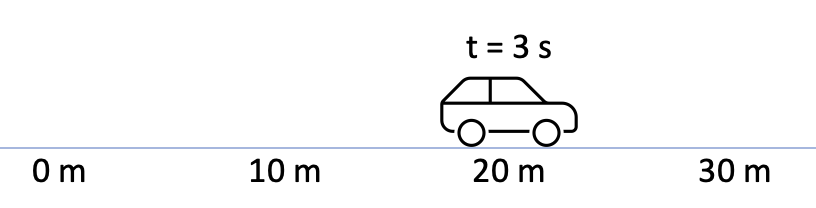
There are several ways to represent vectors: 1. Words: s = 3.0 m towards the right 2. Symbols: s = −5.0 m (Assuming we have set up a sign convention, ie, to the right is positive, in which case this example would mean 5.0 m to the left) 3. Diagrams:
This would indicate the car being at the 20 m mark.
|
| Example 1 |
|---|
| A girl walks 5 km east and turns around and walks 3 km west. What is her displacement for the whole journey?
Her displacement is 2 km east. |
| Example 2 |
|---|
| You walk 2 km to school in the morning and then 2 km home again in the afternoon. What is your total displacement for the whole day?
Your displacement for the day is 0 km. Obviously we do not need to state a direction here because the displacement is zero. |
| Example 3 |
|---|
| A boy runs 10 km north and then turns around and runs 7 km south. What is the magnitude of his total displacement for the whole journey?
The magnitude of his displacement is 3 km. We do not need to state a direction here because we are only asked for the magnitude of the displacement. |
| Example 4 |
|---|
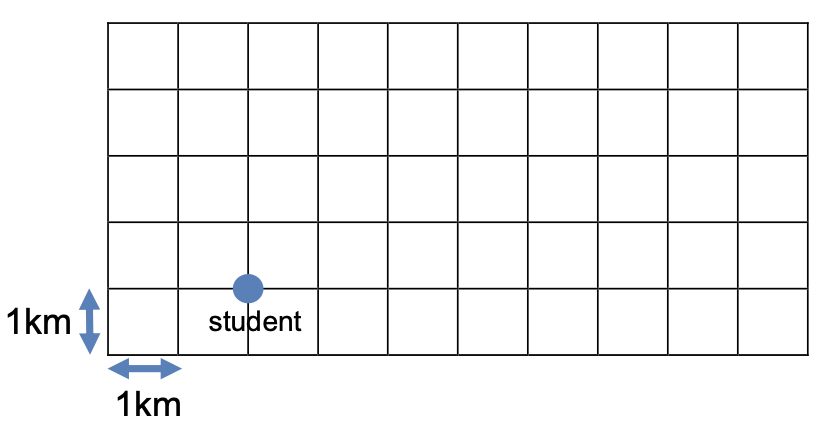
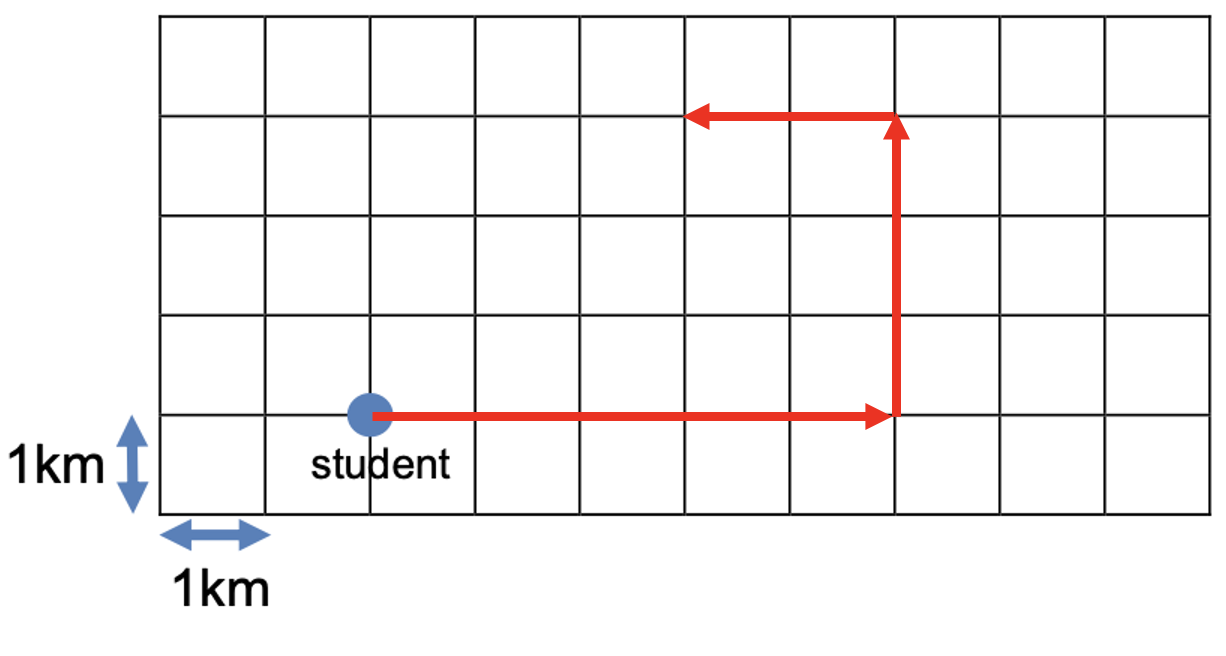
| A student walks 5.0 km East from her home to school in the morning. After school, she walks 3.0 km North and another 2.0 km West to a park.
Determine
distance travelled = 5 km + 3 km + 2 km = 10 km (b) her displacement.
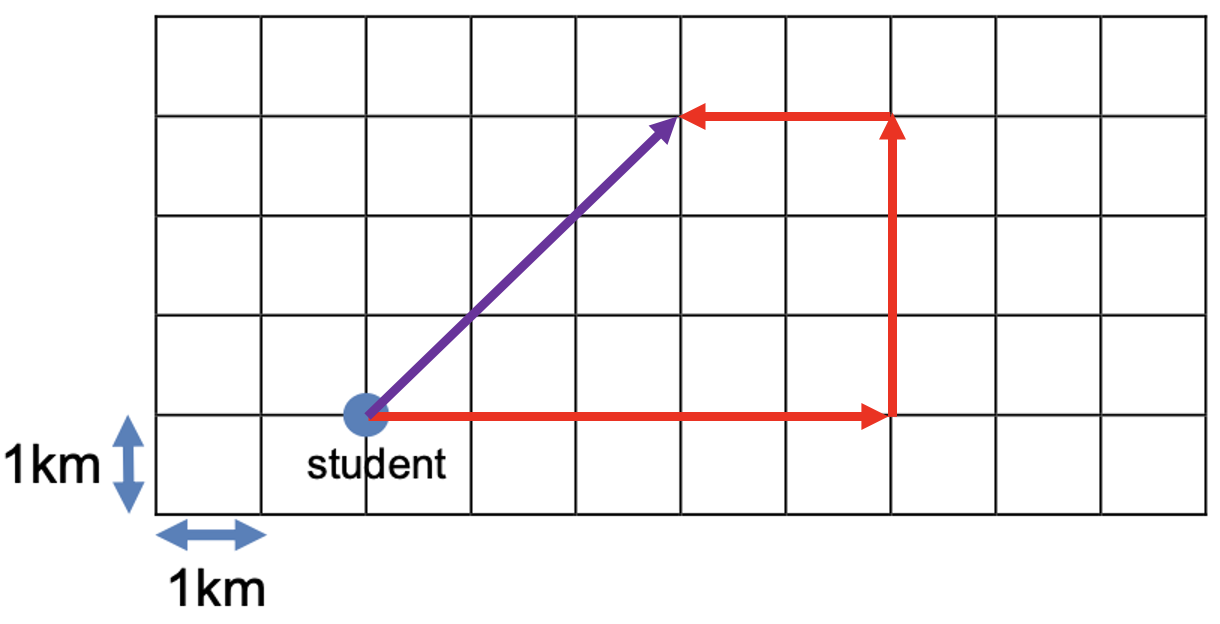
displacement is given by the purple arrow. length of this can be found from Pythagoras (√(3²+3²)) = 4.24 km Displacement is 4.24 km north-east of her home. |
| Note |
|---|
| we can use the phrase north-east in the above example only because the direction was exactly half-way between north and east (ie at 45º).
Other angles we would have to state the direction more explicitly and mention the angle. |
| << Back | Kinematics | Next >> |