If an object is changing velocity then the object is accelerating. In everyday language we will normally mean the object is “speeding up” or the object is “slowing down”.
| Definition: Acceleration |
|---|
| Acceleration is the rate of change of velocity at a specific instant. |
SI units are metres per second squared (m s-2). You could also think of this as metres per second per second.
An acceleration states the amount the velocity (or speed) changes by every second.
Average acceleration can be calculated by (change of velocity ÷ total time taken)
We could say:
acceleration = 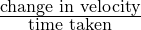
Or:
acceleration = 
In equation form we can use the following:
a =  |
where:
a is acceleration (m/s²)
u is initial velocity (m/s)
v is final velocity (m/s)
t is the time taken (s)
| To Help You Remember |
|---|
| You know your alphabet:
a b c d e …. U V ….. w x y z. U comes first. V is later. |
| Example 1 |
|---|
| A car accelerates from rest at 2.0 m s⁻². What is the velocity of the car after 5 seconds? |
| Example 2 |
|---|
| A sports car can accelerate from 0 to 100 km/hr in 3.8 seconds. What is the average acceleration of the car over this period? |
 ) × (
) × ( ) = 27.8 m s⁻¹
In the above example we cannot assume the acceleration was constant. i.e. the velocity at t = 1.0 s may not have been 7.3 m s⁻¹.
| Example 3 |
|---|
| A car slows down from 30 m/s to 10 m/s in a period of 5.0 seconds.
What is the average deceleration of the car over this period? |


 = –4.0 m s⁻²
Acceleration and the Sign Convention
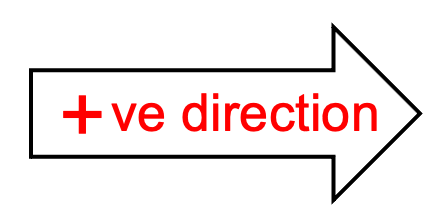
Let us take anything going to the right to be positive. I will frequently draw an arrow to remind me of this:
| Note |
|---|
| This is completely arbitrary and choosing left to be positive would produce similar results.
If I had chosen left to be the positive direction, ALL of the signs in the below examples would need to be swapped (i.e. −ve becomes +ve and vice versa.) |
(i) +ve velocity, +ve acceleration
This could be represented in a digram like this:
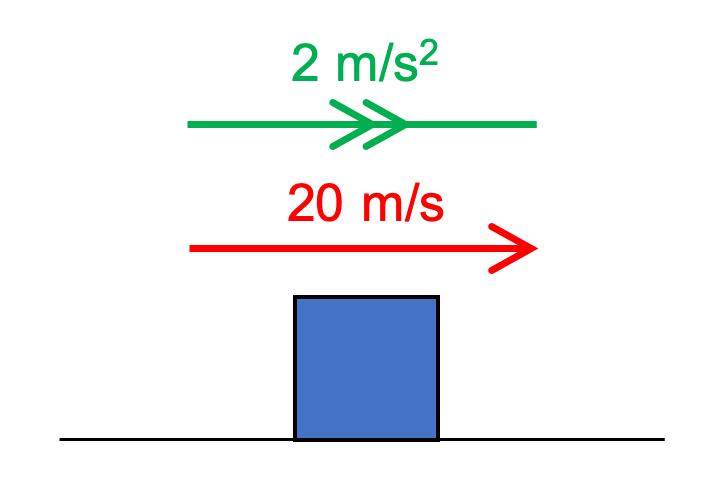
Initial velocity, u = 20 m s⁻¹
Acceleration, a = 2 m s⁻²
| time / s | velocity / m s-1 |
|---|---|
| 0 | 20 |
| 1 | 22 |
| 2 | 24 |
The object’s speed increases.
(ii) +ve velocity, −ve acceleration
This could be represented in a digram like this:
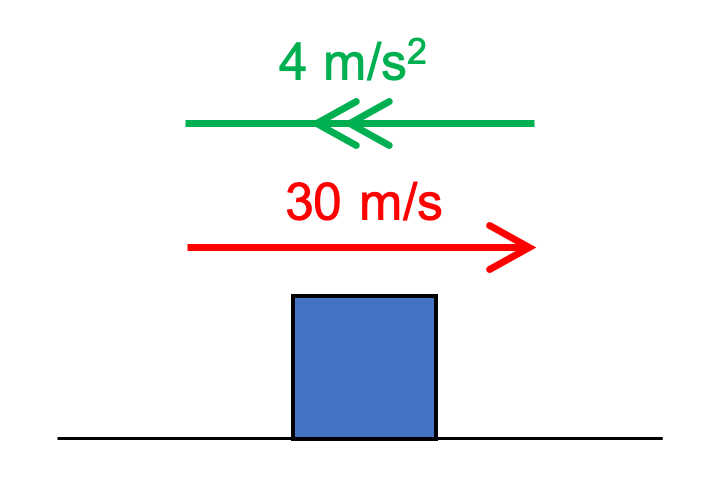
Initial velocity, u = 30 m s⁻¹
Acceleration, a = −4 m s⁻²
| time / s | velocity / m s-1 |
|---|---|
| 0 | 30 |
| 1 | 26 |
| 2 | 22 |
The object’s speed decreases.
(iii) −ve velocity, +ve acceleration
This could be represented in a digram like this:
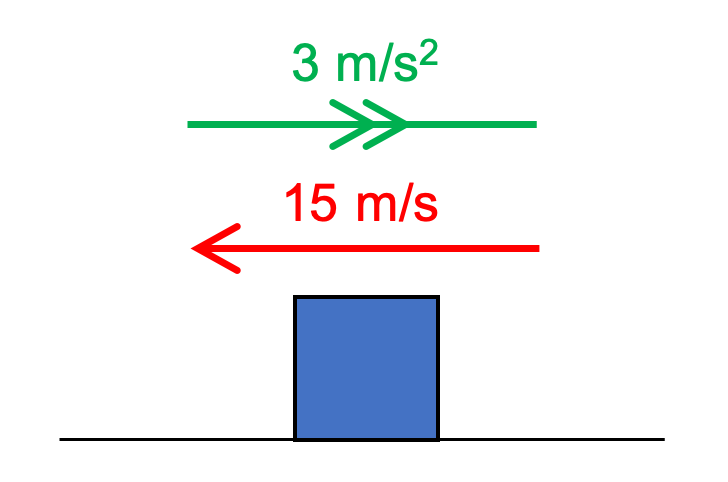
Initial velocity, u = −15 m s⁻¹
Acceleration, a = 3 m s⁻²
| time / s | velocity / m s-1 |
|---|---|
| 0 | −15 |
| 1 | −12 |
| 2 | −9 |
The object’s speed decreases.
(iv) −ve velocity, −ve acceleration
This could be represented in a digram like this:
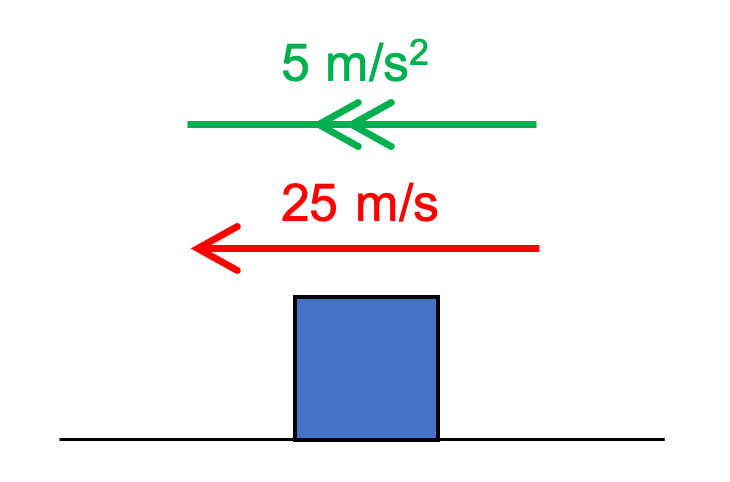
Initial velocity, u = −5 m s⁻¹
Acceleration, a = −25 m s⁻²
| time / s | velocity / m s-1 |
|---|---|
| 0 | −25 |
| 1 | −30 |
| 2 | −35 |
The object’s speed increases.
In summary:

| Caution |
|---|
| Negative acceleration is NOT the same as saying the object is decelerating. The direction in which the object is moving also needs to be taken into account. |
Constant vs Non-Constant Acceleration
| Example 1: Constant +ve Acceleration | ||||||||||||||||||||||
|---|---|---|---|---|---|---|---|---|---|---|---|---|---|---|---|---|---|---|---|---|---|---|
If the acceleration is 3 m s-2, and the object was initially at rest, the following would be the velocities over the first 5 seconds of motion:
Note that the velocity is increasing all the time, but the acceleration here is constant. We would thus refer to the motion not just as acceleration but as uniform acceleration. In this table (and the following tables on this page) the acceleration column is actually the change in velocity over the preceding one second time interval and thus is not actually the instantaneous acceleration at the time in the first column. This explains why the columns don’t line up. Rather it represents the average acceleration over the preceding one second. This is probably easier to see in later tables. |
| Example 2: Constant −ve Acceleration | ||||||||||||||||||||||
|---|---|---|---|---|---|---|---|---|---|---|---|---|---|---|---|---|---|---|---|---|---|---|
In this example the object’s speed is decreasing. We can use the words decelerating or retarding to indicate an object is slowing down. However, the velocity is still changing by the same amount in each one-second interval. In this case the velocity is reducing by 3 m/s every second. So there is an acceleration of −3 m s-2. We would thus refer to the motion as uniform deceleration or uniform retardation. If we wanted to express the magnitude as well, either of the following could be used: uniform acceleration of −3 m s-2 |
| Example 3: Increasing Acceleration | ||||||||||||||||||||||
|---|---|---|---|---|---|---|---|---|---|---|---|---|---|---|---|---|---|---|---|---|---|---|
In this table the velocity is obviously increasing from one second to the next – so we have acceleration. However, the acceleration itself changes with time. In this example the acceleration is increasing with time. We would thus refer to the motion not just as acceleration but as increasing acceleration. Thus the average acceleration was 3 m s-2 between t=2.0 s and t=3.0 s (i.e. over the third second of travel). Actually as the acceleration itself is changing we could attribute this exact acceleration to the time t=2.5 s (ie mid-point through the time interval). |
| Example 4: Decreasing Acceleration | ||||||||||||||||||||||
|---|---|---|---|---|---|---|---|---|---|---|---|---|---|---|---|---|---|---|---|---|---|---|
In this table the velocity is increasing from one second to the next. However, the acceleration itself changes with time. In this example the acceleration is decreasing with time. We would thus refer to the motion as decreasing acceleration. |
| Example 5 | ||||||||||||||||||||||
|---|---|---|---|---|---|---|---|---|---|---|---|---|---|---|---|---|---|---|---|---|---|---|
In this example the negative acceleration actually causes the speed of the object to increase. (An object travelling −15 m/s is travelling faster than −5 m/s). |
| Example 6 | ||||||||||||||||||||||
|---|---|---|---|---|---|---|---|---|---|---|---|---|---|---|---|---|---|---|---|---|---|---|
In this final example we can see that although the acceleration is uniform the object changes direction. (Goes from a positive velocity to a negative velocity.) |
| Caution |
|---|
| “Constantly accelerating” does NOT mean the same thing as “constant acceleration“. |
| << Back | Kinematics | Next >> |