| << Back | Dynamics |
Understanding Resolution of Forces
Imagine a boy pulling his toy truck with an 8.0 N force pulling at an angle as shown:
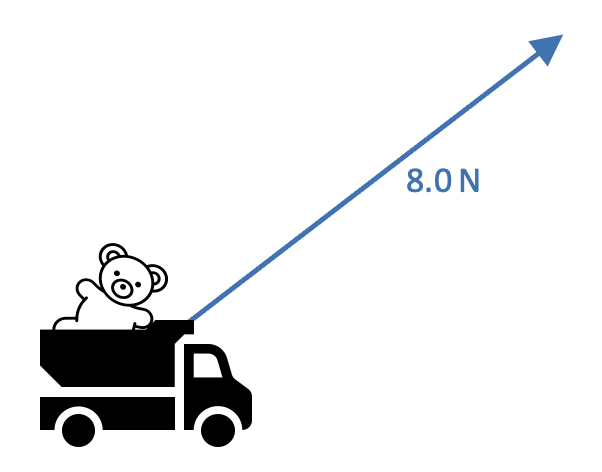
Assuming this force is not large enough to lift the truck into the air, it will be responsible for causing the truck to accelerate horizontally along the ground. However, we can not apply F=ma to calculate this acceleration as the 8 N force is not in the same direction as the acceleration. We should only consider the component of the force acting in the horizontal direction when trying to calculate the acceleration of the truck.
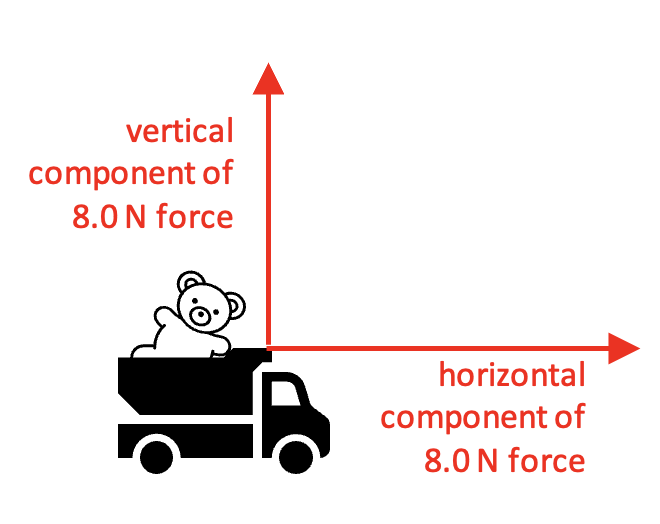
These 2 forces are useful to us as they are in directions that are useful (in this case horizontal and vertical). The horizontal and vertical components can be determined graphically like this:
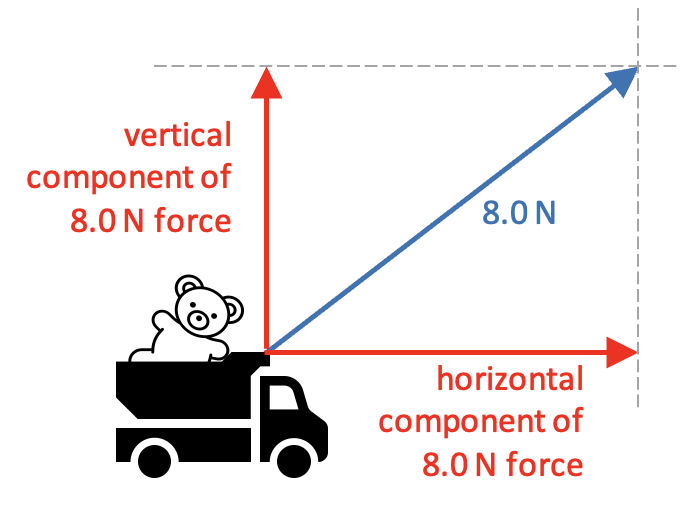
Resolving a force into two components like this can be thought of as the reverse of addition of two forces.
In addition of forces we actually have many forces, but we add them up to get one resultant (or net) force.
In force resolution, we actually only have one force, but we are imagining it as the sum of two separate forces. These will be perpendicular to each other chosen to be in directions that are more useful to us than the original.
Vector Resolution of Forces
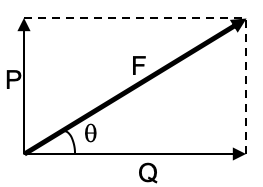
- Force F, can be resolved into two components P and Q at right angle to each other.
- Each component shows the effect of the force in that direction.
If Q acts at angle θ to the original force, F, then P acts at an angle (90o – θ) to the original force.
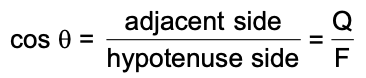
The magnitude of P and Q, using trigonometry is
OR
Q = F cos θ

OR
P = F sin θ
| Example |
|---|
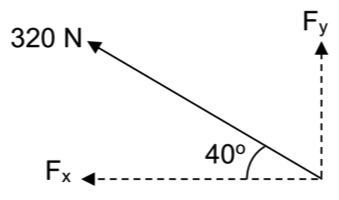
| A force of 320 N acts in the direction as shown.
(a) horizontal component, FX
(b) vertical component FY. |
| Notes: |
|---|
|
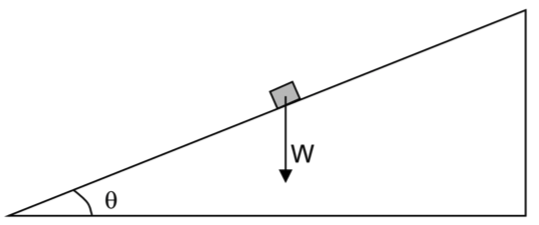
6.8.1 Body at rest on a slope (resolution of weight)
- Consider a body of weight W resting on a slope (due to its friction).
- Use the upper end of the slope (on the right) to draw the triangle ABC. Draw arrows to show W and its two components.
- The vector triangle ABC allows us to resolve the weight W into its two components:
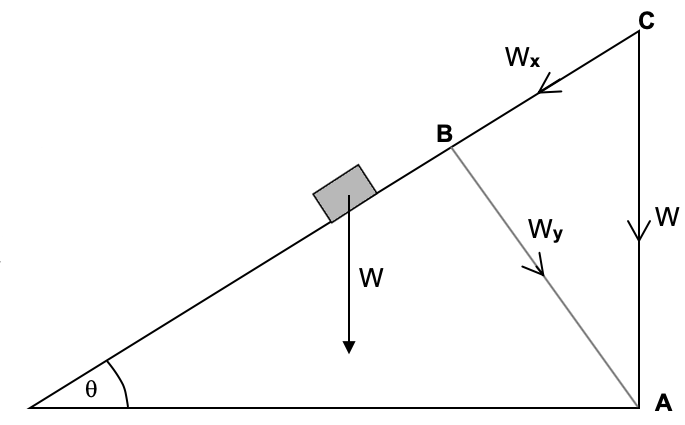
- Wx: component of W down along the slope
- Wy: component of W ‘into’ the slope
| Example |
|---|
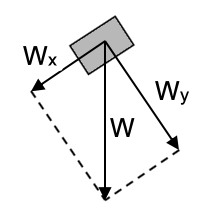
| A box of weight W rests on a slope at an angle θ to the horizontal.
Find the component of W which (a) acts parallel to the slope
(b) acts normally (perpendicular) to the slope |
6.8.2 Body at rest on a slope (forces acting on body)
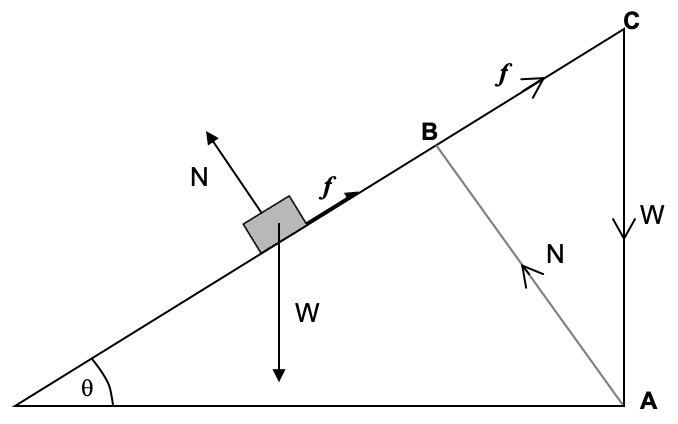
- Consider a body of weight W resting on a slope.
- The other two forces acting on the body are friction f and normal contact force N.
- The 3 forces keep the body in equilibrium.
- Use the upper end of the slope (on the right) to draw the triangle ABC. Draw arrows to show W, f and N.
| Example |
|---|
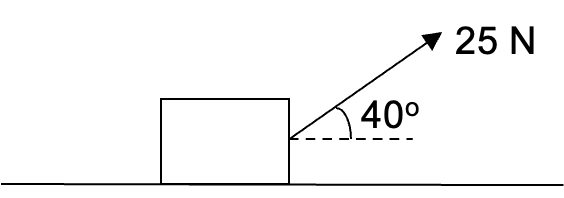
| A force of 25 N acts on a 2.0 kg box that is at rest on a smooth horizontal surface as shown in the diagram.
Determine the
(b) acceleration of the box along the horizontal surface. |
| << Back | Dynamics |