| << Back | Dynamics | Next >> |
When a body falls vertically through air, the air resistance R can act on it. The air resistance R increases with increasing velocity.
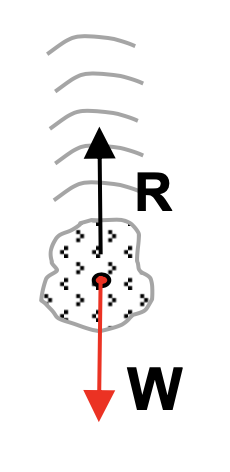
Eventually when the downward force of gravity W (weight) on the object is equal to the air resistance R on the body, the body will fall with a terminal velocity.
This is the constant maximum velocity of the body.
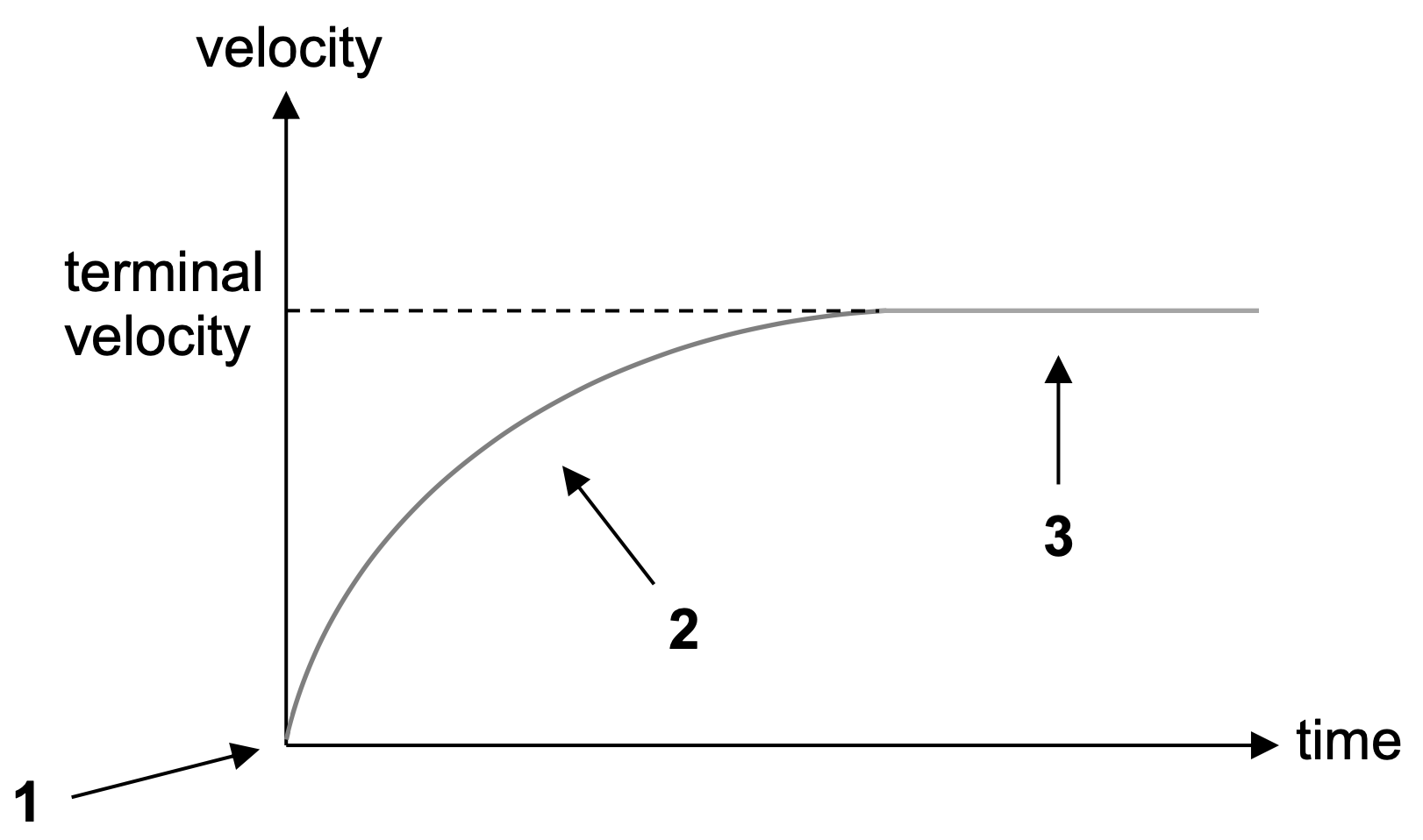
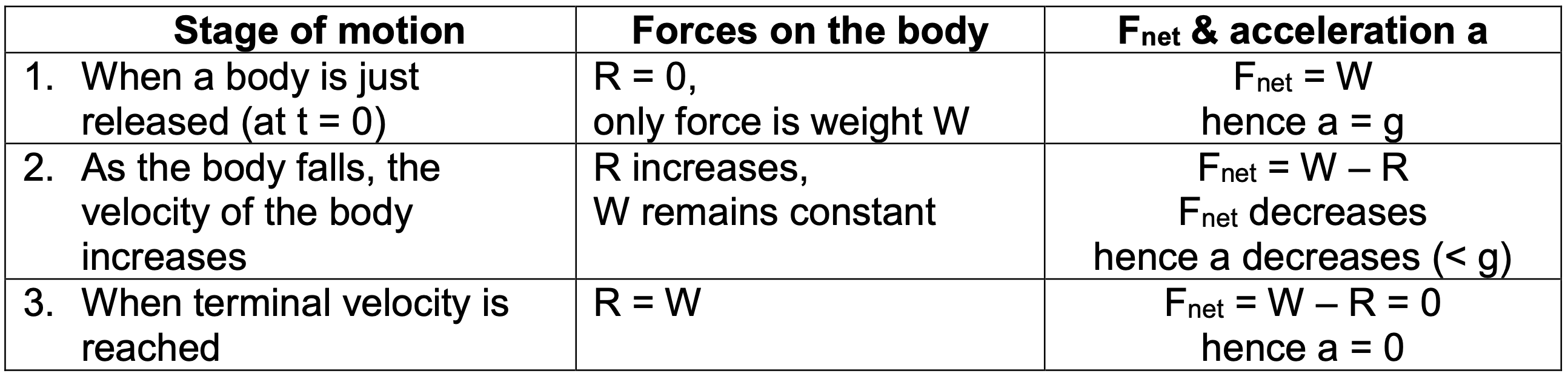
The net force Fnet = 0, acceleration a = 0, hence velocity is constant
| Example 6.5.3 |
|---|
| A 50 kg parachutist falls through the air.
(a) Calculate the net force acting on him and his net acceleration: Net force = mg = 50 kg x 10 m s⁻² = 500 N (air resistance is negligible) Net acceleration = 10 m s⁻² (ii) After falling for a while and he experiences an air resistance of 60 N opposing his motion. Net force=mg–R=500 N–60 N=440 N Net acceleration = net force ÷ m = 440 N ÷ 50 kg = 8.8 m s⁻² (iii) When he opens his parachute and the air resistance increases to 475 N. Net force = mg – R = 500 N – 475 N = 25 N Net acceleration = net force ÷ m = 25 N ÷ 50 kg = 0.5 m s⁻² (b) As his acceleration decreases to zero, he reaches terminal velocity. What is the magnitude of the air resistance for this to happen? When acceleration is zero, net force = zero. Hence, air resistance = weight = 500 N |
| << Back | Dynamics | Next >> |