| << Back | Dynamics | Next >> |
Newton’s Third Law of Motion states that the force which body A exerts on body B is always equal in magnitude and opposite in direction to the force which body B exerts on body A.
Newton’s third law tells us that
- forces always occur in pairs called action and reaction forces,
- each pair of such forces are always
- equal in magnitude;
- opposite in direction;
- acting on different bodies;
- of the same nature.
Note: A force only exists if you can answer the question “What body exerts this force?”.
| Example 1 |
|---|
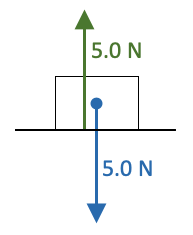
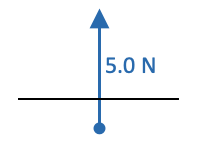
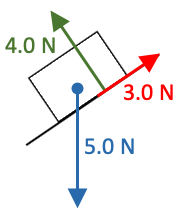
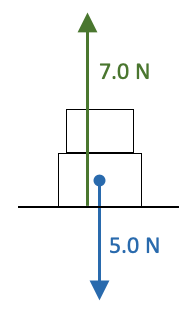
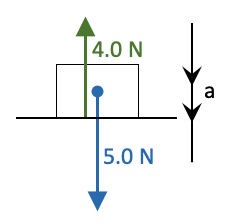
| Is this pair of forces an action-reaction pair?
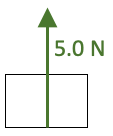
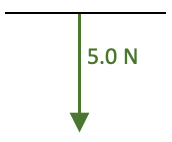
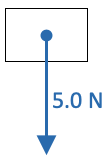
In fact the correct action-reaction pairings are:
Normal contact force acting on the ground and
|
Examples of Action-Reaction Pair Forces
- A fish swims through the water. The fish pushes the water backwards; thus the water pushes the fish forwards.
- A car spins it wheels as it drives forward. Friction at the car wheel pushes back on the road; friction from the road pushes the wheel forward. (Friction)
- Air is pushed backwards out of a deflating balloon; the air pushes on the balloon pushing it forward. (Thrust)
- You push against a wall; the wall pushes back on your hand. (Normal Contact Force)
- You jump into the air. You are attracted to the Earth; the Earth is attracted to you. (Gravitational attraction)
- Stretching a rubber band. You pull on the rubber band to stretch it; the rubber band pulls back on your hand. (Tension)
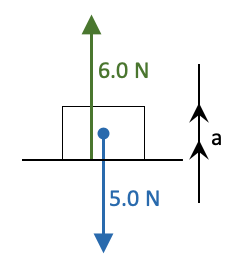
Normal Contact Force in a Lift
Consider a lift accelerating upwards at 2 m/s².
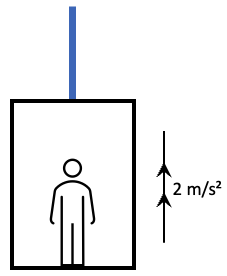
A person inside the lift will also experience this same upwards acceleration.
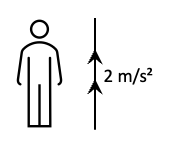
From Newton’s second law we know that there must be a net force acting on the person to cause this acceleration.
So why is there a net force? Because the normal contact force is larger than the weight of the person.
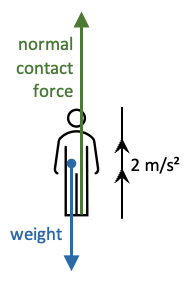
If the person had been standing on weighting scales in the lift the scales would show an increase in reading when the accelerated upwards.
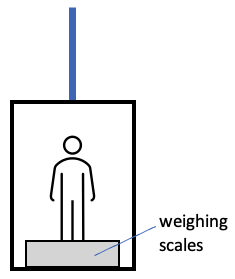 This is because the scales actually show the value of the normal contact force pressing onto them.
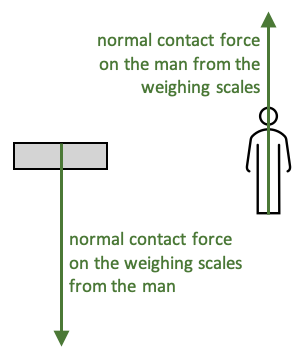
| Example: Lift Question |
|---|
| A 75 kg man steps into a lift and stands of some weighing scales.
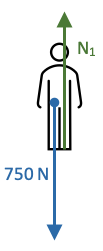
(a) What is the reading on the scales when the lift is STATIONARY?
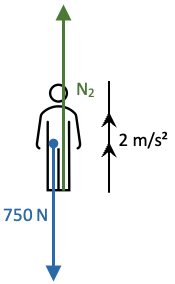
Net force = 0 N (from Newton’s First Law) Thus N1 = 750 N The reading on the weighing scales will be 750 N. (b) What is the reading on the scales when the lift is ACCELERATING UPWARDS at 2 m/s²?
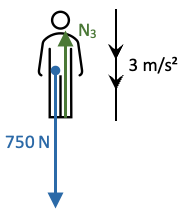
Net force must be upwards to cause an upwards acceleration. F = ma N2 – 750 = 75 × 2 Thus N2 = 900 N The reading on the weighing scales will be 900 N. (c) What is the reading on the scales when the lift is ACCELERATING DOWNWARDS at 3 m/s²?
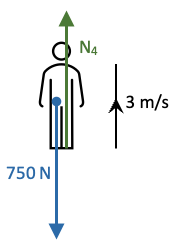
Net force must be downwards to cause a downwards acceleration. F = ma 750 – N3 = 75 × 3 Thus N3 = 525 N The reading on the weighing scales will be 525 N. (d) What is the reading on the scales when the lift is moving upwards at a CONSTANT SPEED of 3 m/s?
Constant speed => net force = 0 N (from Newton’s First Law) Thus N4 = 750 N The reading on the weighing scales will be 750 N. |

| << Back | Dynamics | Next >> |