| << Back | Dynamics | Next >> |
Newton’s Second Law looks at the case of unbalanced forces acting on an object.
Newton’s Second Law
The resultant force acting on an object is equal to the mass of that object times its acceleration, the acceleration being in the same direction as the applied force
Again there are really two parts to this law – the motion and the force.
The force is an unbalanced force this time.
The motion of the object is now an acceleration. In the usual case of constant force acting on an object of fixed mass, the acceleration will be a constant acceleration.
This force is written in equation form as
F=ma
If the mass of an object is doubled, its acceleration will halve if the applied force is kept constant.
If asked to define Newton’s Second Law in words it is unacceptable to state ‘force is equal to mass times acceleration’.
Physics questions on Newton’s Second Law frequently involve calculations.
| Example 1 |
|---|
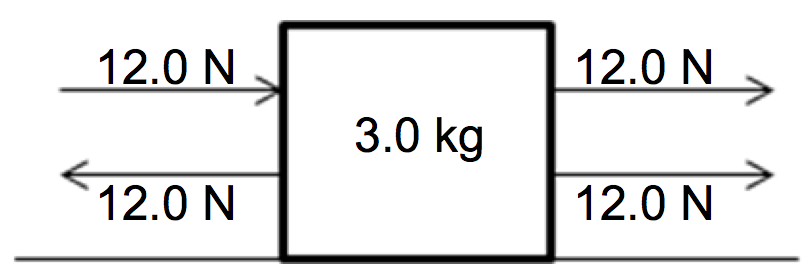
| Q. What is the acceleration of the following block?
Here we will first determine the resultant force acting on the block (24.0 N to the right). We are given the mass of the block. Next we use F=ma to determine the acceleration. We have made the assumption that there is no friction on between the black and the ground. |
| Example 6.5(a) |
|---|
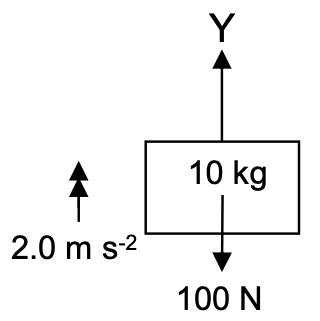
| What is the value of the unknown force Y?
The object is accelerating upwards, this tells us that Y must be larger than 100 N. Fnet = ma 100 − Y = 10 × 2.0 Y = 120 N |
| Example 6.5(b) |
|---|
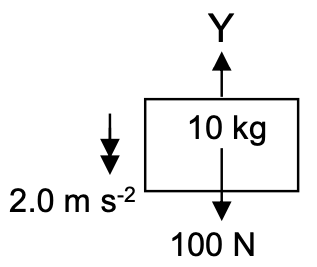
| What is the value of the unknown force Y?
The object is accelerating downwards, this tells us that 100 N must be larger than Y. Fnet = ma Y − 100 = 10 × 2.0 Y = 80 N |
| Note |
|---|
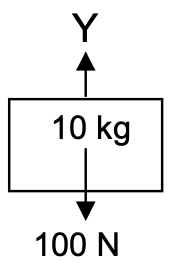
| If the above question had mentioned that the object was at rest or the object was moving with a constant velocity (either up or down), then (from our understanding of Newton’s First Law) we know the resultant force on the object is zero, and the value of Y is thus 100 N.
|
| Example |
|---|
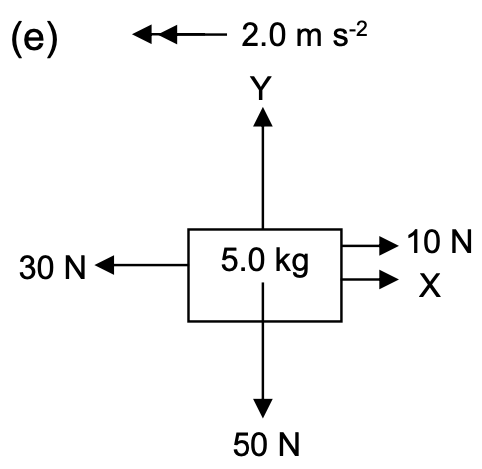
| What are the values of the unknown forces X and Y?
In the horizontal direction, the object is accelerating leftwards, this tells us that left acting forces (30 N) must be larger than the right acting forces (X + 10 N). Fnet = ma 30 − (X + 10) = 5.0 × 2.0 30 − X − 10 = 10 X = 10 N
In the vertical direction, the object has no acceleration. This tells us that teh forces acting upwards must be equal to the forces acting downwards (from Newton’s first law). i.e. no resultant force in the vertical direction. Y = 50 N |
| Example 2A |
|---|
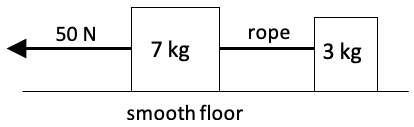
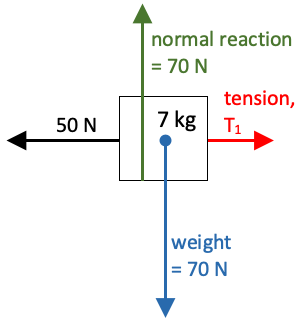
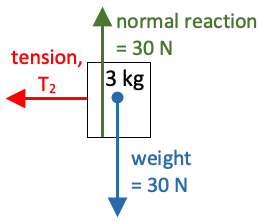
(a) Draw free-body diagrams for both boxes. Of course T1 = T2 = T (from Newton’s 3rd Law) (b) Calculate the acceleration of the boxes. Applying Newton’s second law to the 7 kg box: F=ma 50 – T = 7a Applying Newton’s second law to the 3 kg box: F=ma T = 3a Substituting we get 50 – 3a = 7a a = 5.0 m/s² (c) Calculate the tension in the rope. T = 3 x 5.0 T = 15 N |
| Example 2B |
|---|
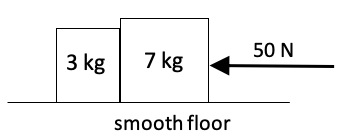
(a) Draw free-body diagrams for both boxes. Of course N1 = N2 = N (from Newton’s 3rd Law) (b) Calculate the acceleration of the boxes. Applying Newton’s second law to the 7 kg box: F=ma 50 – N = 7a Applying Newton’s second law to the 3 kg box: F=ma N = 3a Substituting we get 50 – 3a = 7a a = 5.0 m/s² (c) Calculate the normal reaction force between the two boxes. N = 3 x 5.0 N = 15 N |
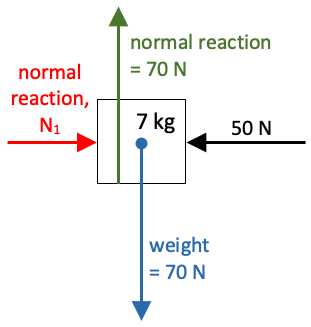
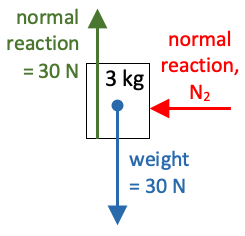
| Example 2C |
|---|
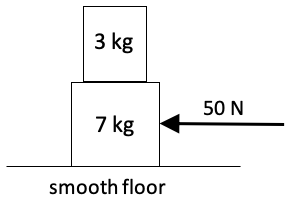
(a) Draw free-body diagrams for both boxes. Of course F1 = F2 = Fr (from Newton’s 3rd Law) (b) Calculate the acceleration of the boxes. Applying Newton’s second law to the 7 kg box: F=ma 50 – Fr = 7a Applying Newton’s second law to the 3 kg box: F=ma Fr = 3a Substituting we get 50 – 3a = 7a a = 5.0 m/s² (c) Calculate the friction between the two boxes. Fr = 3 x 5.0 Fr = 15 N |
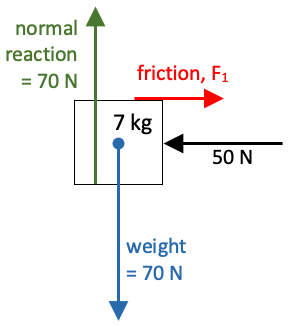
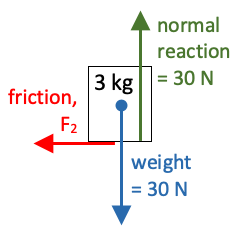
You can see that the three problems above are actually virtually the same problem.
| << Back | Dynamics | Next >> |