(ADVANCED PHYSICS TOPIC)
1 Angular Displacement, θ
-
- Angular displacement, θ, is the angle swept out by the radius joining the body to the centre of the circle.
- In circular motion, it is convenient to measure angles in radians rather than in degrees.
- Angle in radians

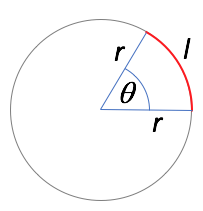
where,
l: length of arc
r: radius of circle
-
- length of arc l = r θ
One complete circle = 360° or 2 π radians
2 Angular Velocity, ω
-
- Angular speed, ω, is the angle swept out by the radius per second.
 units: radians / s
- Angular velocity is the angular speed in a given direction (ie clockwise or anticlockwise). It is defined as the rate of change of angular displacement.
- In one revolution, θ = 2π, t = T where T: period
- ω = θ / t =2π / T = 2π f where f : frequency
| Example 2A |
|---|
| What is the angular speed of a fan blade rotating at 2.5 r.p.m. (revolutions per minute)?
|
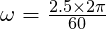
 0.26 rad s-1
| Example 2B |
|---|
| What is the angular speed of the minute hand of a clock?
The minute hand makes one complete revolution in one hour.
|

| Angular Velocity vs Linear Velocity |
|---|
| Consider an object moving around a circle at a constant rate (constant speed).
The linear velocity for this object is constantly changing (it is constantly changing direction). The angular velocity for this object is constant. Angular velocity is a vector quantity describing an object in circular motion; the direction is perpendicular to the plane of its circular motion. By convention, positive angular velocity indicates anticlockwise rotation, while negative is clockwise. |
3 Linear Speed v
v = l / t units: m s-1
From earlier equations:
v = l / t
v = r θ / t
v = r ω
Hence
v = r ω
(this equation will be given to you)
4 Centripetal Acceleration, a
-
- Consider a particle going around a circle of radius r with a constant speed v.
- Although the speed is constant, the direction of the velocity is always changing, so there is acceleration.
- This acceleration has a magnitude a = v2 / r and is directed towards the centre of the circle. This means that the net force on the particle must be directed towards the centre of the circle.
a = v2 / r
(this equation will be given to you)
Substituting in the earlier equation we get:
a = (r ω)2 / r
a = r ω2
| Example 4A |
|---|
| Calculate the acceleration of a car which is moving in a circle of radius 90 m and has a linear speed of 10 m/s?
a = v2 / r a = 10²/90 a = 1.1 m/s² |
| Example 4B |
|---|
| Calculate the acceleration of a car which is moving in a circle of radius 90 m and has a linear speed of 20 m/s?
a = v2 / r a = 20²/90 a = 4.4 m/s² |
| Example 4C |
|---|
| A centrifuge is required to give an acceleration of 1000g to a particle at a distance of 8.5 cm from the axis of rotation. Find the necessary angular speed of the centrifuge.
1000g means an acceleration 1000 × that of earths gravity a = r ω2 ω = √(a/r) ω = √(10,000/0.085) ω = 340 rad s¯¹ |
5 Centripetal Force, F
- Any net force causing uniform circular motion is called a centripetal force. The direction of a centripetal force is toward the centre of curvature, the same as the direction of centripetal acceleration. (Centripetal means centre-seeking.)
- From the above equation for acceleration we can derive the expression for the centripetal force
F = m v2 / r
OR
F = m r ω2
- We call this net force centripetal force and this provides the centripetal acceleration of the particle.
Examples of circular motion & centripetal force
- A car making a circular bend or turn – the centripetal force is provided by friction between the road and the tyres of the car.
- The Earth revolving around the Sun – the centripetal force is provided by the gravitational attraction force exerted on the Earth by the Sun.
| Example 5A |
|---|
|
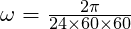
A geosynchronous satellite makes a complete circular orbit around Earth once every 24 hours. The radius of the orbit is 4.2 x 10⁷ m. (a) What is its angular speed?
(b) What is its linear speed? v = r ω v = 4.2 x 107 x 7.272 x 10-5 v = 3054 v = 3100 m/s (2 s.f.) (c) What is its centripetal acceleration? a = v2 / r a = (3054)2 / 4.2 x 10⁷ a = 0.22 m s¯² |
| Example 5B |
|---|
|
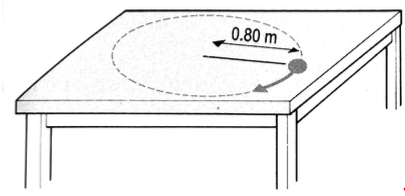
The figure below shows a mass of 0.300 kg rotating in a circular path of radius 0.80 m on a friction-free table. It is attached by a string to a peg at the centre of the circle.
What is the force which the string exerts on the mass when the mass is moving at a constant speed of 3.45 m/s? Centripetal force is provided by the tension in the string, T. F = m a F = m v2 / r T = 0.300 x (3.45)2 / 0.80 T = 4.46 N |
| Example 5C |
|---|
|
A rope is tied to a bucket of water, and the bucket is swung in a vertical circle of radius 1.2 m. Determine the minimum speed of the bucket at the highest point of the circle if the water is to stay in the bucket throughout the motion. Forces on water at highest point are weight, W, (acting downwards) and normal contact force of bucket on water, N, (acting downwards). Fnet = m a N + W = m v2 / r N = (m v2 / r) − mg For water to remain in bucket we need N≥ 0 N (m v2 / r) ≥ mg v2 ≥ rg v ≥ √(rg) v = √(1.2 x 10) v = 3.5 m s¯¹ |
| Dynamics |