| << Back | Dynamics | Next >> |
| Definition: Friction |
|---|
| Friction is the contact force that opposes or tends to oppose motion between surfaces in contact. |
Friction is a force that exists between two solid surfaces when at least one is rough. It causes wear and tear on surfaces. Friction generates heat.
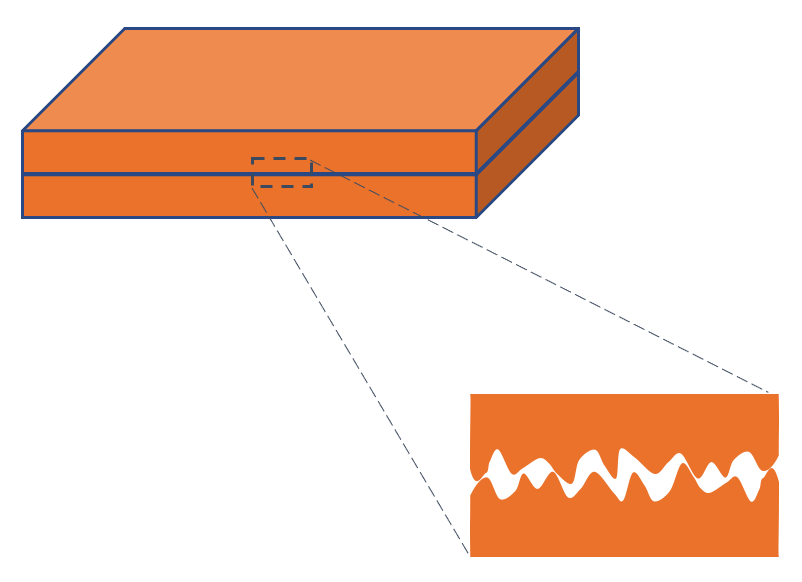
- Friction is due to microscopic surface irregularities of surfaces.
-
- Friction opposes relative motion between two surfaces in contact.
It can slow down a moving object or prevent a stationary object from moving.
- Friction opposes relative motion between two surfaces in contact.
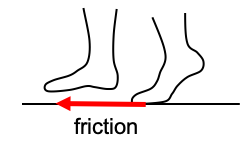
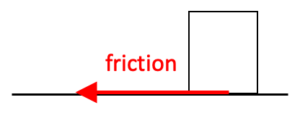 Friction should be represented like this – with the force acting along where the surfaces are touching.
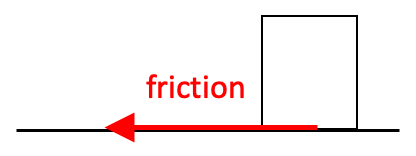
As friction here is shown acting towards the left the object is either moving to the right or has a rightward force applied to it which is trying to make it move towards the right.
-
- Friction increases with applied force until maximum value (limiting friction).
- Friction depends on the nature of the contact surfaces.
What the material is made of and how smooth / rough it is.
- Friction is proportional to the normal contact R from the surface in contact.
F=μR
- Friction increases with applied force until maximum value (limiting friction).
- Friction is zero when there is no force applied on the object even if both of the surfaces are rough.
- Friction is zero when surfaces are smooth even if a normal contact force is applied and/or object is moving.
Such as an object trying to move on ice.
Friction can be good or bad
- Friction is useful for:
- walking,
- keeping a ring on your finger,
- tyres providing grip on the road,
- brakes bringing a car to a stop.
- Friction is undesirable:
- making machines less efficient,
- causing wear and tear.
- Friction can be reduced greatly by:
- the use of lubricant on a surface,
- using wheels,
- using rollers or bearings,
- using a cushion of air
| Example: Direction Friction Acts In |
|---|
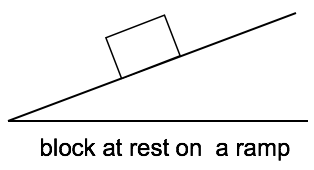
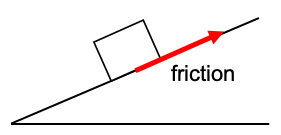
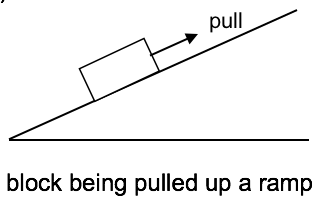
| Show the direction in which friction acts in the following examples.
|
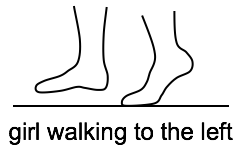
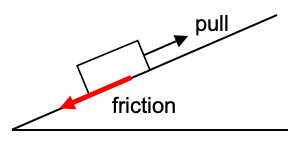
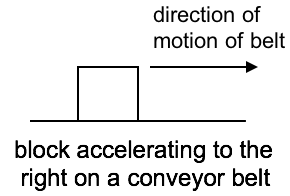
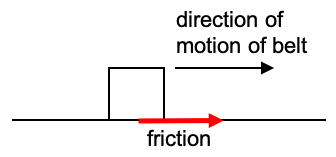
Friction on a Wheel
Consider the case of a bicycle peddling and accelerating as it moves to the right:
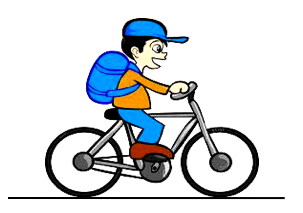
When the bicycle is peddled, only the rear wheel is connected to the pedals and will try to turn. It is thus just the rear wheel that is responsible for causing the bicycle to move.
The friction force on the rear wheel must be pushing the wheel (and hence the whole bicycle) forward – i.e. this is the force responsible for making the bike move.
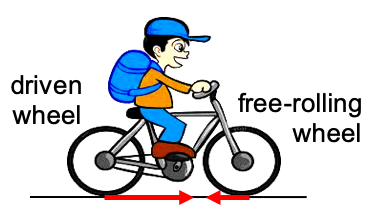
The front wheel gets pushed along the ground and this friction force will cause the front wheel to also start turning. The force on this wheel will oppose the direction of motion of the bicycle.
The front wheel of a bicycle is free-rolling (or trailing) and does not contribute to the moving forward of the bicycle.
The rear wheel is driven (powered) and is responsible for the moving forward of the bicycle.
| https://youtu.be/RHYHtfyamOw?si=VUCiR5Tq5U4nxoSO |
| << Back | Dynamics | Next >> |