| << Back | Dynamics | Next >> |
Gravitational Force / Weight
- A body on earth’s surface experiences a downward gravitational force which is the pulling force on it due to the earth. This force is also called the weight of the body.
| Definition: Weight |
|---|
| Weight is the gravitational force acting on an object that has mass. |
- As weight is a force, it is measured in units of newtons (N).
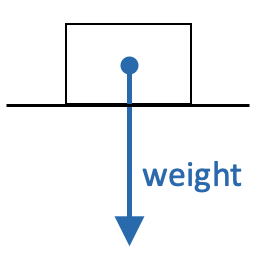 We will draw the weight force acting on an object like this. The dot in the centre of the object represents the centre of gravity (COG) of the object.
Gravitational Field & Gravitational Field Strength
| Definition: Gravitational Field |
|---|
| A gravitational field is a region in which a mass experiences a force due to gravitational attraction. |
The Earth has an enormous mass creating a strong gravitational field around it. Any object within the Earth’s gravitational field will experience a force exerted by the Earth on it. This field is strongest at the Earth’ s surface and gets weaker as we move away from the Earth. Even at a large distance the field does not disappear – it just keeps getting weaker. Think of the Moon, that is still experiencing the Earths attraction and thus must still be inside the Earth’s gravitational field.
| Definition: Gravitational Field Strength |
|---|
| Gravitational field strength, g, is the gravitational force per unit mass placed at that point. |
On Earth, the gravitational field strength g is approximately 10 N/kg.
- Using W = mg, the gravitational force acting on a mass of 1 kg is 10 N (approximated from 9.81 N) near the earth’s surface.
- Hence the earth’s gravitational field strength g is 10 N kg-1 near its surface. The values of g decreases as we move away from earth.
- All masses attract each other. This attractive force between masses is called gravitational force.
- From Newton’s second law (F =ma)
gravitational force on body = weight (W) = mass (m) x gravitational acceleration (g)
| W = m g |
where g is 10 m s-2 on earth’s surface.
- Using W = mg, the gravitational force acting on a mass of 1 kg is 10 N (approximated from 9.81 N) near the earth’s surface.
- Hence the earth’s gravitational field strength g is 10 N kg-1 near its surface. The values of g decreases as we move away from earth.
- In practice, gravitational field strength is equivalent to gravitational acceleration, and it can be shown that 10 N kg-1 = 10 m s-2.
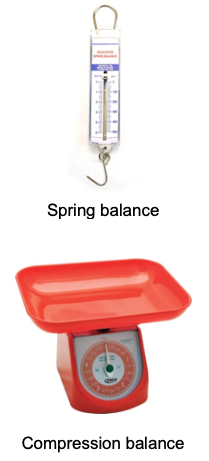
- A spring balance or a compression balance is used to measure the weight of an object.
| Mass vs Weight | |||||||||||||||||
|---|---|---|---|---|---|---|---|---|---|---|---|---|---|---|---|---|---|
Remember mass and weight are different physical quantities. The differences are summarised in the table below:
|
|||||||||||||||||
| Example |
|---|
| An object has a mass of 20 kg. Assume that the gravitational field strengths on the Moon and on Mars are 1.6 N/kg and 3.7 N/kg respectively. Calculate its weight on
(a) the Moon and
(b) on Mars respectively. |
| << Back | Dynamics | Next >> |