(ADVANCED PHYSICS TOPIC)
1 Linear Momentum, p
You wouldn’t want to be hit by a charging elephant or a bullet. The elephant because of its large mass, the bullet because of its high velocity.
These two different objects actually are similar in having large momentum.
Momentum can be thought of as how hard it is to bring a moving object to rest. Momentum is usually used in physics problems involving collisions between objects.
| Definition: Linear Momentum |
|---|
| Linear momentum is defined as the product of the mass and the velocity of a body. |
| p= mv |
Where:
m = mass of body (in kg)
v = velocity of body (in m s⁻¹)
- It is a vector, being in the same direction as the velocity.
- It has units of kg m s-1
| Linear & Angular Momentums |
|---|
| We use the term “linear momentum” to differentiate it from “angular momentum”. However, frequently we will just refer to “linear momentum” as “momentum”. |
| Example 1A |
|---|
| Calculate the magnitude of the momentum of an alpha particle of mass 6.6 × 10⁻²⁷ kg travelling with a speed of 2.0 x 10⁷ m s-1
p=mv = (6.6 × 10⁻²⁷)(2.0 × 10⁷) = 1.3 × 10⁻¹⁹ kg m s-1 |
| Example 1B |
|---|
| Calculate the magnitude of the momentum of an oil tanker of mass 50 000 tonnes travelling with a speed of 50 m s-1.
[1 tonne = 1000 kg] p=mv = (50 000 × 103)(50) = 2.5 × 10⁹ kg m s-1 |
| Example 1C |
|---|
| Calculate the magnitude of the momentum of a Formula One car of mass 1000 kg travelling at a speed of 300 m s-1
p=mv = (1000)(300) 3.0 × 10⁵ kg m s-1 |
2 Principle of Conservation of Momentum
| Definition: Principle of Conservation of Momentum |
|---|
| Principle of conservation of momentum states that total momentum of a system remains constant if the resultant force (or net force) on the system is zero. |
| External Forces |
|---|
| No external forces (resultant force on the system is zero) does not mean that forces are not present – it’s just that the forces are only between the objects being looked at.
Eg. we might analyse the motion of two cars crashing by looking at the momentum of each car. Of course, as the cars collide, there will be forces acting on each car, but these are between the objects we are studying and so are forces within the system – not external forces. |
- Consider two particles of mass m1and m2, making a direct, head-on collision.
- Choose a sign convention: to the right is positive.
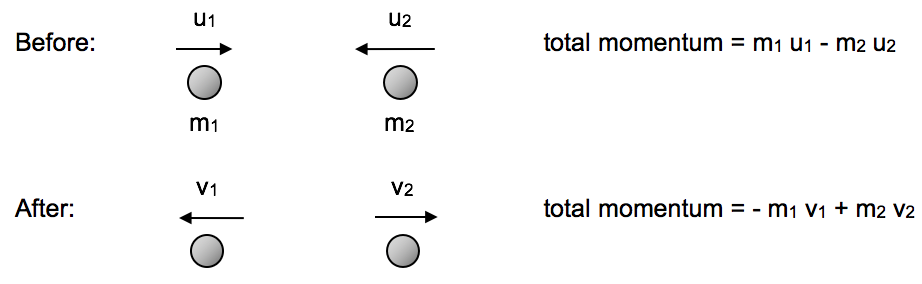
By the principle of conservation of momentum,
total momentum before collision = total momentum after collision
m1u1– m2u2 = – m1v1+ m2v2
m1(u1+ v1) = m2(u2+ v2)
| Example 3 |
|---|
| A cannon of mass 1.5 tonnes fires a cannon-ball of mass 5.0 kg. The speed with which the ball leaves the cannon is 70 m s-1 relative to the Earth.
Determine the initial speed of recoil of the cannon.
[0.23 m s-1] |

| Example 4 |
|---|
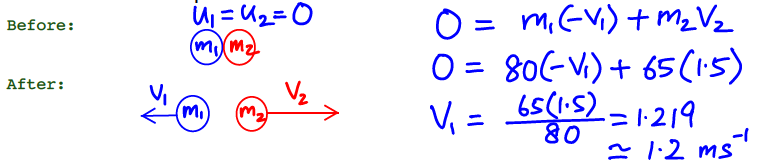
| An ice-skater of mass 80 kg, initially at rest, pushes his partner, of mass 65 kg, away from him so that she moves with an initial speed of 1.5 m s-1.
Determine the initial speed of this skater after this manoeuvre.
[1.2 m s-1] |
3 Kinetic Energy, Elastic & Inelastic Interactions
- If a collision is elastic, the total kinetic energy before the collision is equal to the total kinetic energy after the collision. This means there is conservation of kinetic energy.
- If a collision is inelastic, the total kinetic energy before the collision is not equal to the total kinetic energy after the collision. In such a collision, kinetic energy is not conserved; it is transformed into heat, sound and/or other forms of energy.
- Although kinetic energy may or may not be conserved in a collision,
- linear momentum is always conserved, and
- total energy is always conserved.
| Example |
|---|
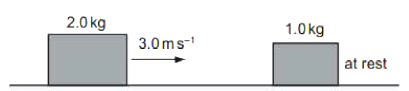
| A 2.0 kg mass travelling at 3.0 m s⁻¹ on a frictionless surface collides head-on with a stationary 1.0 kg mass. The masses stick together on impact.
(a) What is the velocity of the masses after the collision?
(b) Is the collision elastic?
|
| NEW Example |
|---|
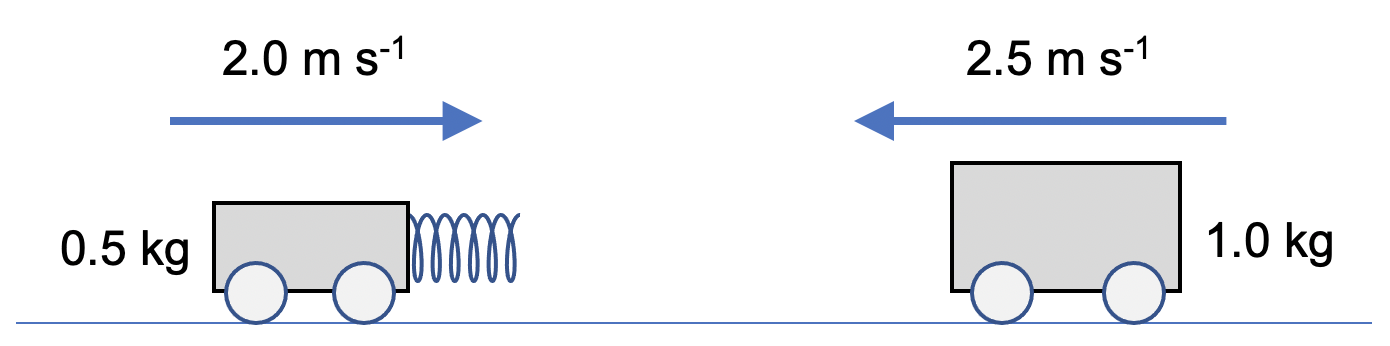
| A trolley of mass 0.5 kg moving to the right at 2.0 m s⁻¹ moves towards a trolly of mass 1.0 kg moving with a speed of 2.5 m s⁻¹ to the left. There is a spring placed between the trollies.
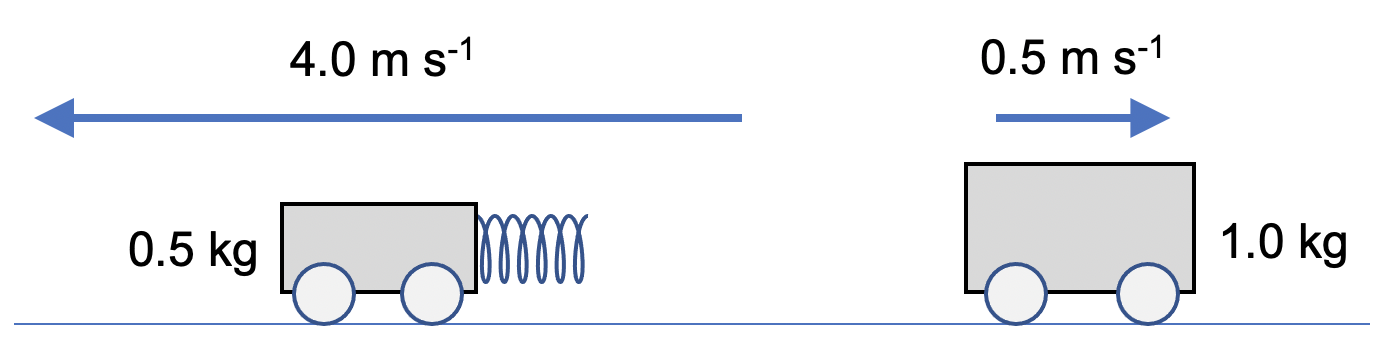
(a) Calculate the total momentum of the system before the collision. (b) Calculate the total energy of the system before the collision. After colliding the trollies separate from each other at the speeds shown.
(c) Calculate the total momentum of the system after the collision. (d) Calculate the total energy of the system after the collision. (e) Is the collision an elastic collision? At one instant during the collision the 0.5 kg trolley comes to rest.
(f) Calculate the velocity of the 1.0 kg trolley at this instant. (g) Calculate the kinetic energy of the 1.0 kg when moving at the velocity calculated in (f). (h) Explain why the answers to (b) and (d) differ from (g). |

| http://hyperphysics.phy-astr.gsu.edu/hbase/elacol.html |
4 Impulse
When playing tennis, a coach may tell you to “follow through” with the hit. This would make the racket remain in contact with the ball for a longer time. This would then result in the ball leaving the racket at a higher speed.
| Definition: Impulse |
|---|
| Impulse is the product of the average force on a body and the time of impact. |
Impulse is a measure of the effect of a force. A larger impulse (whether caused by larger force or longer duration of applied force) will result in a greater change in velocity for a given object.
As an equation:
|
Impulse = FΔt |
- where:
F = average force (in N)
Δt = time of impact / time for which the force was acting (in s)
Impulse is thus measured in units of newton-seconds (N s).
| Δ |
|---|
| The greek symbol “Δ” (delta) is used in many maths and science equations to represent a change in something. You would read “Δt” as “delta-tee” or “change in time”. |
5 Resultant Force & Rate of Change of Momentum
- From Newton’s 2nd law of motion,
resultant force or net force: Fnet= ma
F= m 
F = 
Since (mv – mu) = change of momentum
Hence, resultant force is equal to the rate of change of momentum.
Fnet = 
Newton’s 2nd law of motion may also be stated as:
| Definition: Newton’s Second Law |
|---|
| The resultant force on a body is equal to the rate of change of its momentum. |
- Also, FΔt = mv – mu and impulse = FΔt
- Hence, impulse = change in momentum = Δp
impulse = FΔt = mv – mu
This formula would be given in EOY Exams.
| Example 5 |
|---|
| Show that if the net force on a system is zero, the total momentum of the system is constant.
|

| Example 6 |
|---|
| A safety feature of modern cars is the air-bag, which in the event of a collision, inflates and is intended to decrease the risk of serious injury. Use the concept of impulse to explain why an air bag might have this effect.
|

| Example 7 |
|---|
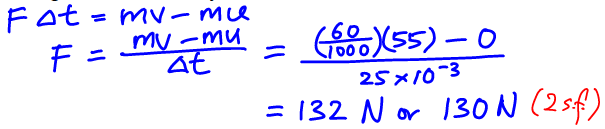
| Some tennis players can serve the ball at a speed of 55 m s-1. The tennis ball has a mass of 60 g. In an experiment using high speed camera and video tracker, it is determined that the ball is in contact with the racket for 25 ms during the serve.
Calculate the average force exerted by the racket on the ball.
|
| Example 8 |
|---|
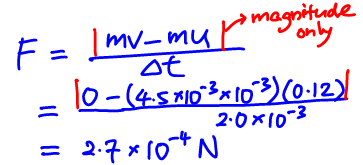
| An insect of mass 4.5 mg, flying with a speed of 0.12 m s-1, encounters a spider’s web, which brings it to rest in 2.0 ms. Calculate the force exerted by the insect on the web.
4.5 mg = 4.5 x 10⁻³ g = 4.5 x 10⁻⁶ kg
|
| Example 9 |
|---|
| When a space rocket is taking off, the propellant gases are expelled from the rocket at a rate of 900 kg s-1 and at a speed of 40 km s-1. Calculate the thrust exerted on the rocket.
|

| Dynamics |