(ADVANCED PHYSICS TOPIC)
Gravitational Fields
- How does the force ‘travel’ from one body to another? How does a mass ‘know’ that another mass is attracting it? To answers these questions, physicists introduce the idea of a field.
- We say that a mass creates a gravitational field in a region of space around it. Other masses respond to this field by having a gravitational force act on them. This field is a property of the mass.
Newton’s Law of Gravitation
This law states that the gravitational force between two masses
- is directly proportional to their masses and
- inversely proportional to the square of their distance apart.
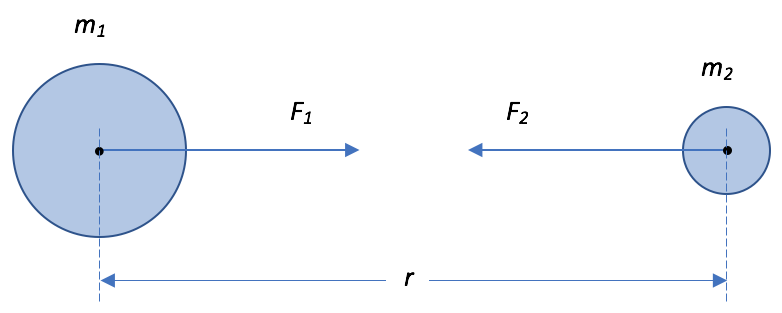
F1 = F2 = F
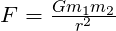 |
You will be given this equation in all Exams /Tests if you need it.
where:
F: gravitation force
m1 and m2: mass of two masses
r: distance between masses (from their centre-of-gravity)
G: universal gravitational constant (from experiment, G is found to be 6.7 x 10⁻¹¹ N m2 kg-2)
You will told this value if you need it.
frequently this is written as
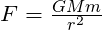 |
Where:
M: mass of one object (usually the more massive one)
m: mass of the other object (usually the less massive one)
Gravitational force is always an attractive force.
This law is an inverse square law equation (there are lots of these in physics!)
| Example 1 |
|---|
|
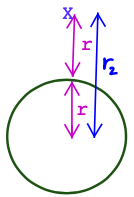
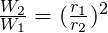
The weight of a body is 20 N on a planet’s surface.
The force is weight, thus
W = 5.0 N |
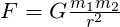


Gravitational field strength g
- Gravitational field strength at a point is the gravitational force exerted per unit mass placed at that point. This is a vector.

- Consider the gravitational field created by a spherical mass M.
- A point mass m placed a distance r from the centre of M will experience a force
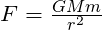
- The gravitational field strength at a point a distance r from M is

| Example 2 |
|---|
|
The mass of Jupiter is 1.9 x 1027 kg and its radius is 7.1 x 10⁷ m. Calculate the gravitational field strength at the surface of Jupiter.
gjupiter = 25 N kg¯¹ |

| Example 3 |
|---|
|
The radius of the Earth is 6.4 x 10⁶ m and the gravitational field strength at its surface is 9.8 N kg¯¹ . (a) Assuming that the field is radial, calculate the mass of the Earth.
mass= 6.0 x 1024 kg
(b) The radius of the Moon’s orbit about the Earth is 3.8 x 10⁸ m. Calculate the strength of the Earth’s gravitational field at this distance.
g = 2.8 x 10⁻³ N kg¯¹
(c) The mass of the Moon is 7.4 x 10²² kg. Calculate the gravitational attraction between the Earth and the Moon.
F = 2.1 x 10²⁰ N |




Gravitational field of a point mass
- The gravitational field of a point mass is radial.
- We may consider the Earth as behaving like a point mass, so its gravitational field is also radial.
- The gravitational force acting on a body placed at a distance from a planet or star is often called its weight.
- Weight = F = m g since gravitational field strength

- Near the surface of Earth, the gravitational field is approximately uniform (or constant. The gravitational field lines would be parallel to each other.
- Varies from place to place due to:
- difference in distance from the centre of the earth (the earth is not a sphere, but an oblique spheroid)
- different composition (density of rocks)
- Standard value of g is 9.806 65 m s¯² although we often use 9.81, 9.8 or 10.
5 Circular orbits
- Most planets in the Solar system have orbits which are nearly circular.
- Similarly, most artificial satellites moving round the Earth and natural satellites (moons) moving round the planets have almost circular orbits.
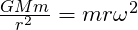
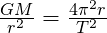
- We can apply the equations for circular motion and the concept of centripetal force for these orbits.
| Example 4 |
|---|
|
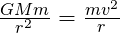
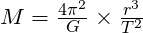
The Earth orbits the Sun in a circular orbit of radius 1.5 x 10¹¹ m. Determine the mass of the Sun. Let mass of Sun = M The gravitational force provides the centripetal force for the circular orbit. Period of orbit = 365 days = 365 x 24 x 60 x 60 = 3.154 x 10⁷ s.
M = 2.0 x 1030 kg |



| Dynamics |
| Links |
|---|
| Online Physics Textbook |
| How Long To Fall Through The Earth? – MinutePhysics |