The study of light as a particle, or photon, has helped develop the study of atoms too. In this chapter on Atomic Physics, we are looking at a model of a single atom, and will study the Hydrogen atom!
Structure of an Atom
J.J. Thomson discovered the electron in 1897, showing that atoms are NOT the smallest division of matter, and that they have some form of internal structure.
Thomson proposed a raisin-cake model (or plum pudding model) of the atom, in which small negative electrons are embedded in a sphere of positive charge.

Kurzon, CC BY-SA 4.0, via Wikimedia Commons
Ernest Rutherford, one of Thomson’s former students, was working with radioactive decay at that time, and termed a form of decay “alpha rays”. Together with two students, he set up an experiment in which alpha rays are projected towards a thin gold foil and the detectors are moved around the set-up to find out where these alpha particles are deflected towards.
| Ernest Rutherford (1871 – 1937) |
|---|
| New Zealand Physicist famous for the discovery of alpha and beta radiation as well as the Rutherford model of the atom. |
Rutherford’s Scattering Experiment
This is the first nuclear physics experiment to be conducted.
Let’s use an analogy. If you are in a dark room, and you want to see what’s in a fishbowl, you shine light at it. The light rays reflect and enter your eyes. That’s how you see what’s in the fishbowl.
Similarly, when we want to see what’s in an atom, we shoot beams of alpha particles at the electrons, and we have receivers all around the atom to capture where they are reflected to. This will help us “see” what’s in the atom.

Kurzon, CC BY-SA 3.0, via Wikimedia Commons
The results showed that:
Most of the alpha particles passed through the gold foil undeflected,
Some of the alpha particles were deflected through a large angle!
This led to Rutherford’s Nuclear Model of the atom: A massive nucleus in the middle, with mainly space between the electrons and the nucleus.
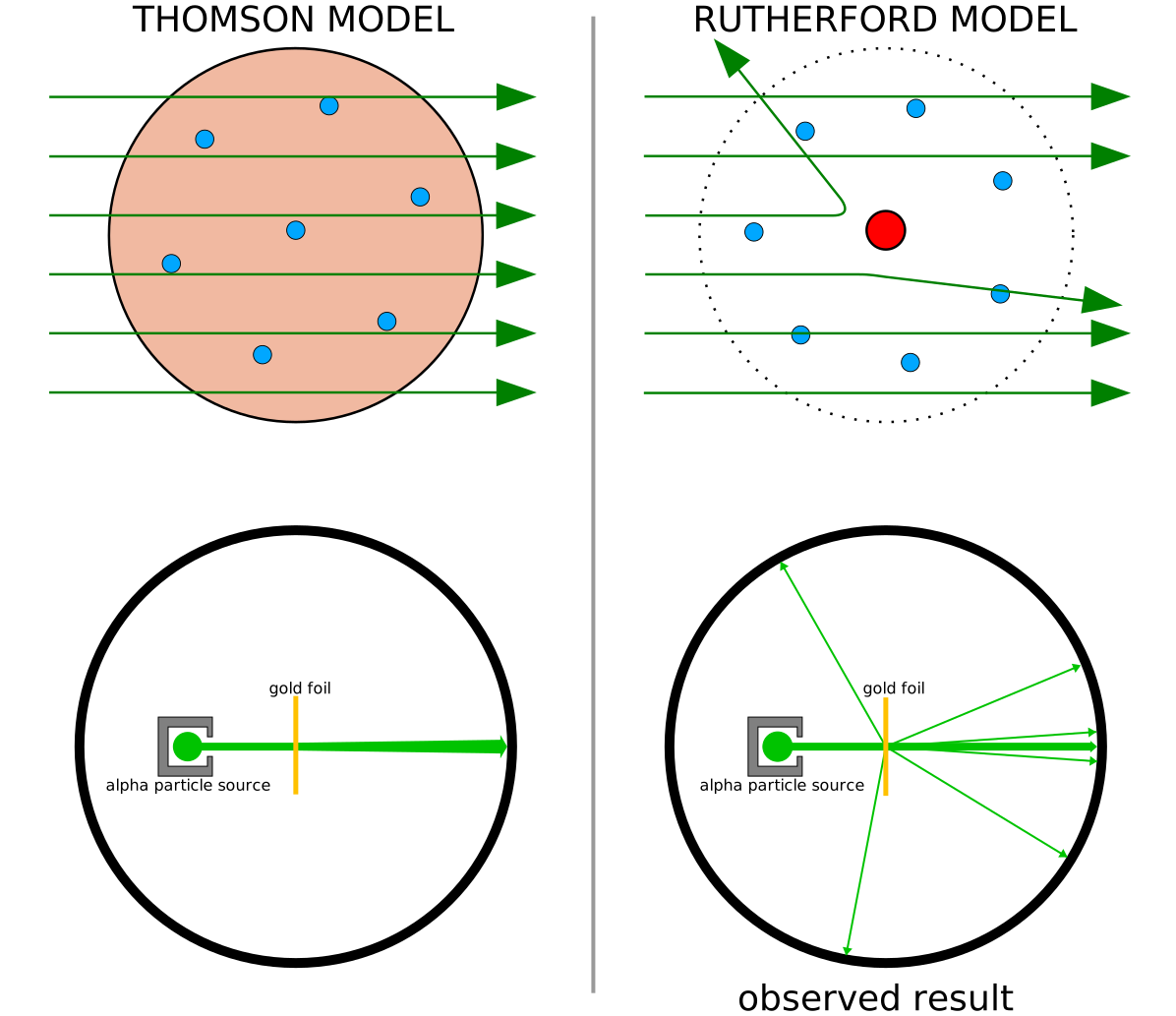
Kurzon, CC BY-SA 3.0, via Wikimedia Commons

(This page still under construction from here on)
Rutherford’s Scattering Experiment helped us see the general structure of atoms. Spectroscopy is also a method for us to know about the energy levels within atoms!
Spectroscopy
We have learnt that white light is made up of a continuous spectrum of light, as we observe during a rainbow. It has been discovered that if a high voltage is applied to two electrodes sealed in a glass tube filled with a low-pressure gas, the gas begins to glow and emits light with a colour that is unique to that gas. Scientists soon realised that the light was being emitted by the atoms in the gas. These atomic spectra were a new way to study the properties of the elements.
Light emitted by atoms in a gas discharge tube has a discrete spectrum
Every element in the periodic table has its own unique spectrum.
These spectra lines, as with many others, are first observed, then explained. So what produces these discrete gaps in coloured light, as well as the bands of coloured light?
The Hydrogen Atom
Recall that we talked about the discretization of energy under Quantum Physics and about Bohr’s model of atom where only particular orbits are allowed.
We start with a one proton – one electron atom to kickstart our analysis!
Bohr’s Model
In the earlier discussion, we described Bohr’s model as the answer to classical physics’ problem with the collapsing electron orbit. Bohr’s model is one in which only certain discrete orbits are allowed, and that it is in these orbits that electrons will not radiate EM radiation as they accelerate. These are considered the stationary states of the atom, where electrons can form standing wave patterns about the nucleus.
Let us study the stationary states in greater detail. (Textbook pp. 964-968)
(Classical) Energy of electron-proton interaction
(Classical) Centripetal force acting on the electron
(Classical) Circular orbit of the electron
(Quantum) De Broglie Wavelength of electron
(Quantum) Circumference of orbit must be an integral multiple of the standing wave for a circular standing wave pattern
Substitute 3. with 5. (simultaneous equations involving v and r), we end up with discrete values of r and v.
The discrete values of r gives us the stationary states.
The discrete values of v gives us the discrete energy levels after substituting back to 1.
The discrete values of r and v also give rise to the discretization of angular momentum.
Bohr’s model correctly predicts the spectroscopy results! As can be seen from the analysis above, Bohr’s model is known as a “semiclassical” theory. Bohr’s model was however, not enough to explain even the Helium atom, suggesting that a better model needs to be discovered.
The Quantum Mechanical Model
Schrodinger came up with a model which characterizes the state of a hydrogen atom by 4 quantum numbers:
Principal quantum number, n
Orbital quantum number, l
Magnetic quantum number, m
Spin quantum number, s
With these model, the Pauli-Exclusion Principle as well as the arrangement of electrons in various elements can be explained! You can read up on it on your own.
Explanation of the Formation of Spectral Lines
Now that we know about energy levels within atoms, we can have a better discussion on what causes these spectral lines. We say that the electrons in higher energy levels are excited or in an excited state. And as described above, these excited states are discrete, not continuous!
These are the states which give rise to the spectra lines we observe! If an electron is not excited, we say that it is in its ground state. That is where it is at the lowest energy level. There are two basic mechanisms for excitation: absorption and collision.
Absorption Spectra
An electron can jump from lower to higher energy states by absorbing a photons of specific frequencies. The frequency of the photon absorbed must correspond to the difference in energy levels.
The absorption spectra is observed when light is shone on gaseous atoms. Electrons in these gaseous atoms absorb specific frequencies of light and jump to an excited state. The gaps in the spectrum show where bands of light have been absorbed.
There is a transition selection rule where the excitation state must differ in quantum orbital number by 1. This makes the bands on the absorption spectra less than those on the emission spectra.
Emission Spectra
An electron can be excited to higher energy states by collisions. There are no selection rules for the excited by collisions.
The emission spectra is observed when gaseous atoms are bombarded with fast-moving electrons in a dark room. Light emitted by the gaseous atoms are then captured.
When other fast-moving particles collide with an electron in the gaseous atoms, the electron jumps to an excited state. However, it cannot stay at the excited state for long. It will eventually drop back to its ground state. When an electron drops from a higher energy state to a lower energy state, it loses energy in the form of a photon, and emits a photon of the same energy as the difference in energy levels.
An electron need not drop from an excited state directly to the ground state. It can drop to a lower excited state first before dropping to the ground state. In this way, it will emit one photon at each drop in energy state, so two photons will be emitted.
Therefore, there are usually more lines on the emission spectra.
Molecules
Although we have considered only atoms for now, quantum mechanics actually also applies to molecules! But molecules are more complex because they can rotate about their centre of mass or vibrate back and forth as if the molecular bonds holding them together were little springs. These are modes in which they can store energy as well!
You can read up more about molecules in your textbook!
https://sites.google.com/a/nygh.edu.sg/2014-s4-physics-olympiad/atomic-physics