| << Back | Dynamics | Next >> |
It is suggested to only look through these examples when you are already familiar with Newton’s Laws and Vector Resolution.
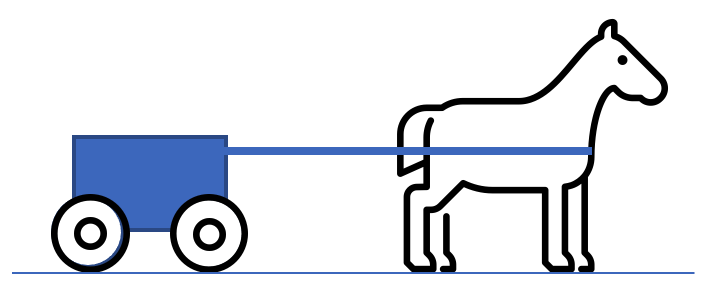
Consider and horse and cart. The horse has a mass of 400 kg and the cart 100 kg.
A rigid metal bar of negligible mass joins them.
The wheels of the cart can be assumed to be frictionless.
Situation 1: Stationary on a Flat Surface
1A) Clearly Label the Forces Acting on the Horse
The forces acting on the horse are the weight and normal contact force (this is shown as a single force although, in actuality, exists on each of the horse’s feet).
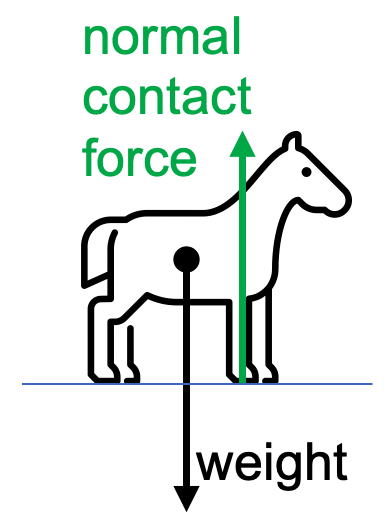 Weight is easily determined from w = mg = 400 × 10 = 4000 N
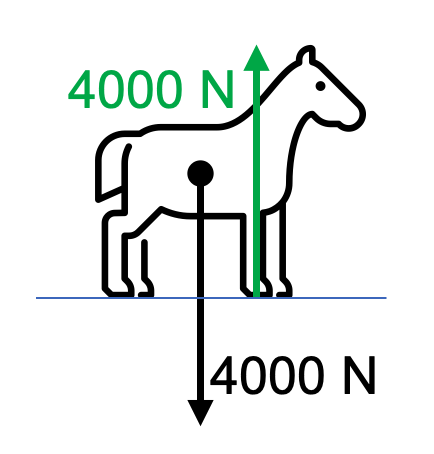
As the horse is in equilibrium (not moving) according to Newton’s First Law the net force on the horse must be zero. Thus contact force must be equal to the weight, i.e. contact force = 4000 N.
Thus the forces (with magnitudes) would be:
 The tension in the bar between the horse and cart must be zero in this case.
Situation 2: Accelerating on a Flat Surface
2A) Clearly Label the Forces Acting on the Cart
There will be three forces acting on the cart:
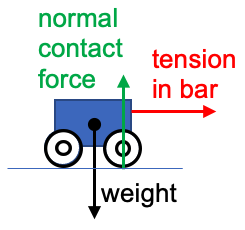
Weight is easily determined from w = mg = 100 × 10 = 1000 N
As the cart has no change of motion in the vertical direction then, according to Newton’s First Law, the net vertical force on the cart must be zero. Thus normal contact force must be equal to the weight, i.e. normal contact force = 1000 N.
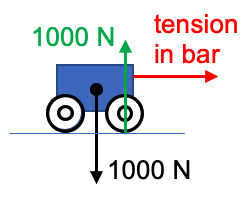
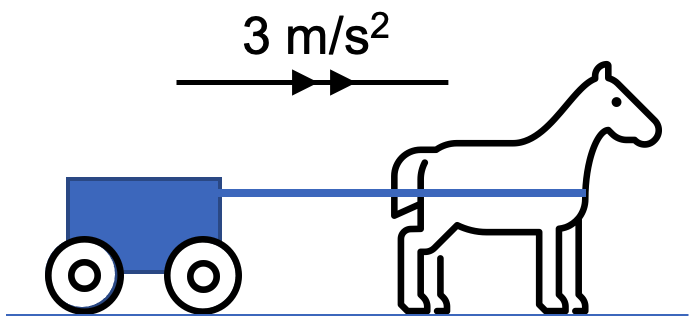
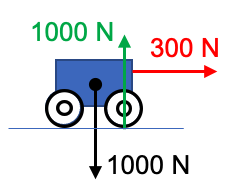
The cart is accelerating at 3 m s⁻², thus acceleration is caused by the tension force, T, acting on the cart. Thus, from Newton’s second law (F = ma) we get:
T = 100 × 3 T = 300 N
2B) Clearly Label the Forces Acting on the Horse
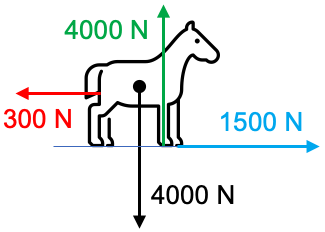
There will be four forces acting on the horse:
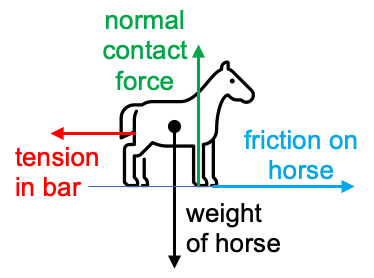
Weight is determined from w = mg = 400 × 10 = 4000 N
As the horse has no change of motion in the vertical direction then, according to Newton’s First Law, the net vertical force on the horse must be zero. Thus normal contact force must be equal to the weight, i.e. normal contact force = 4000 N.
Tension acting in the bar will be 300 N (same as that acting on the cart) as the forces are an action-reaction pair.
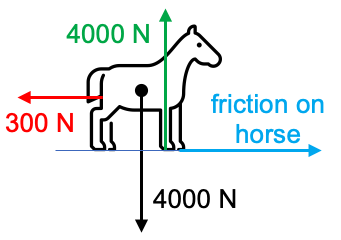
Finally, the horse is accelerating at 3 m s⁻² horizontally. Thus acceleration is caused by the net horizontal force acting on the horse (ie friction force, ƒ, minus the tension force). Thus, from Newton’s second law (F = ma) we get:
ƒ − 300 = 400 × 3 ƒ = 1200 + 300 ƒ = 1500 N
Situation 3: Stationary on a Slope
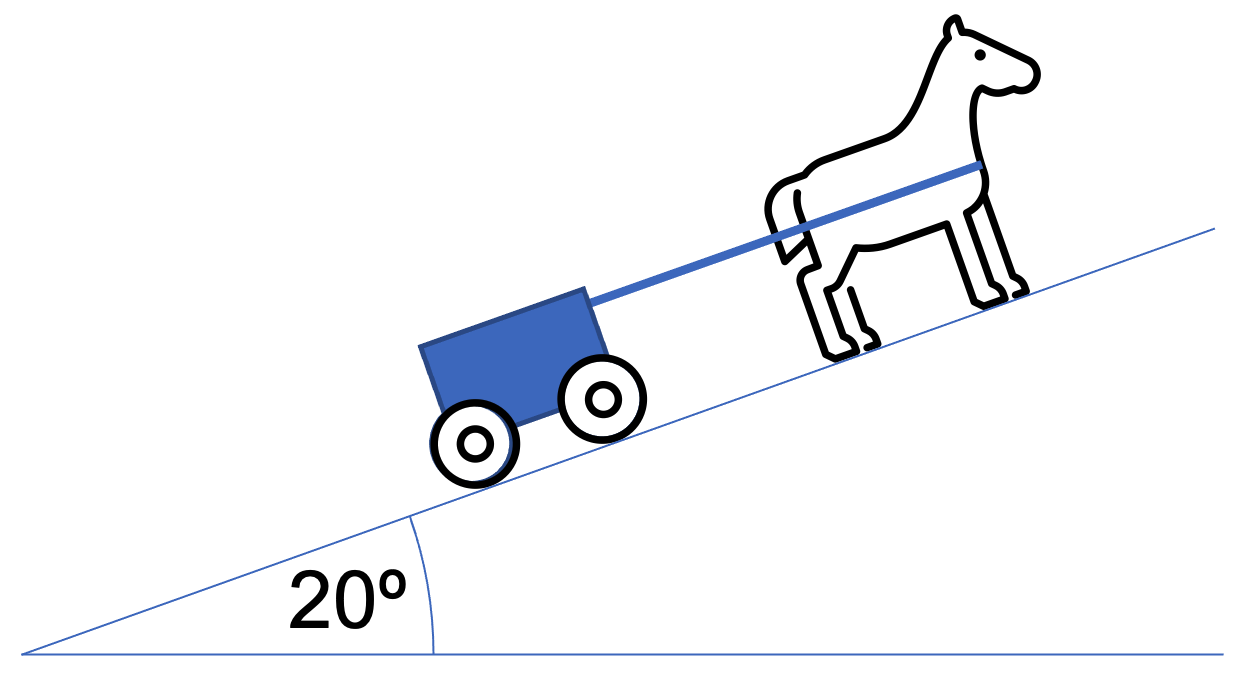
3A) Clearly Label the Forces Acting on the Cart
Weight is easily determined from W=mg =100 × 10 = 1000 N
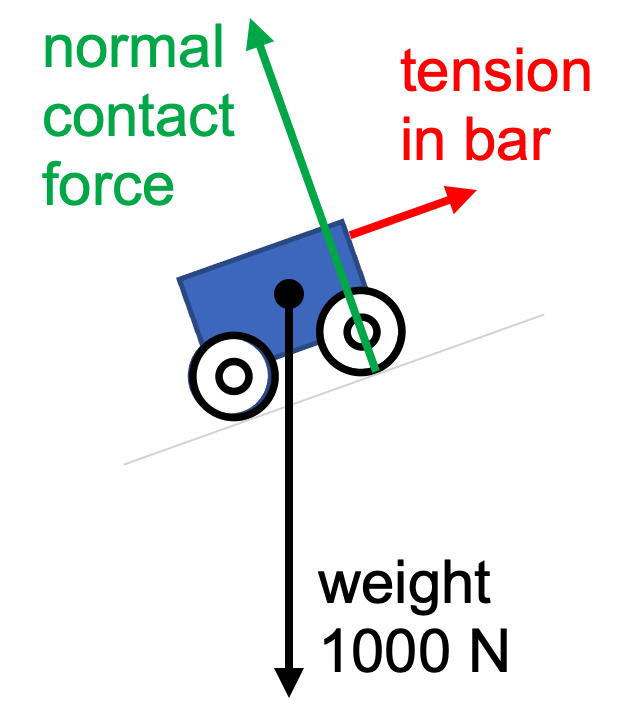
Considering the components of weight acting perpendicular to the slope and parallel to the slope:
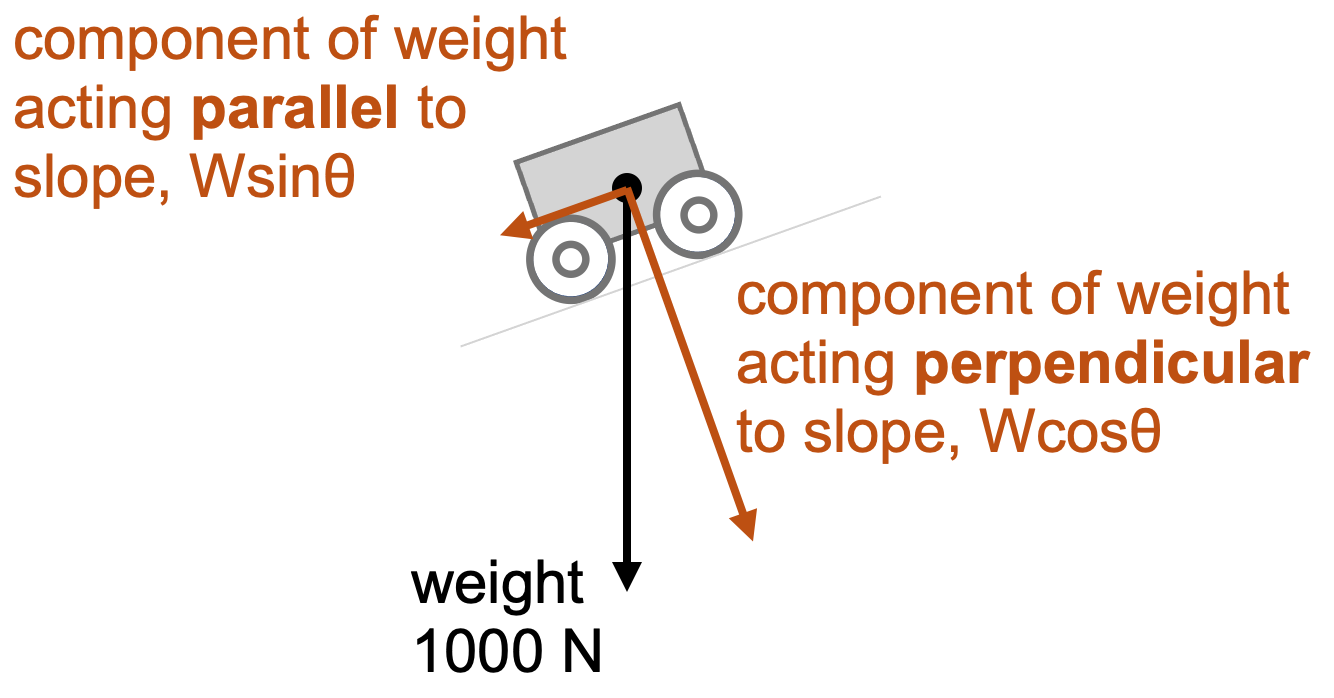
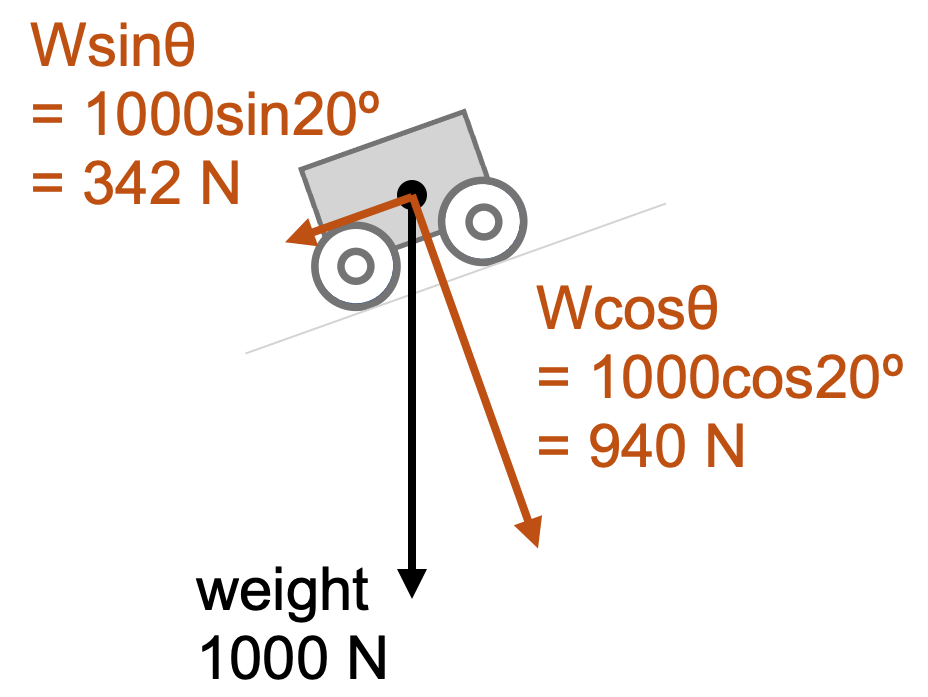
So replacing weight with the 2 components we would get:
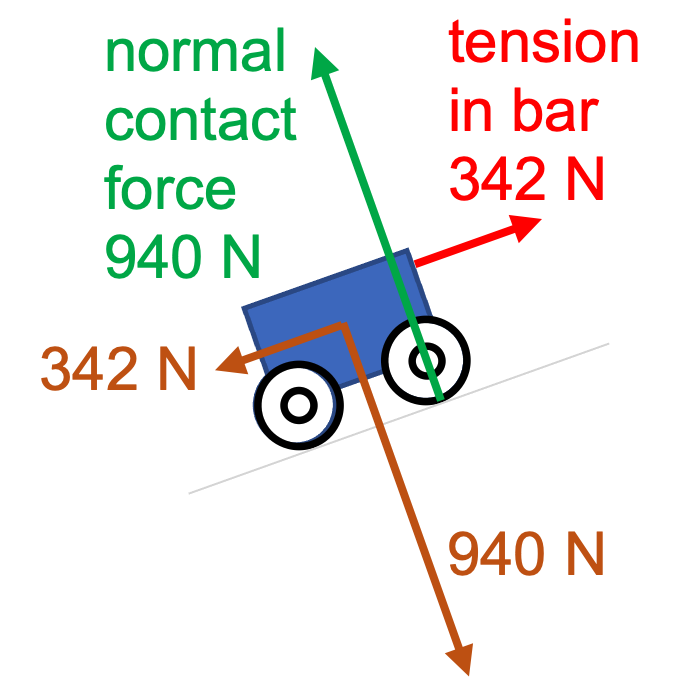 Newton’s first law tell us that the tension must be 342 N and the normal contact force must be 940 N. i.e the net force in each of these directions must be zero.
We could have found the values by drawing a scale force diagram:
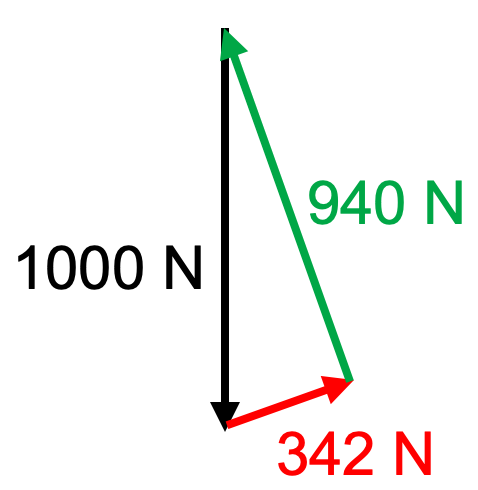
The three forces acting on the cart are thus: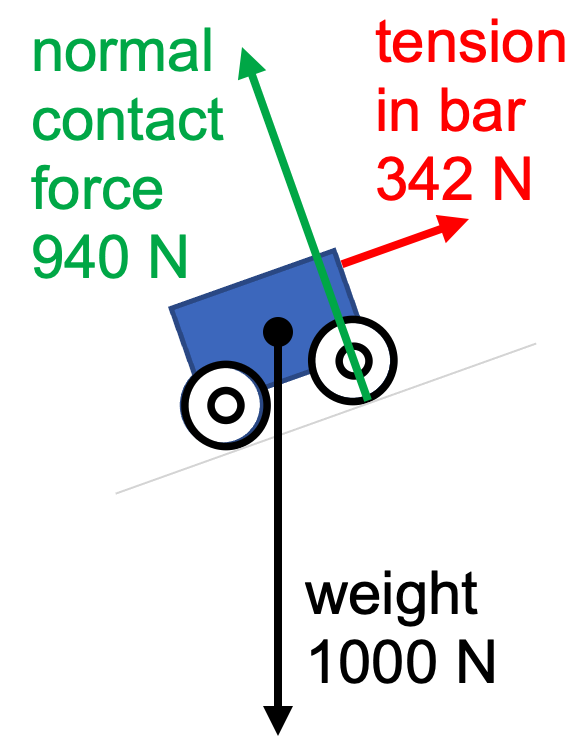
3B) Clearly Label the Forces Acting on the Horse
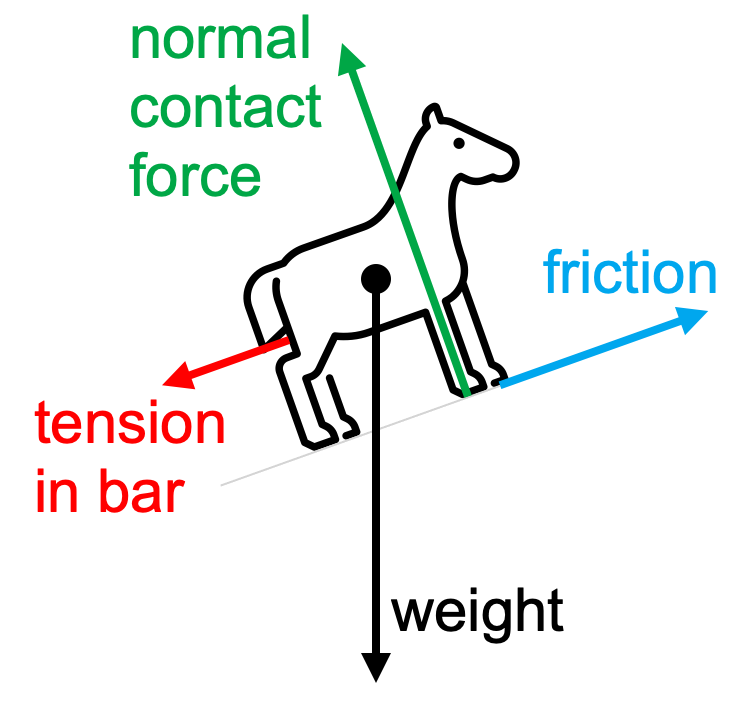
We can easily calculate the weight from the mass of the horse. We know the tension in the bar as it is the same as calculated for the cart (action-reaction pair of tension forces).
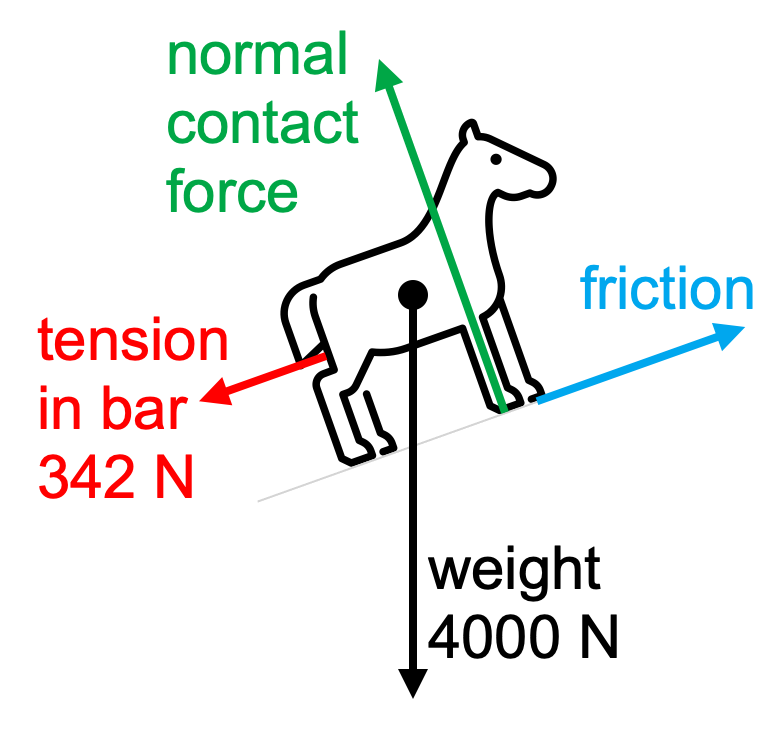 Again, we can simplify the diagram by splitting the weight into components parallel and perpendicular to the slope.
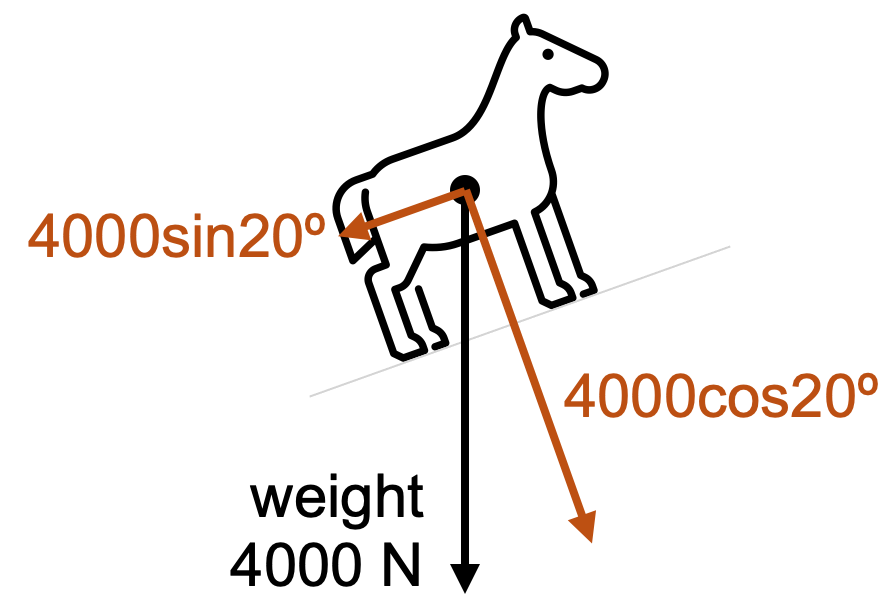
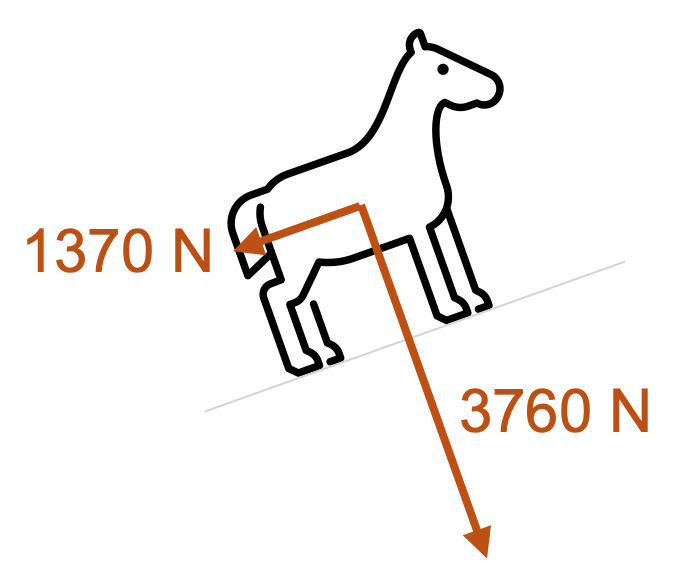
Thus, all the forces can now be shown as:
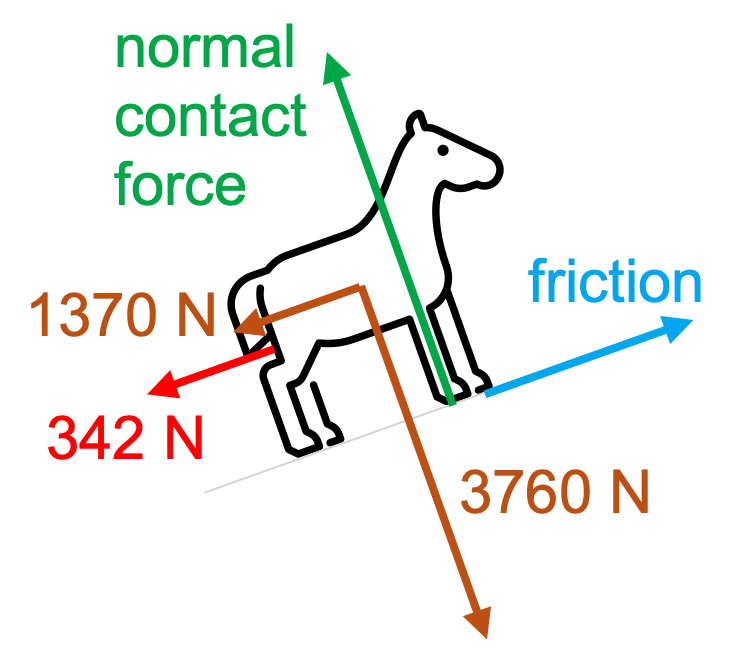 Notice all the forces indicated here are either parallel or perpendicular to the slope.
Applying Newton’s First Law in the direction perpendicular to the slope:
component of weight (3760 N) = normal contact force
Thus, normal contact force = 3760 N.
Applying Newton’s First Law in the direction parallel to the slope:
component of weight (1370 N) + tension (342 N) = friction on horse
Thus, friction on horse = 1370 + 342 = 1710 N (3 s.f.)
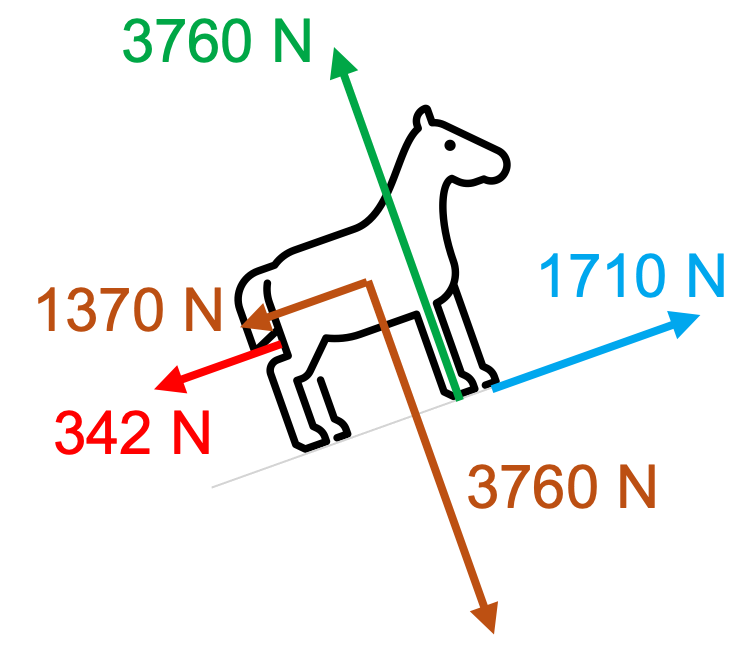
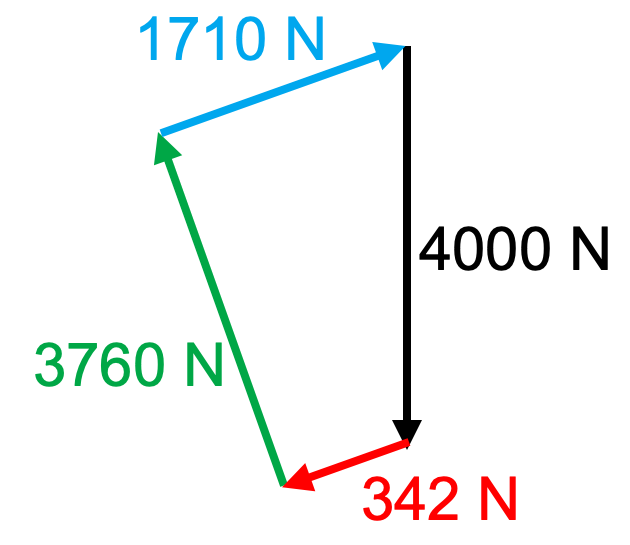
Thus we end up with the (magnitudes of the ) four forces on the horse being:
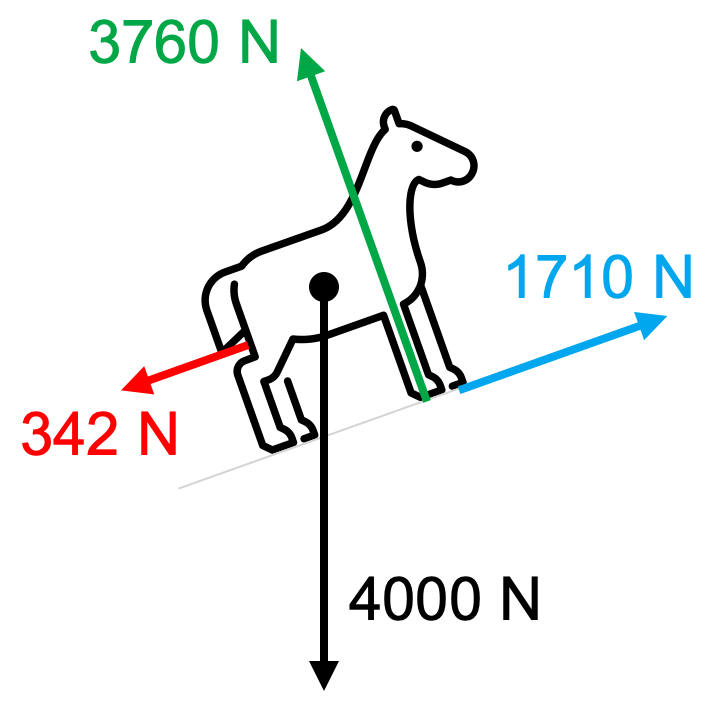
We could have found these values by drawing a scale force diagram like this:
| << Back | Dynamics | Next >> |