Consider two parallel current-carrying wires.
Their cross-sections will look like this:
 Note: These two wires have currents flowing in the same direction but this concept works for all cases.
Each wire will be generating a magnetic field around it due to the current flowing through it. Let’s consider the magnetic field generated by the right wire:
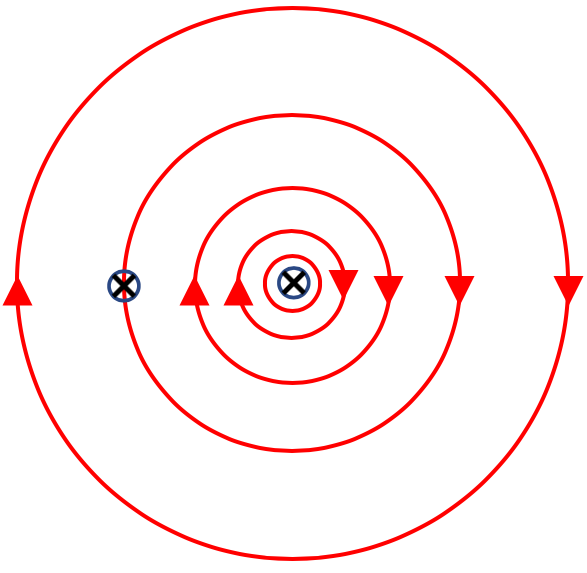
We can see this field passes through the left wire in the direction upwards.
We can thus use Fleming’s Left Hand Rule to determine the direction of the force on the left hand wire.

Of course the left wire itself is also generating a magnetic field that passes thought the right wire like this:
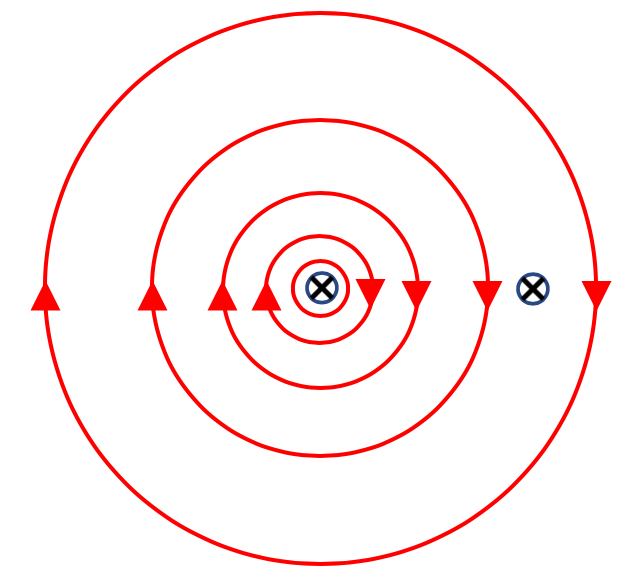

This could also be arrived at from Newton’s 3rd Law as the forces are an action-reaction pair.
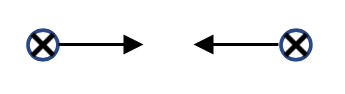
So the two wires will experience forces like this:
In a similar manner we can easily show the following relationships:
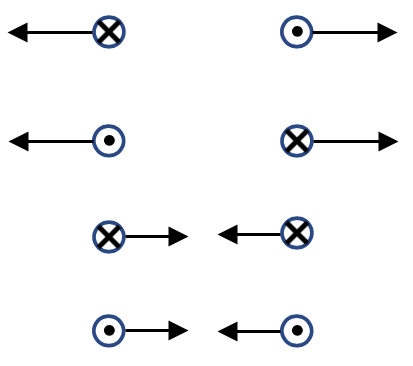
This can be simply remembered as wires with current in the same direction (like currents) will attract; wires with current in opposite direction (unlike currents) will repel.
Note we could have analysed this problem by considering the resultant magnetic field around the parallel wires.
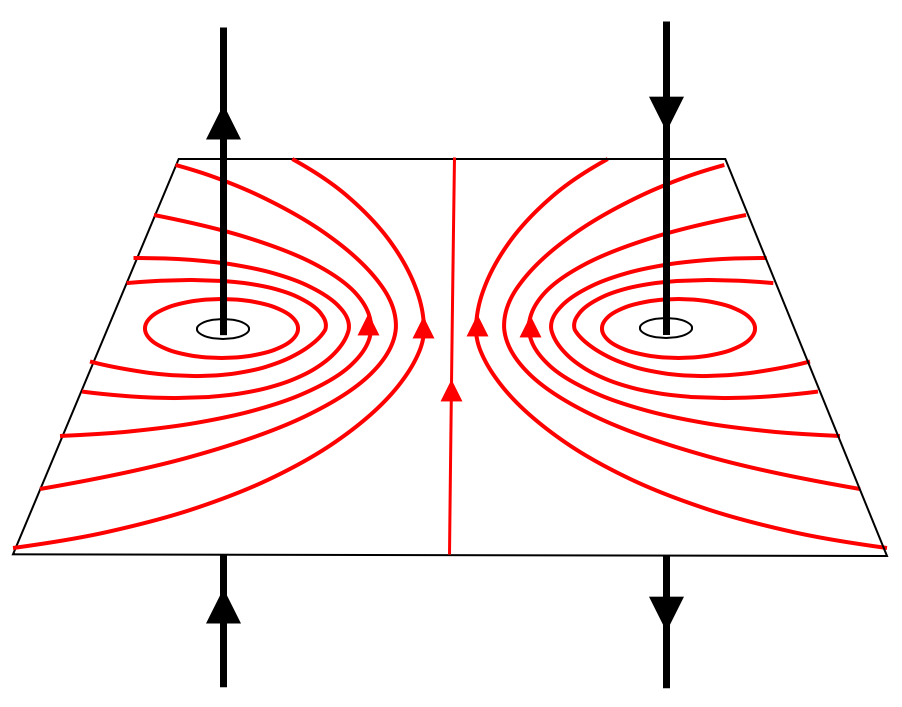
In this case the magnetic field between two wires, with currents in opposite directions, shows a greater field strength (higher concentration of lines) in the region between the two wires, resulting in the wires being pushed away from each other.
| << Back | Electromagnetism | Next >> |