A current is simply charges (electrons) moving through a wire. So it shouldn’t be surprising that a charged particle moving through a magnetic field will experience a force. The force on the moving charged particle can be determined using Fleming’s left hand rule.
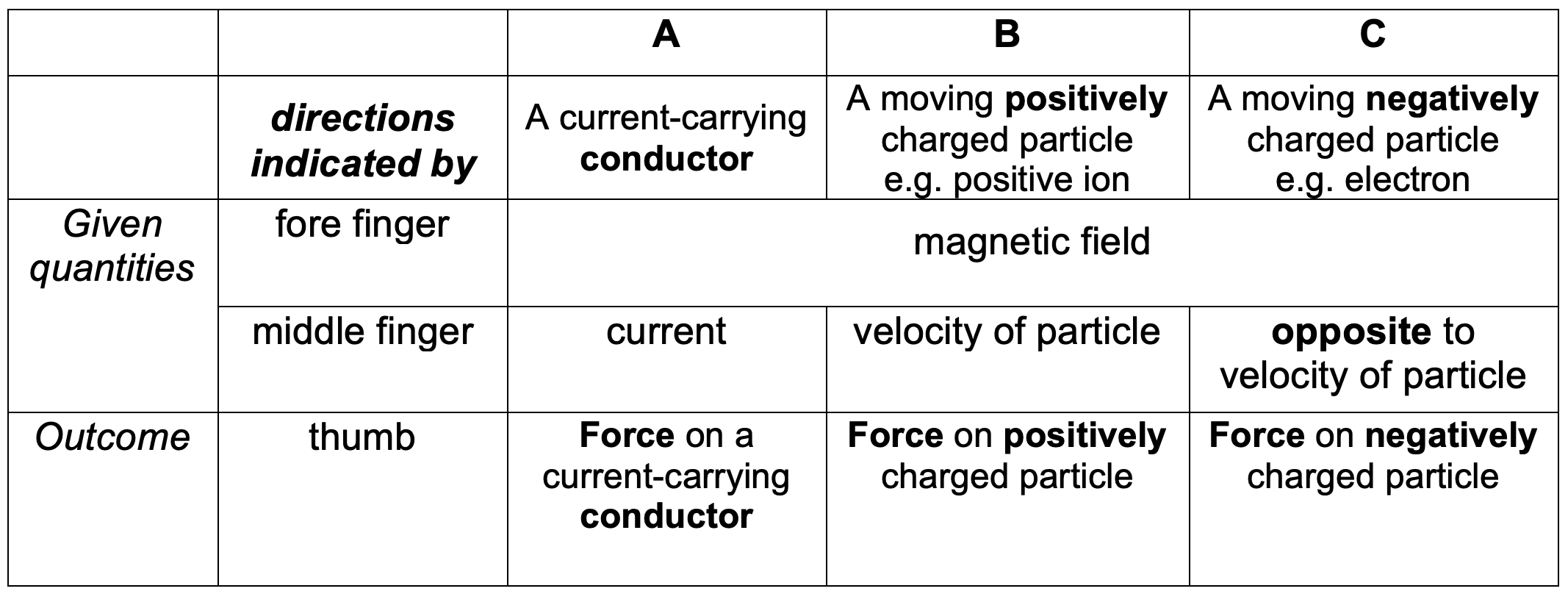
Since the rule is defined using the direction of conventional current (A), the direction given is the same as that for the movement of a positive charge (B). When considering moving negative charges (C) we take the direction of the current to be opposite to that in which the electron flows, thus middle finger must point in the opposite direction to the direction in which the negative charge is moving.
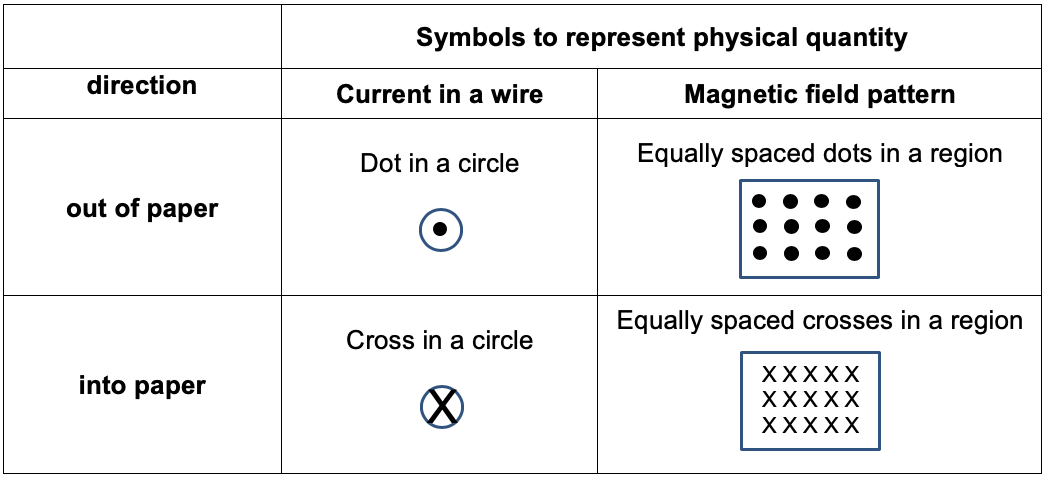
We will continue to use the dot & cross to show things going into/out of the plane of the screen/your paper. As well as current in wires, we will see this in some questions as the direction of magnetic field lines.
As a beam of positively or negatively charged particles enters a magnetic field, the charged particle inside the magnetic field will experience a force acting on it and this force will always be perpendicular to the direction of its motion. Hence, its path in the magnetic field is an arc of a circle.
| Example |
|---|
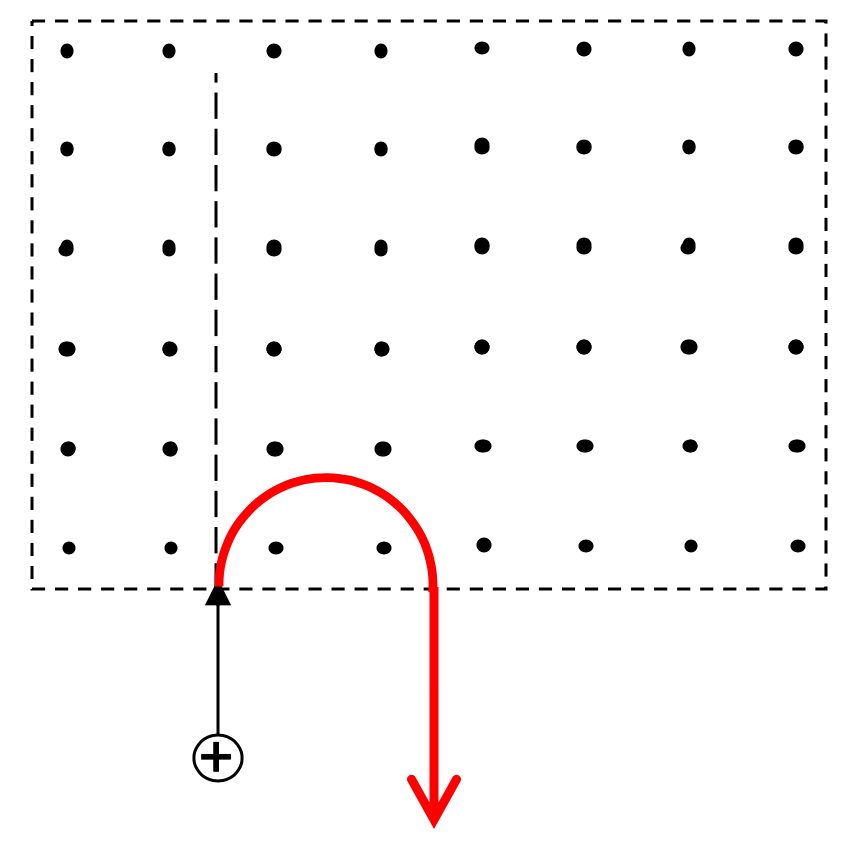
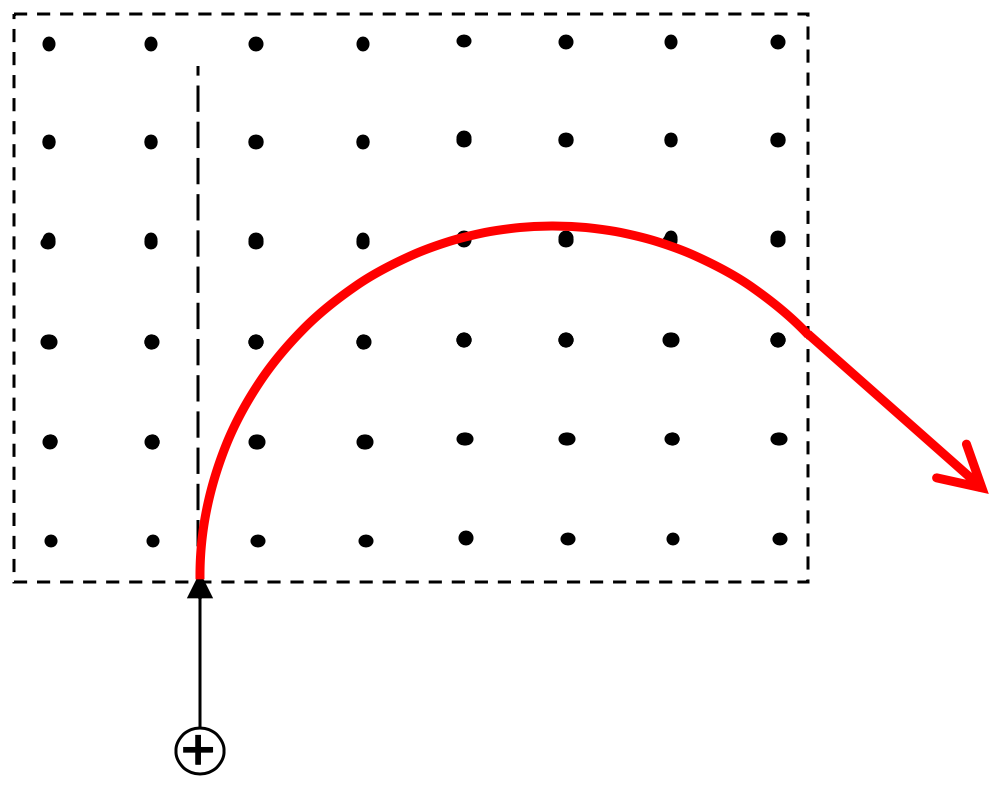
A positive charge enters a region of uniform magnetic field with the field coming out of the screen.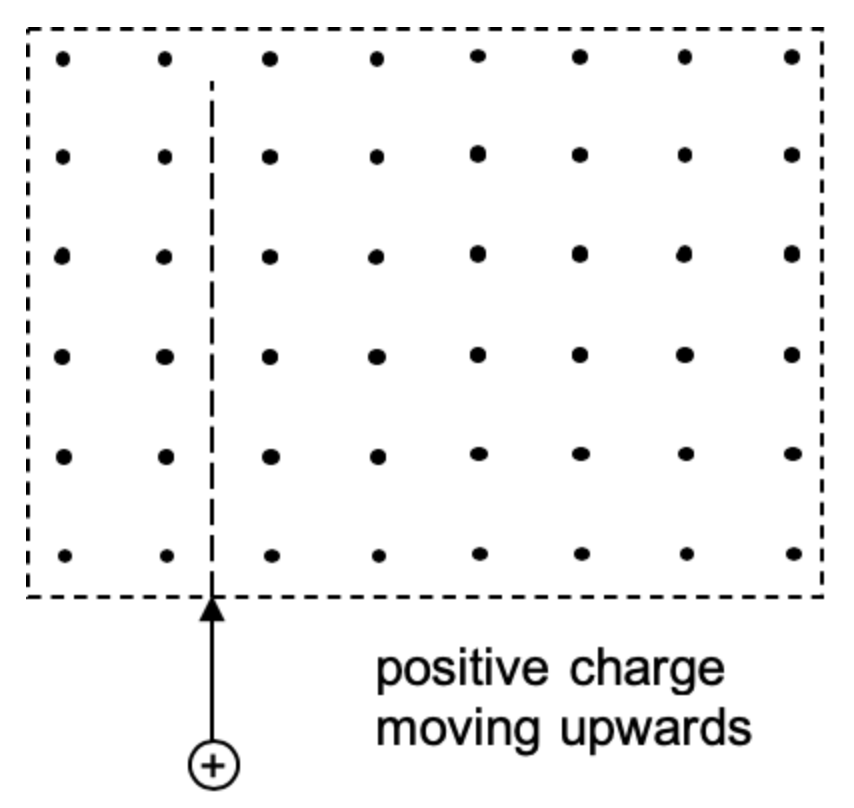
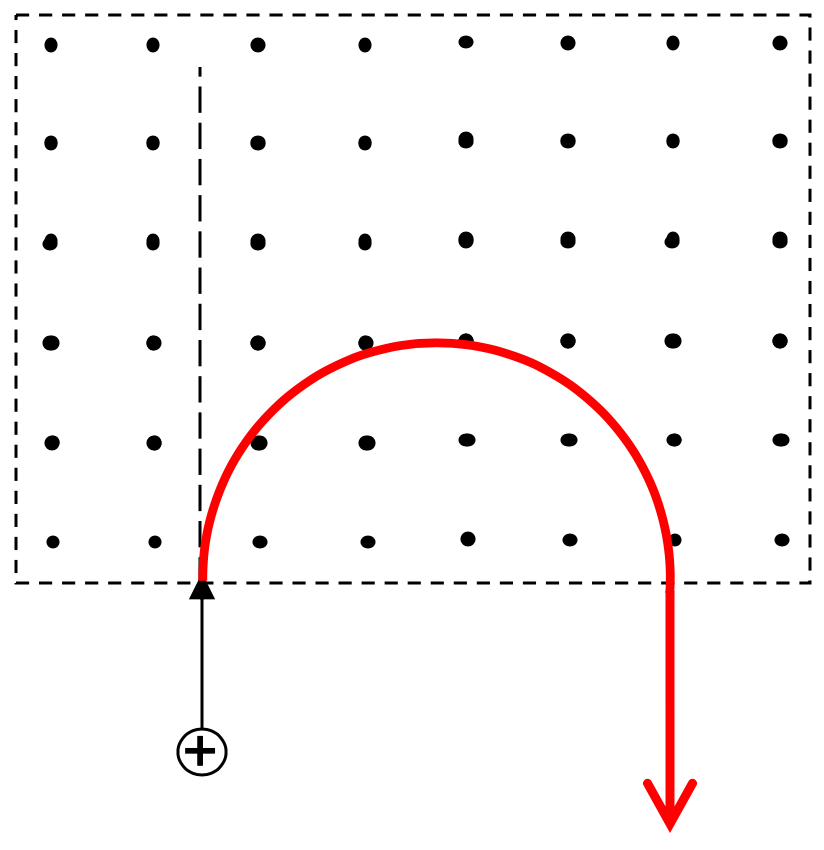
Complete the diagram to show the path of the charged particle as it moves through the magnetic field.
However, as the curvature is not fixed (i.e we don’t know the magnitude of the charge or the strength of the magnetic field) we could have drawn the circle with different diameters. Thus the following would also be correct answers to this question:
Note, that in all cases, as soon as the charged particle leaves the region of magnetic field it will move in a straight line (constant velocity). This is a result of Newton’s First Law. |
| Example |
|---|
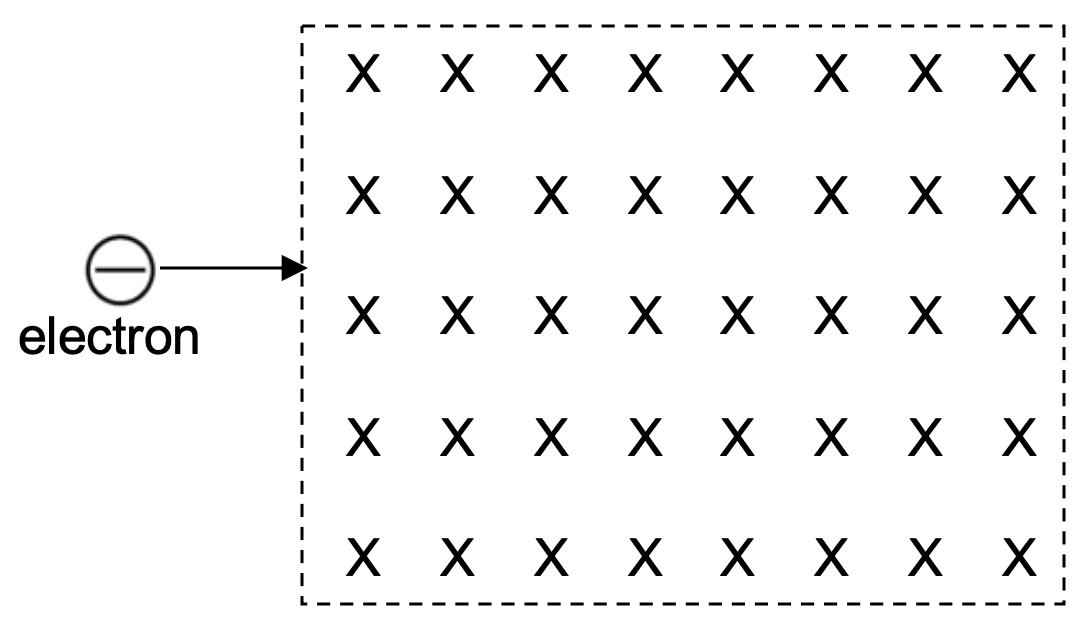
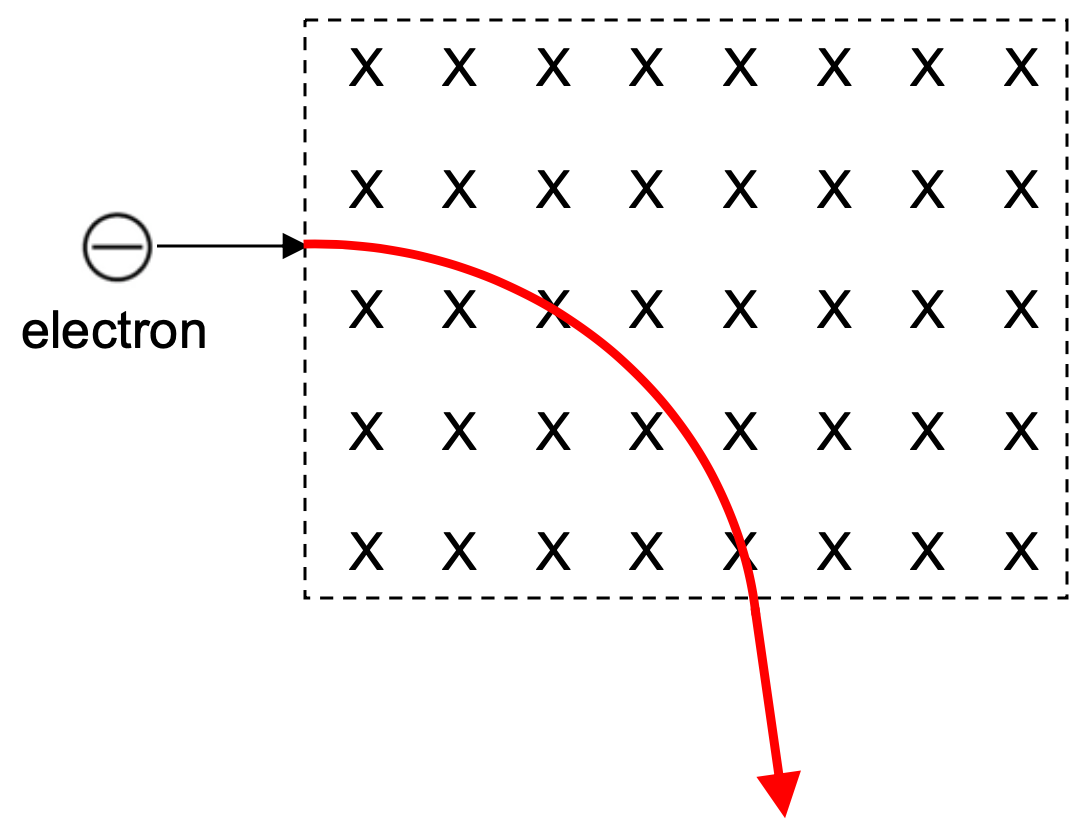
| The diagram shows an electron moving into a region of uniform magnetic field. Draw the path of the electron in the magnetic field.
|
| << Back | Electromagnetism | Next >> |