[Advanced Physics Topic]
Force on Current Carrying Conductors in Magnetic Fields
When a current carrying conductor is placed in a magnetic field, it experiences a force. The direction of the force can be determined using Fleming’s Left Hand Rule if the directions of the current and magnetic field are known. 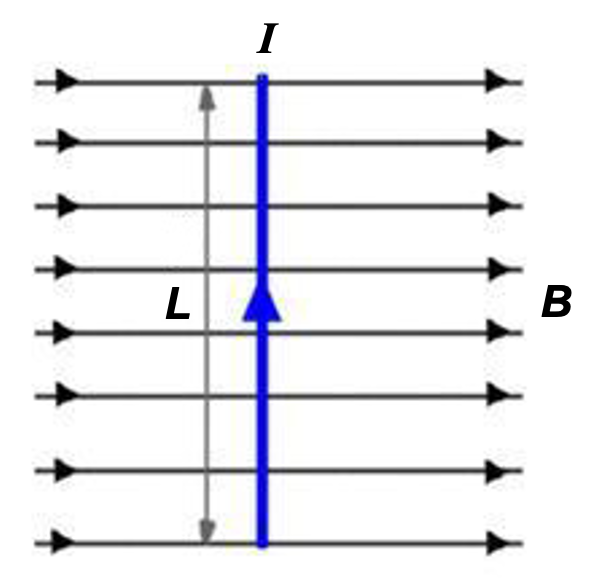
The magnitude of the force for a current carrying conductor that is perpendicular to the direction of the magnetic field can be calculated by:
|
F = BIL where: F: force acting on a conductor of length L (N) |
| Note |
|---|
| You may also come across the equation :
F = BIL sinθ Where θ is the angle the current makes with the magnetic field. We will not be using this equation as we will only be considering the situation where the current runs perpendicular to the magnetic field. |
| Example |
|---|
|
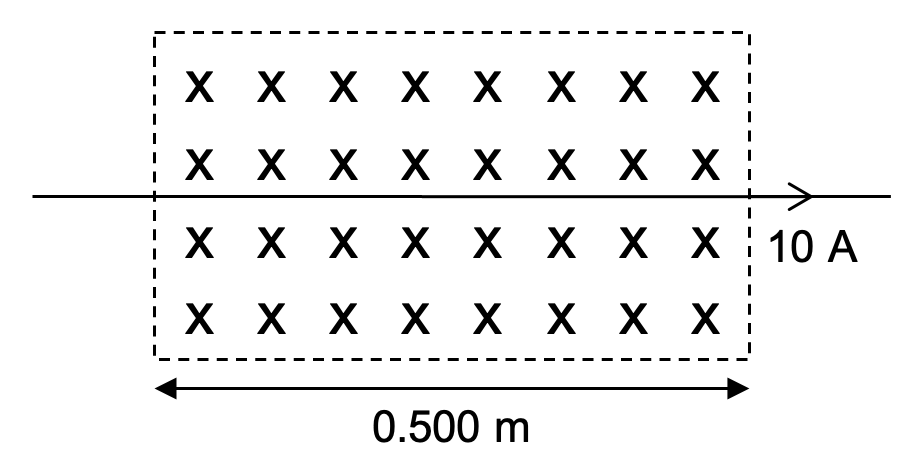
A 0.500 m wire carrying a 10 A current is placed in a magnetic field of 2.0 T. State the direction of the force acting on the wire and determine its magnitude.
|
Force on Moving Charges in Magnetic Fields
As current essentially consists of moving charges, it can be deduced that a moving charged particle must experience a magnetic force.
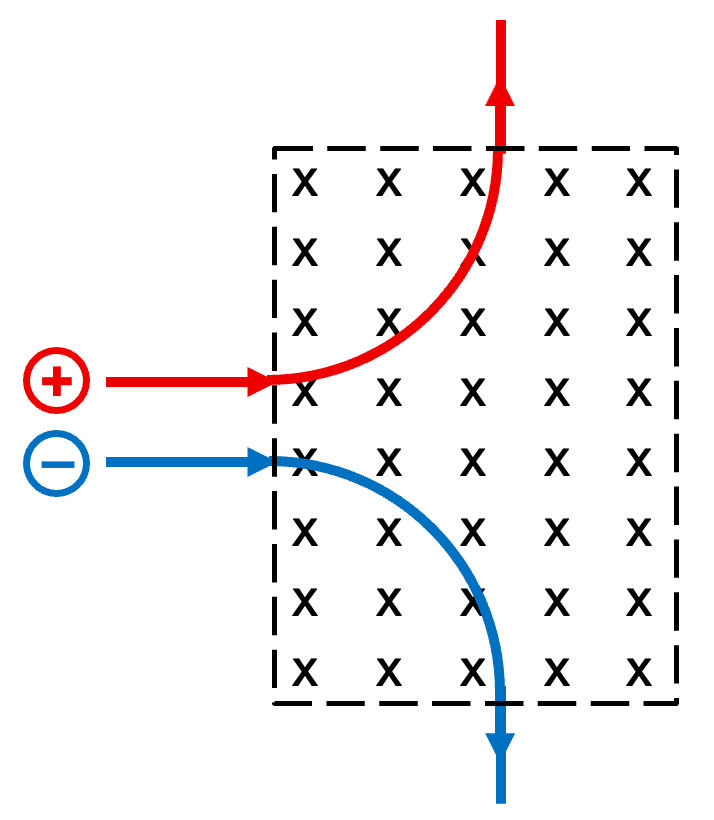
Consider a charged particle travelling at constant speed, perpendicular to the direction of a magnetic field. The magnetic force experienced by the charged particle is given by:
|
F = Bqv Where: F: force acting on the charged particle (N) |
| It can easily be shown that F=Bqv can be derived from F=BIL.
F = BIL |
Motion of Charged Particles in Uniform Magnetic Field
When charged particles enter a uniform magnetic field, they experience a magnetic force that will be perpendicular to the direction of the magnetic field and perpendicular to the direction of motion.
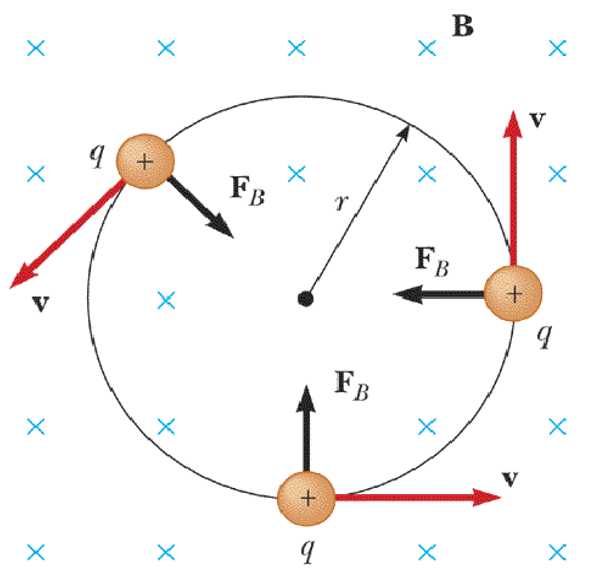
Therefore, the charged particles will move along the arc of a circle.
| Example |
|---|
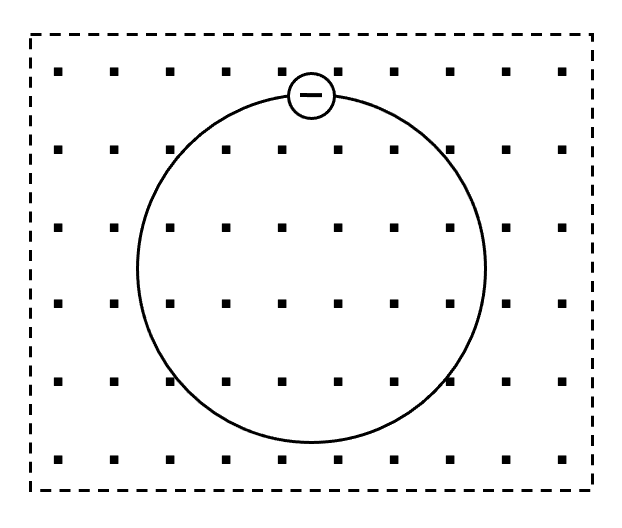
| An electron moves in a circular path in vacuum under the influence of a magnetic field.
The radius of the path is 0.010 m and the magnetic flux density is 0.020 T. Given that the mass of the electron is 9.11 × 10⁻³¹ kg and the charge on the electron is −1.6 × 10⁻¹⁹ C. (a) Determine if the motion of the electron is clockwise or anticlockwise.
(b) Determine the velocity of the electron. |
Velocity Selectors
Uniform electric and magnetic fields could be set up perpendicular to each other such that they produce deflections in opposite directions. The idea is used in a velocity selector, which is an instrument that selects and emits a stream of charged particles of a specific velocity.
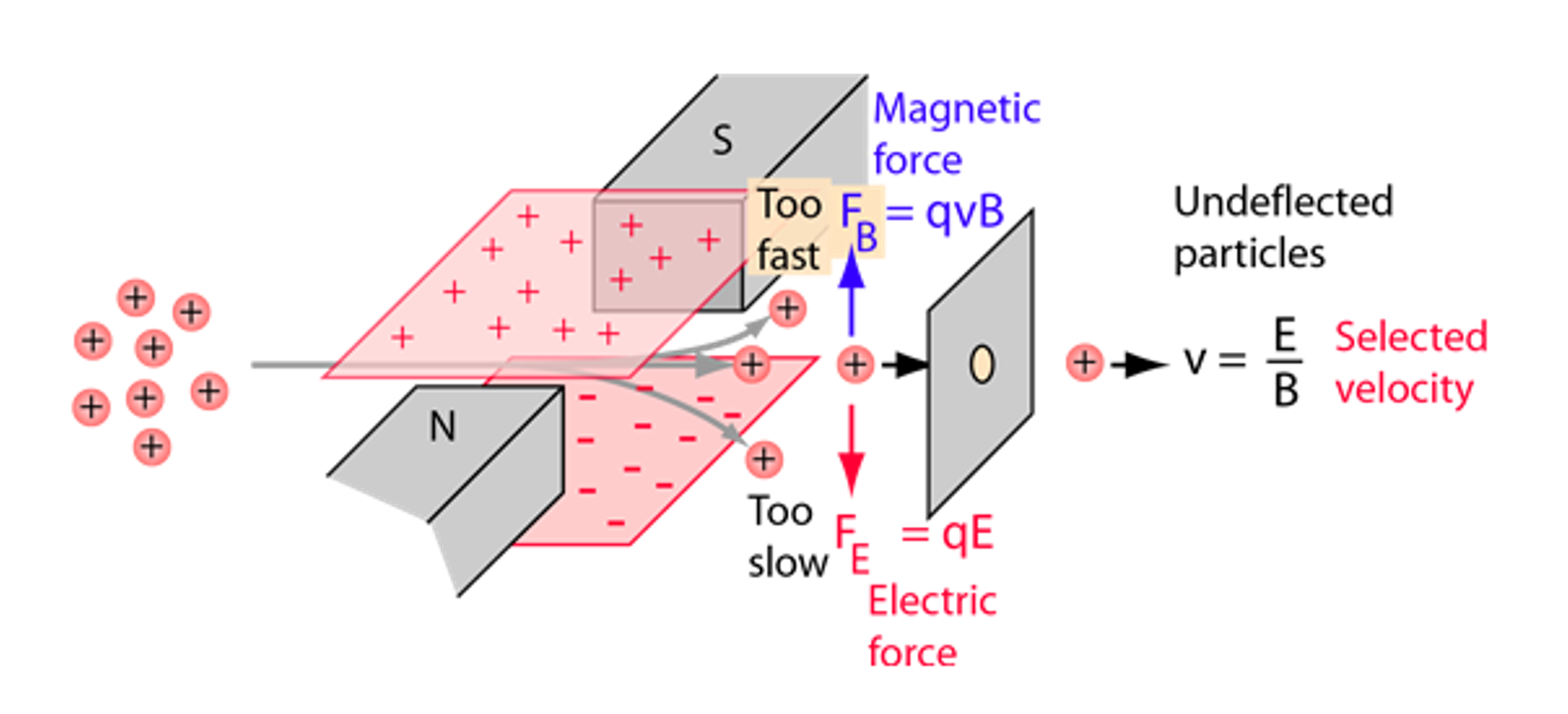
In the diagram above, a beam of positively charged particles with a range of velocities are made to pass through a region of electric field and magnetic field applied perpendicular to each other. In the region, the positively charged particles experience an upward magnetic force and a downward electric force.
For the particles to pass through undeflected, the electric force and magnetic force must be equal in magnitude:
FB = FE
qvB = qE
v = E/B
Therefore, particles which emerge undeflected will have the same speed, determined by the ratio above. Charged particles of a particular desired speed can be “selected” and emitted by adjusting the ratio.
| Example |
|---|
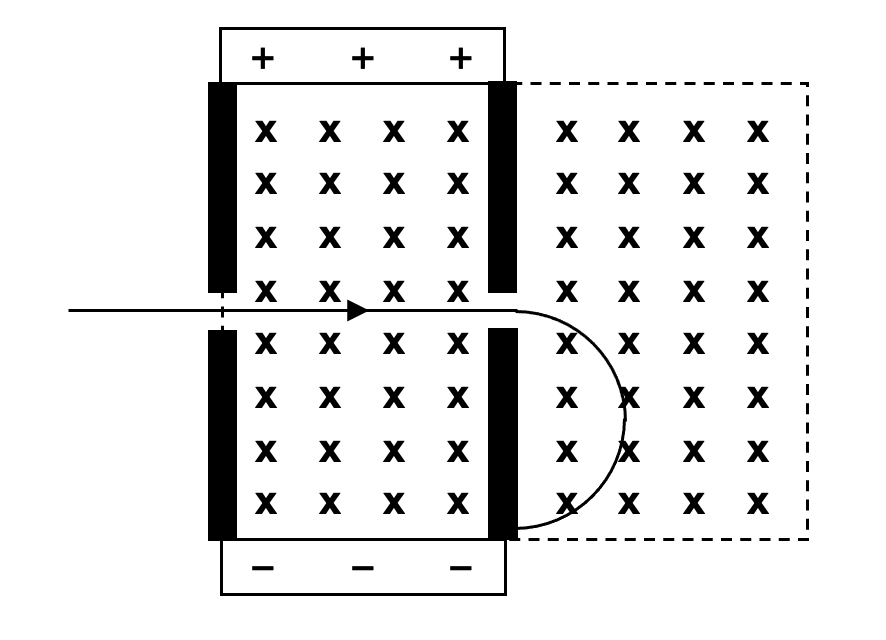
| After passing through a velocity selector as shown in the diagram below, a beam of electrons move in a circular path of radius 5.0 cm.
Given that the electric field strength is 40 N C−1, the mass of the electron is 9.11 × 10⁻³¹ kg and its charge is −1.6 × 10⁻¹⁹ C, determine the magnetic flux density that is applied. |
| Electromagnetism |