An a.c. generator is a device that uses the principle of electromagnetic induction to transform mechanical energy into electrical energy.
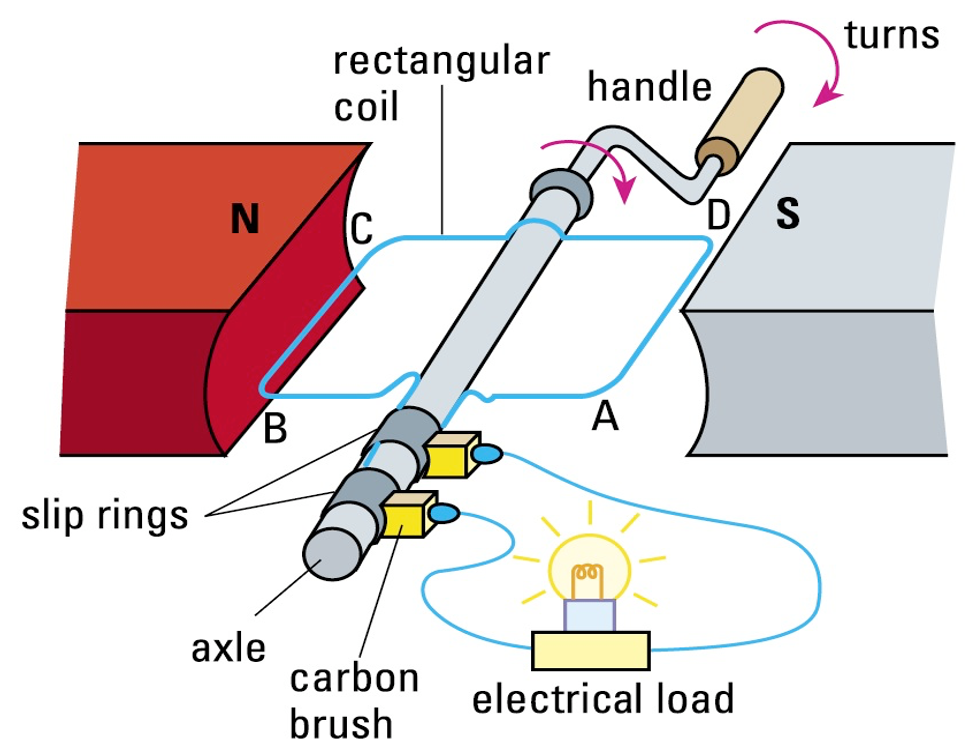
The slip rings allow the coil to be turned continuously in the same direction without the wires getting tangled.
The carbon brushes maintain electrical contact between the coil and the external circuit, while providing a low resistance surface that enables the coil to turn easily.
When the coil is rotating, it cuts the magnetic field lines between the magnetic poles. The rate of cutting of magnetic field lines decreases from a maximum (when the coil is horizontal) to a minimum (when the coil is vertical) and the cycle repeats. By Faraday’s Law, a varying e.m.f is induced in the coil.
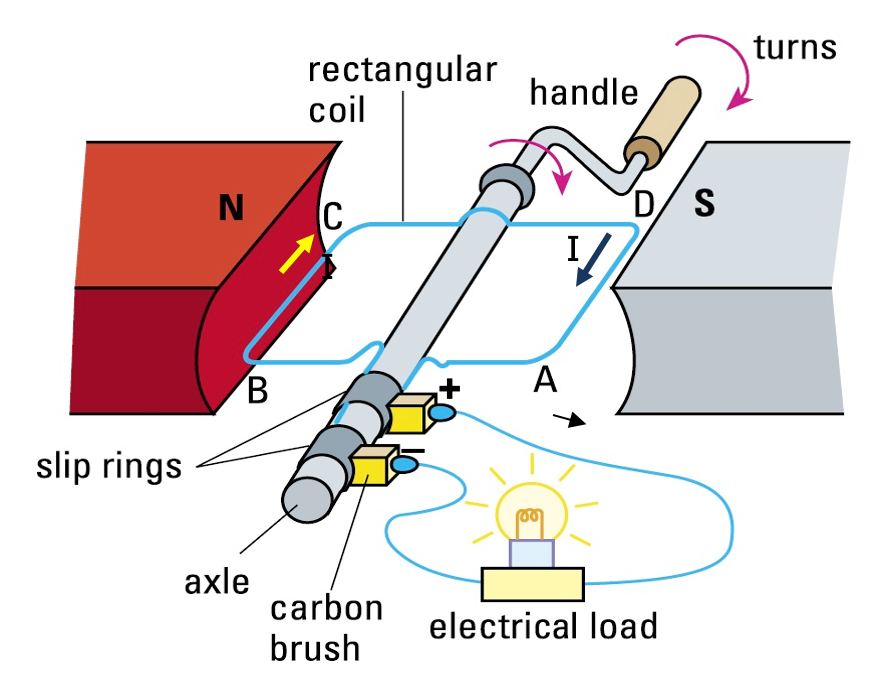
The current can be determined to flow in the direction as shown above, meaning that the current flows from the terminal nearest the coil, around the circuit (through the light bulb) and back into the terminal at the end of the axle. Thus the polarity of the terminals (carbon brushes) is as shown on the above diagram.
Consider a coil in a uniform magnetic field that is being rotated clockwise.
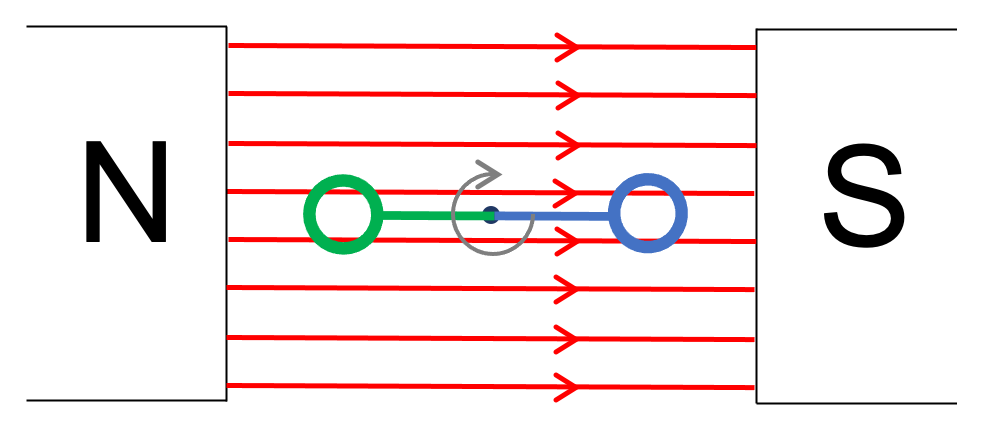
Start Position:
Initially, the coil is in the position show (parallel to the magnetic field) and the directions that each wire is instantaneously moving in is indicated by the blue arrows.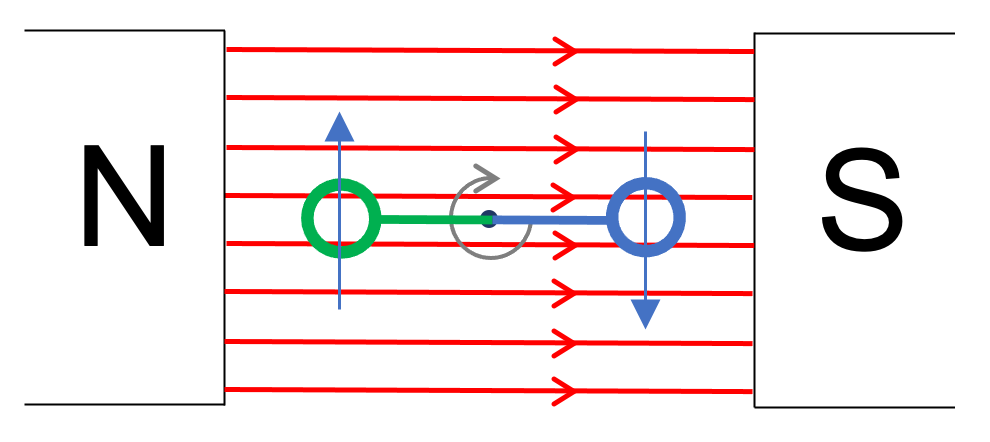
Each moving side of the coil is cutting through the field lines at the fastest rate. They will thus produce the greatest emf at this instant.
Direction of induced current (by application of Fleming’s Right Hand Rule):
Green Wire: Into the screen
Blue Wire: Out of the screen
¼ Turn Later:
The coil continues to be rotated in the same direction and is now in a vertical position (perpendicular to the magnetic field).
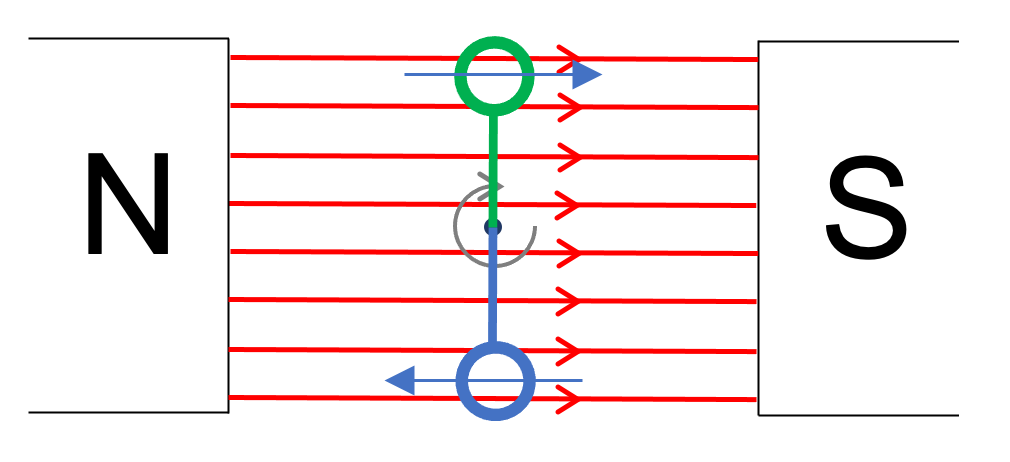
Each moving side of the coil is now not cutting through any field lines as they are moving along parallel to the field lines. They will thus not produce any emf at this instant.
Direction of induced current:
Green Wire: Nil
Blue Wire: Nil
½ Turn Later:
The coil continues to be rotated in the same direction and is now in a horizontal position (parallel to the magnetic field).
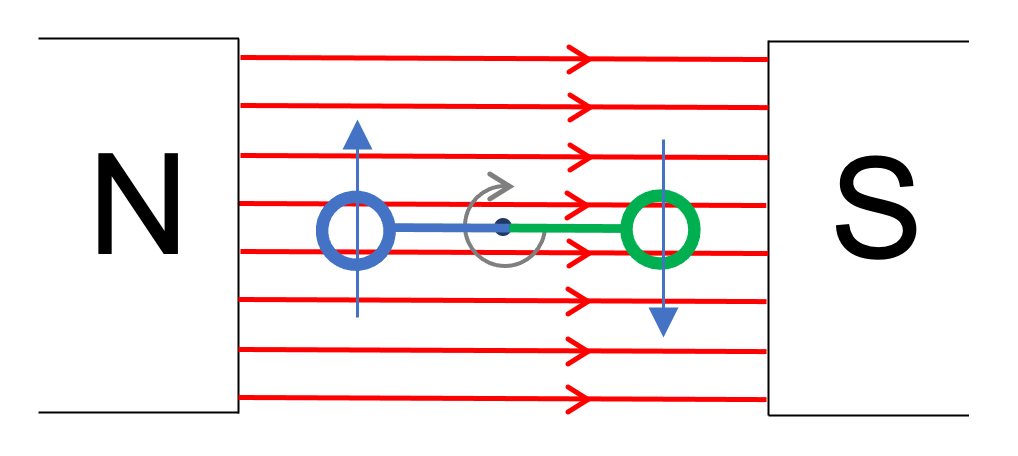
Each moving side of the coil is again cutting through the field lines at the fastest rate. They will thus produce the greatest emf at this instant. However, the direction of motion of each side has reversed and so the induced emf (and hence current) in each side of the coil has swapped over.
Direction of induced current:
Green Wire: Out of the screen
Blue Wire: Into the screen
¾ Turn Later:
The coil continues to be rotated in the same direction and is now once agin in a vertical position (perpendicular to the magnetic field).
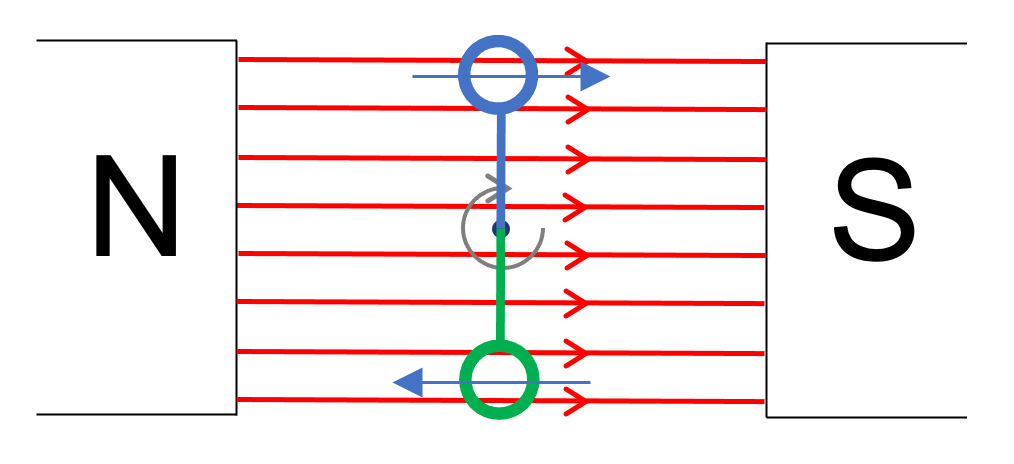
Each moving side of the coil is now not cutting through any field lines as they are moving along parallel to the field lines. They will thus not produce any emf at this instant.
Direction of induced current:
Green Wire: Nil
Blue Wire: Nil
Summarising the above we would obtain the following:
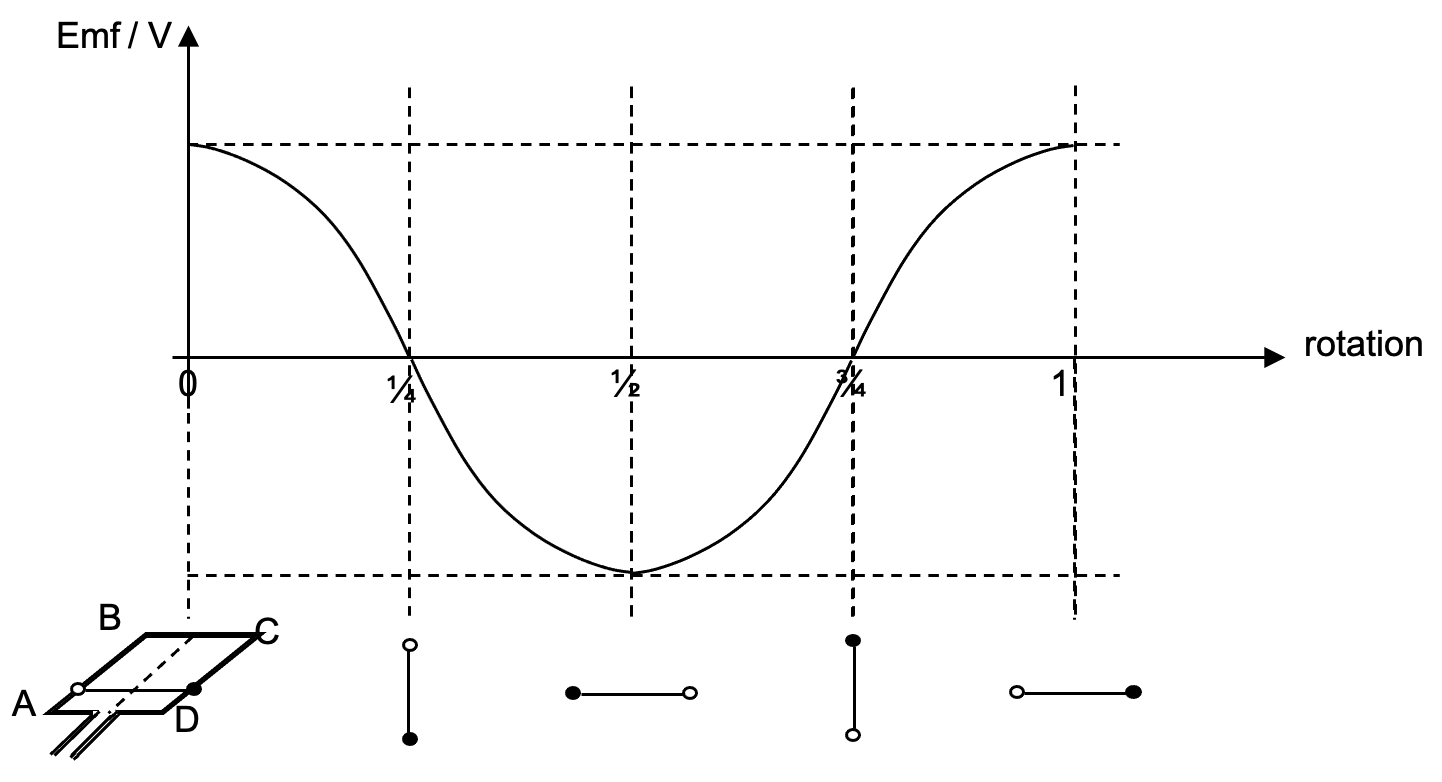
Thus we can see that the output (emf) from this coil is not only changing direction every half revolution, but is also showing a constantly changing magnitude of emf. This is typical of alternating current (A.C.) electricity.
What would happen if we had had
| Example |
|---|
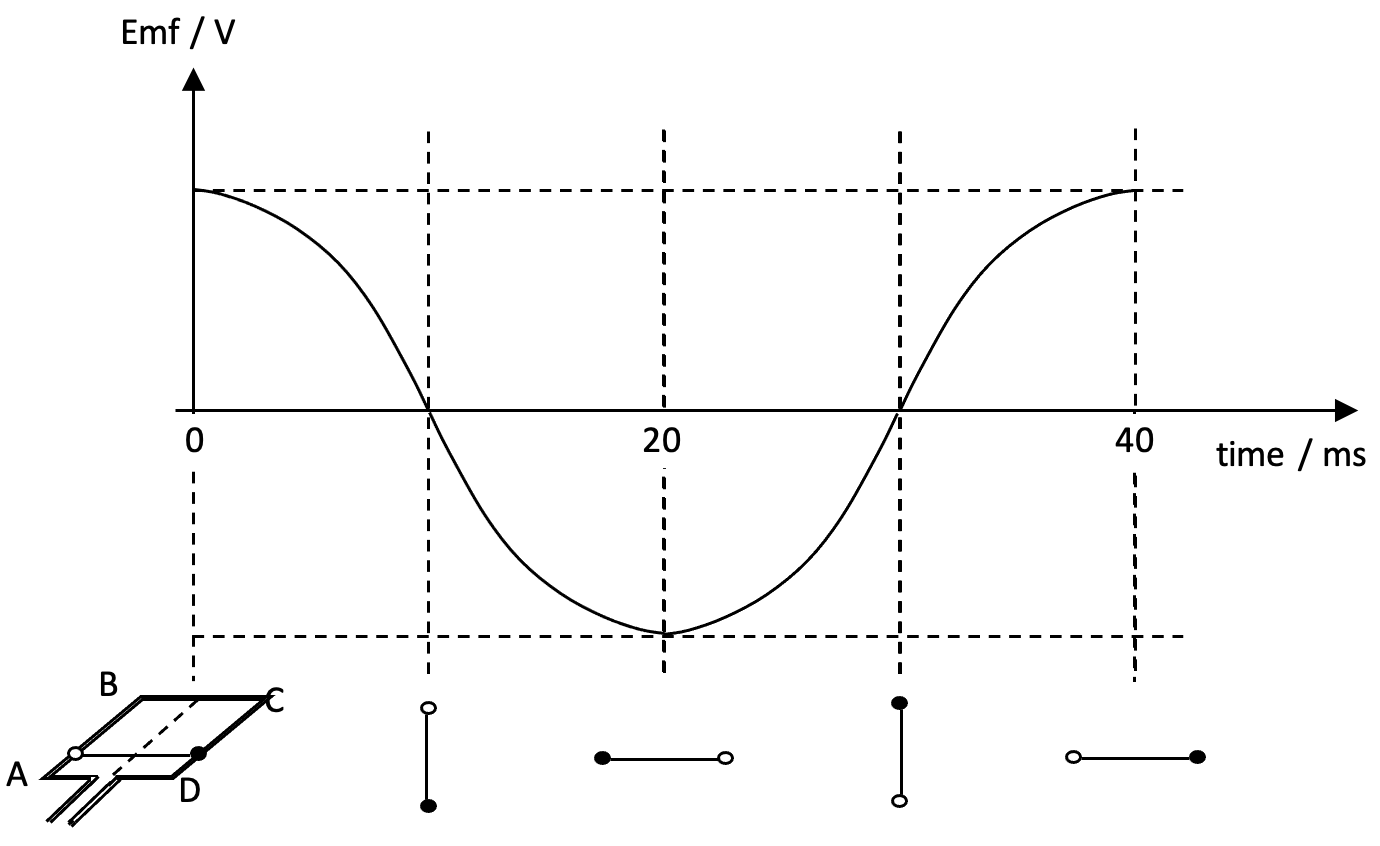
| The following shows the output emf of an A.C.generator which completes one rotation in 40 ms.
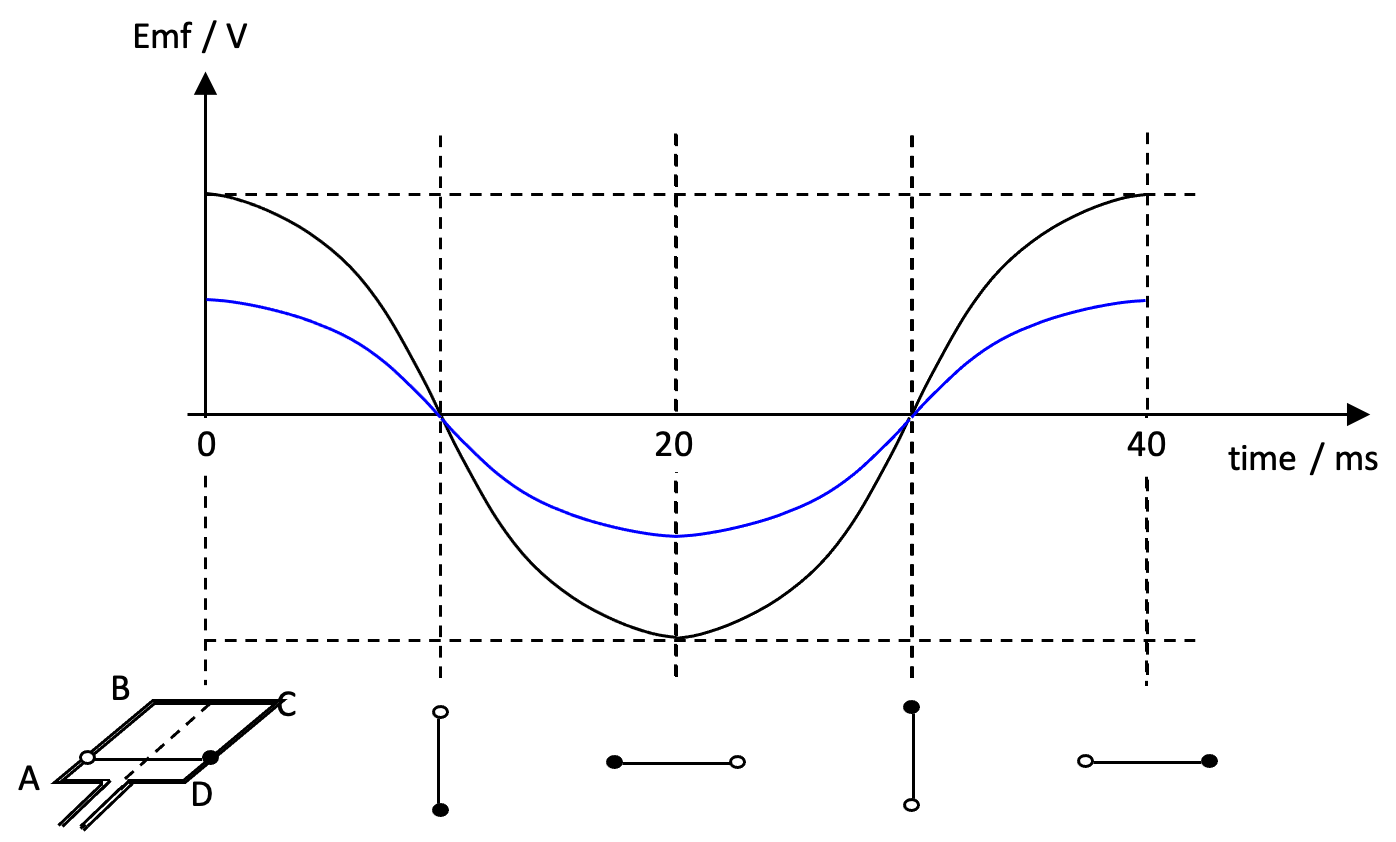
(a) What would the output look like if the number of windings in the coil was halved?
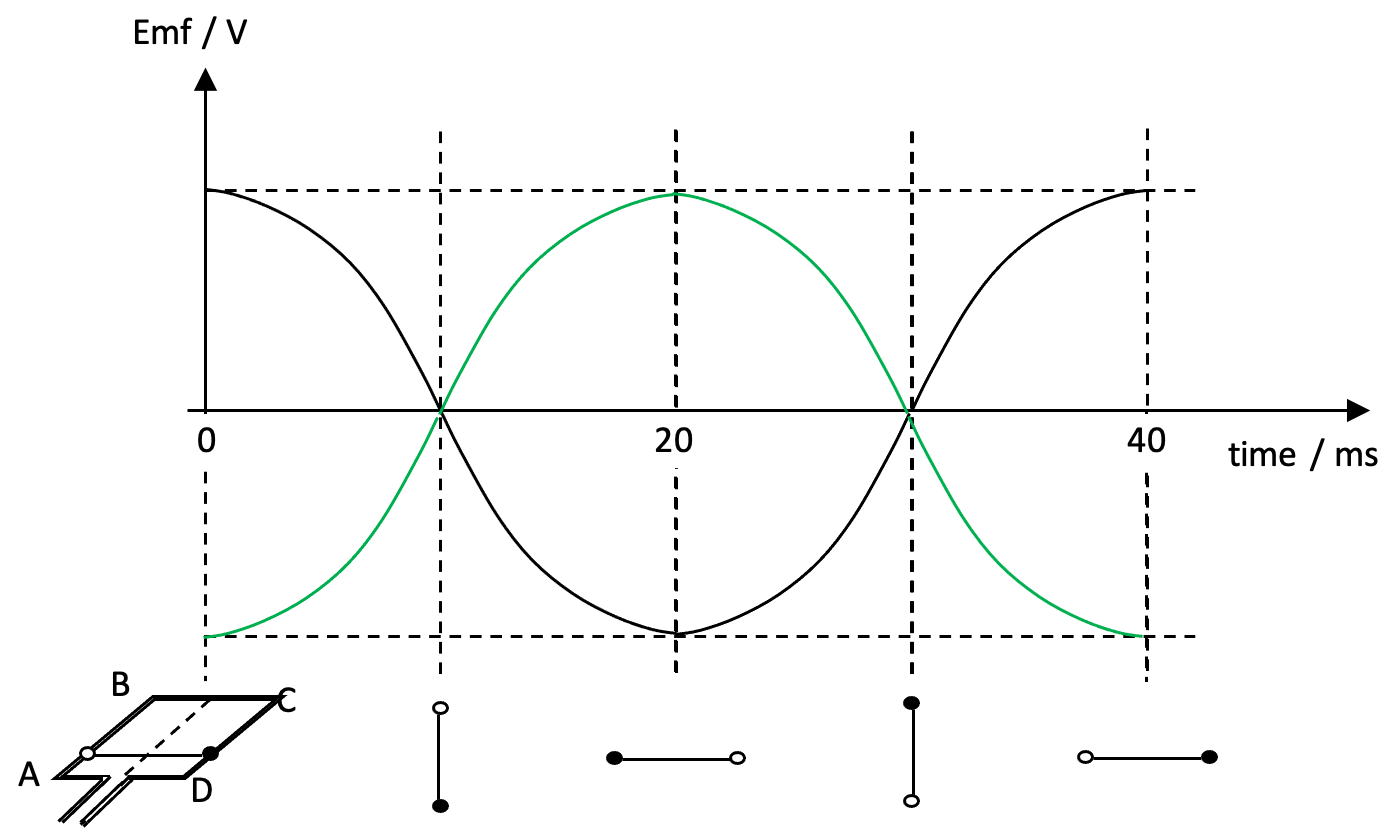
The frequency remains constant, but with half the number of windings there would be half the total rate of cutting field lines taking place which would result in half the maximum emf output being generated. (b) What would the output look like if the carbon brushes were reversed?
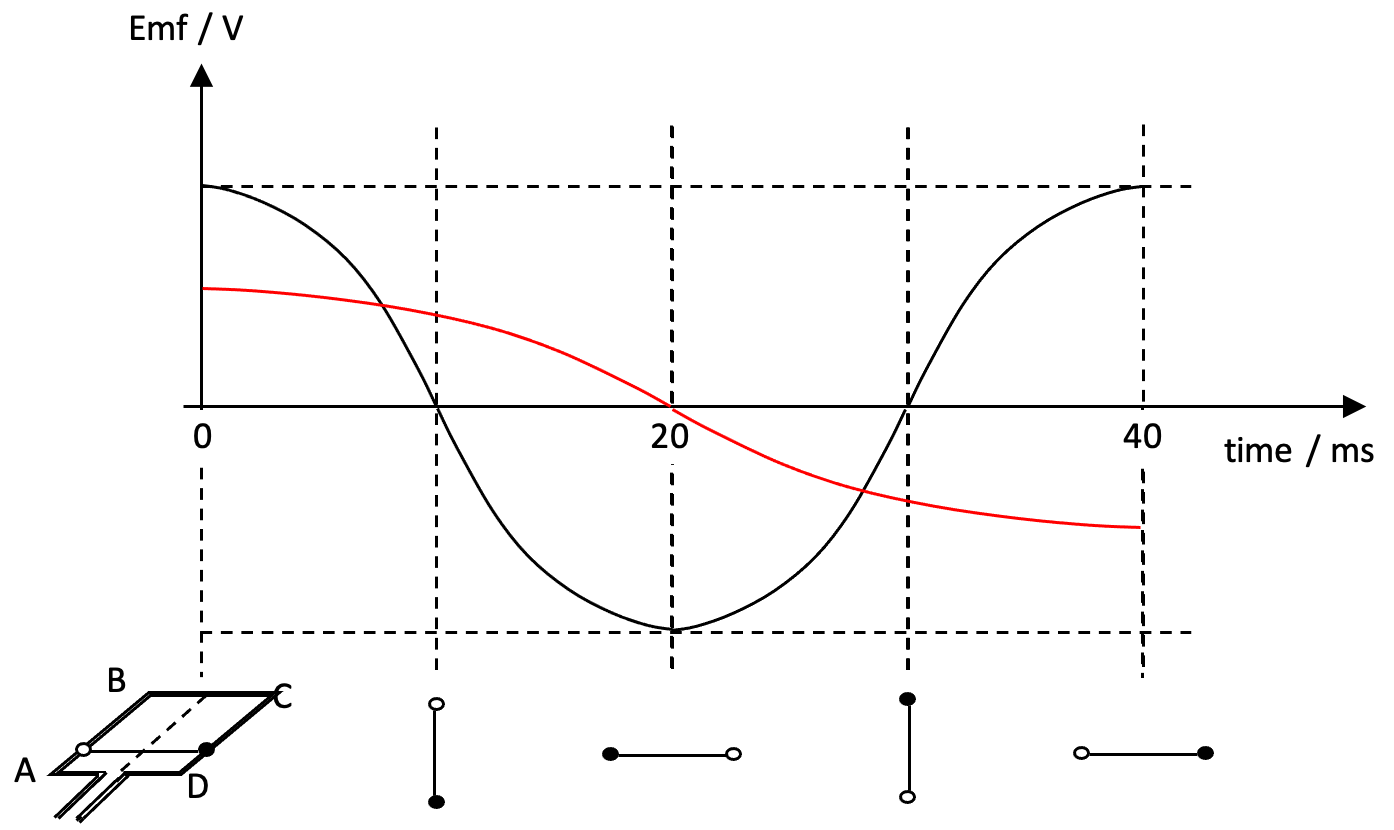
The shape would be identical, but flipped over. (c) What would the output look like if the coil were rotated at half the frequency?
Rotating at half the frequency means that the period would be doubled – i.e. one complete revolution will now take 80 ms. Additionally, as the coil is now moving at half the speed, field lines will get cut at half the rate and so the maximum emf will be half of the original value. |
| << Back | Electromagnetic Induction | Next >> |