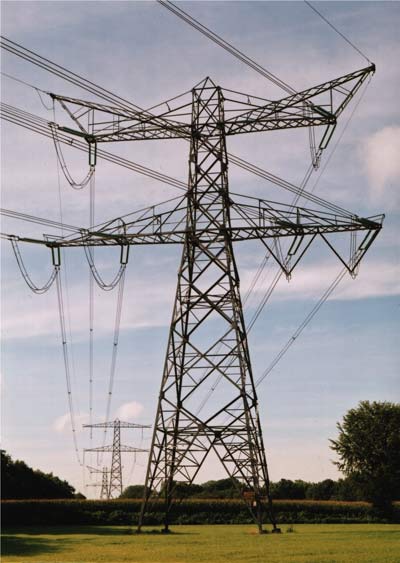
Power Pylons such as shown above can be seen in many countries across the World carrying electricity from the power stations to the consumers. The cost of such pylons can be significantly cheaper than burrying the cables underground. However, they can spoil the look of the countryside.
They do not carry power at 240 V but at a much higher potential. The reason for this is shown below.
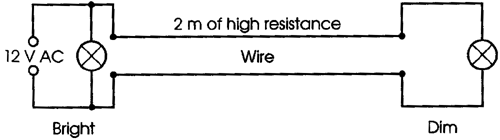
Although the 2 bulbs are in parallel (and ideally they would be equally bright) the far one will be dimmer due to losses in the wires.
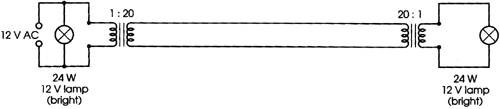
Although the distance of the second bulb is now similar to the first diagram the losses in the wires are reduced by use of a transformers to ensure that the voltage is high (and the current is low) for the long stretch of wire.
| Example 19.8 |
|---|
| The alternating voltage chosen for the transmission of electrical power over a large distance is many times greater than the voltage of the domestic supply.
(a) State two reasons why electrical power is transmitted at high voltage.
(b) State two advantages of using alternating voltages. |
| Example 19.9 |
|---|
|
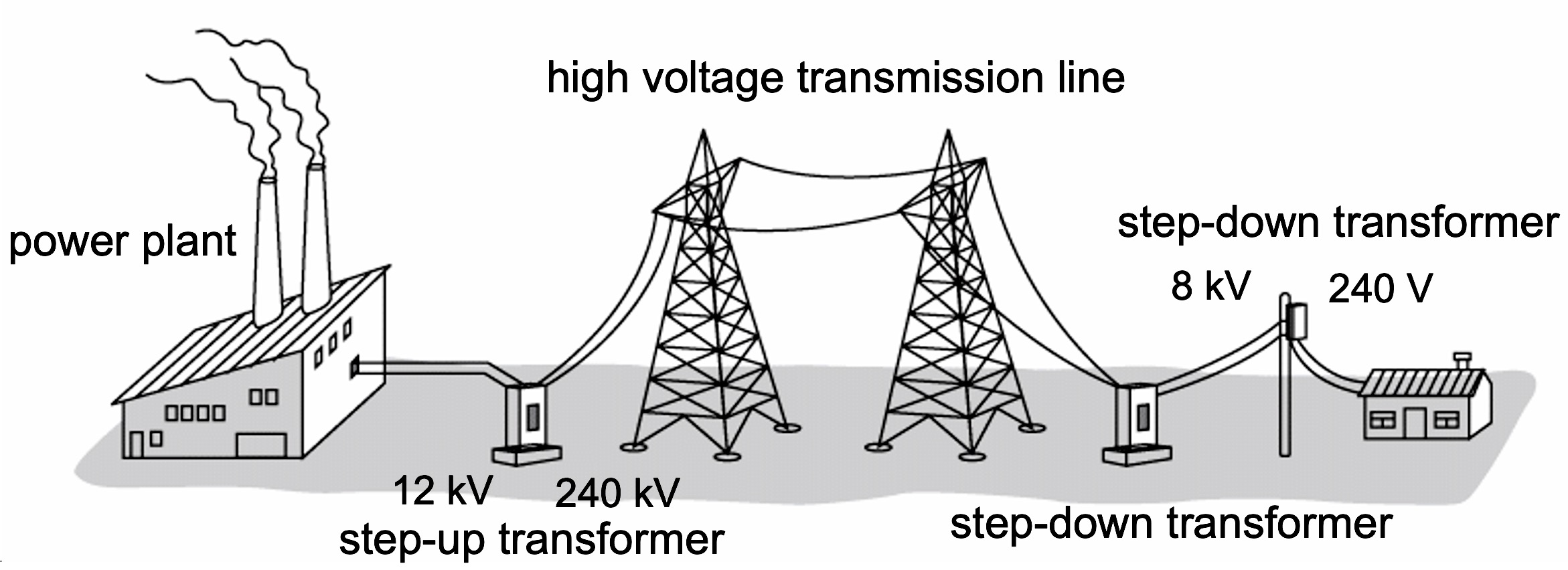
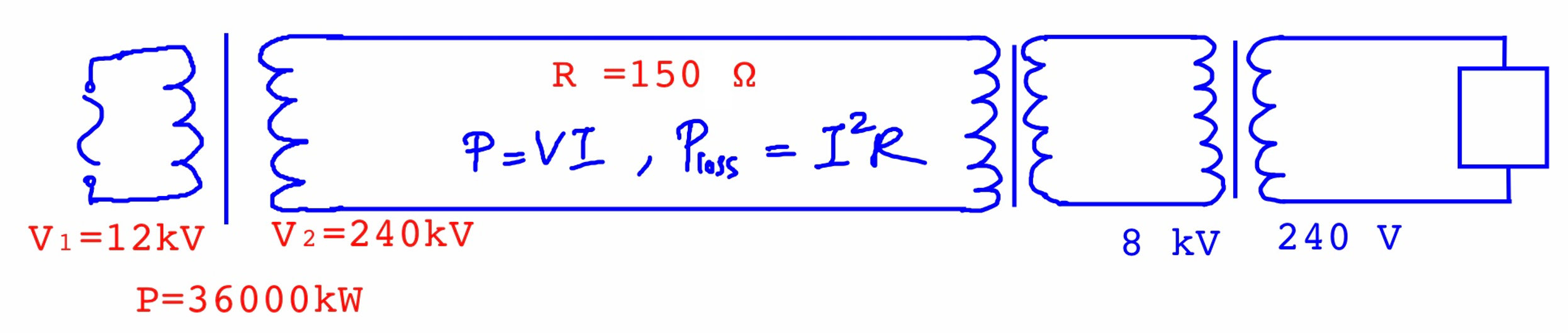
The following diagram shows how electricity is transmitted from a power station to households.
Sketch and label a circuit diagram to represent the above power transmission system.
(a)(i) The step-up transformer changes the voltage from 12 000 V to a higher value of 240 000 V. Calculate the turns ratio of coils in the transformer.
(a)(ii) State whether the step-up transformer also changes energy to a higher value.
(b) The power output from the power plant is 36 000 kW. The total resistance of the transmission lines is known be to 150 Ω.
(b)(ii) Hence, calculate the percentage power loss in the transmission line. |
| Example 19.10 |
|---|
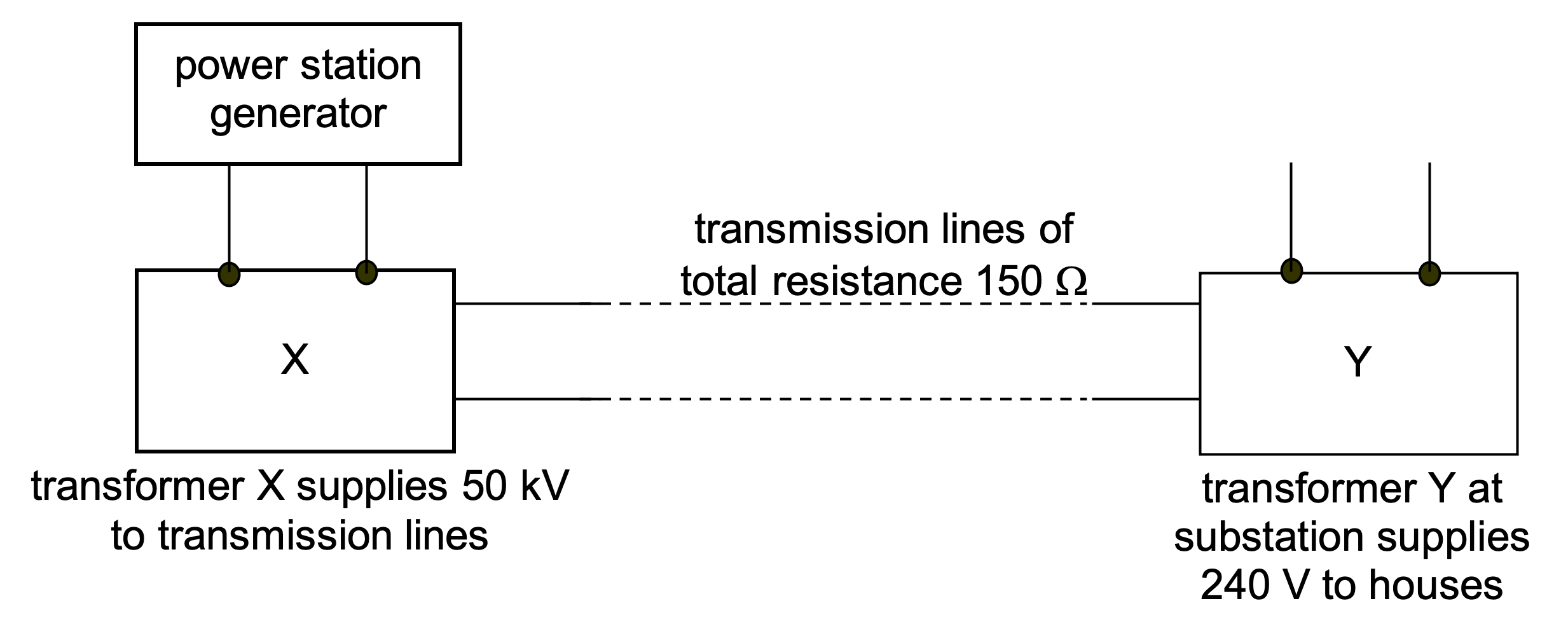
| The diagram represents, in simplified outline, an electrical supply system from a power station generator to a house.
(a) Calculate the current passing through the element of a 3.0 kW electric kettle when it is used in a house in which the supply voltage is 240 V.
(b) The distribution cable connecting transformer Y to the house has a resistance of 0.5 Ω. Calculate the rate at which heat is produced in this cable when the kettle is in use.
(c) The transmission lines have a resistance of 150 Ω and carry a current of 0.062 A. Determine the rate at which heat is produced in the transmission lines.
(d) Comment on the fact that the result for part (b) is much greater than that for part (c). |
| << Back | Electromagnetic Induction |