A changing current in a coil generates a varying magnetic field which can induce an e.m.f. in another coil nearby. This effect is known as mutual induction.
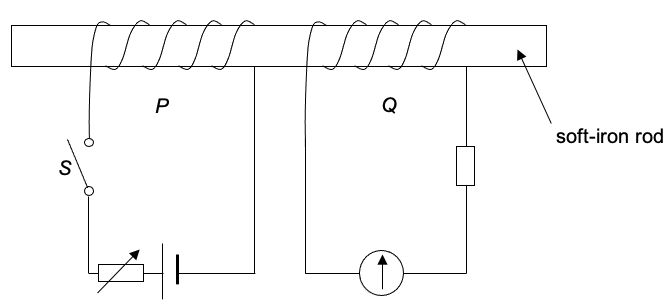
Both coils can slide easily on the rod. Coil P is connected in series to a battery, a rheostat and a switch S. Coil Q is connected to a sensitive centre-zero galvanometer.
When the switch S is closed, a momentary deflection is seen on the galvanometer and the coils slide apart a little.
When the switch S is opened again, a momentary deflection is seen on the galvanometer (this time deflecting to the opposite direction) and the coils slide together a little.
When S is opened, the current decreases to zero and there is a decreasing magnetic flux in P. By Lenz’s law, to oppose this change in magnetic flux in P, the induced current in coil Q flows in the opposite direction to that in (a)(ii) and North pole is induced on the left end of Q. Since both coils now have opposite poles facing each other, they attract and slide towards each other a little. The galvanometer shows a momentary deflection in the opposite direction.
If the iron rod were replaced by wood:
Unlike soft iron, wood is non-magnetic and does not increase the magnetic field through the coils. There is a weaker magnetic flux linkage between the two coils P and Q, the induced e.m.f. and induced current are smaller. Hence, the momentary deflection in the galvanometer and the repulsion between the coils will be smaller.
| << Back | Electromagnetic Induction | Next >> |