15.2.2 – Parallel Circuits

In a parallel circuit, components are connected across two common points.

Charges going around the circuit will have two (or more) paths that they could take in making a complete journey around the circuit.

Current in a Parallel Circuit

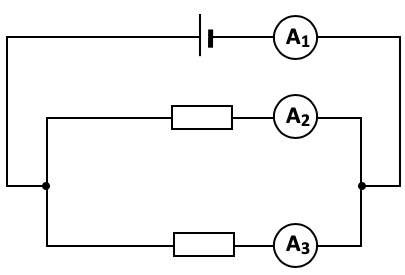
Current from the source is the sum of the currents in the separate branches of a parallel circuit.

\text{I}_1\text{ = I}_2\text{ + I}_3

The current flowing out of the cell is the same as the current flowing back into it.

Also at any junction (node) the sum of the current flowing into the node must equal the sum of the current flowing out of the node.

The current need not split equally (in fact it will do so only if the resistance in each branch is identical).

Potential Difference in a Parallel Circuit

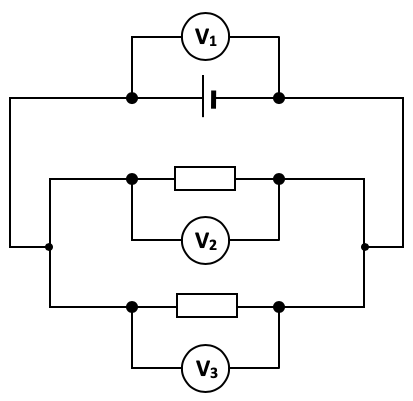
The potential differences across each branch of a parallel circuit are the same.

In this example

V1 = V2 = V3

Resistors in Parallel

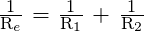
The reciprocal of the effective resistance for resistors in parallel is equal to the sum of the reciprocals of the individual resistances.

\frac{\text{1}}{\text{R}_e}\text{ = }\frac{\text{1}}{\text{R}_1}\text{ + }\frac{\text{1}}{\text{R}_2}

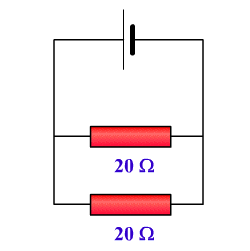
Example 1A

\frac{\text{1}}{\text{R}_e}\text{ = }\frac{\text{1}}{\text{R}_1}\text{ + }\frac{\text{1}}{\text{R}_2}

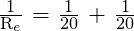
\frac{\text{1}}{\text{R}_e}\text{ = }\frac{\text{1}}{\text{20}}\text{ + }\frac{\text{1}}{\text{20}}

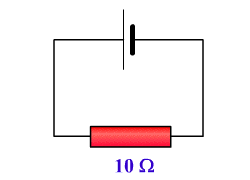
\frac{\text{1}}{\text{R}_e}\text{ = }\frac{\text{1}}{\text{10}}

{\text{R}_e}\text{ = }\text{10 ohm}

Example 1B
 

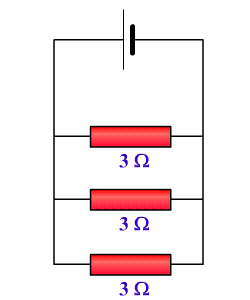
\frac{\text{1}}{\text{R}_e}\text{ = }\frac{\text{1}}{\text{R}_1}\text{ + }\frac{\text{1}}{\text{R}_2}\text{ + }\frac{\text{1}}{\text{R}_3}

\frac{\text{1}}{\text{R}_e}\text{ = }\frac{\text{1}}{\text{3}}\text{ + }\frac{\text{1}}{\text{3}}\text{ + }\frac{\text{1}}{\text{3}}

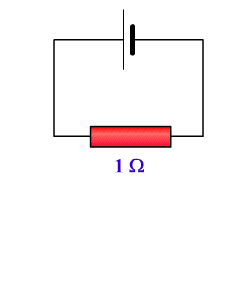
\frac{\text{1}}{\text{R}_e}\text{ = }\frac{\text{3}}{\text{3}}

{\text{R}_e}\text{ = }\text{1.0 ohm}

Example 2A
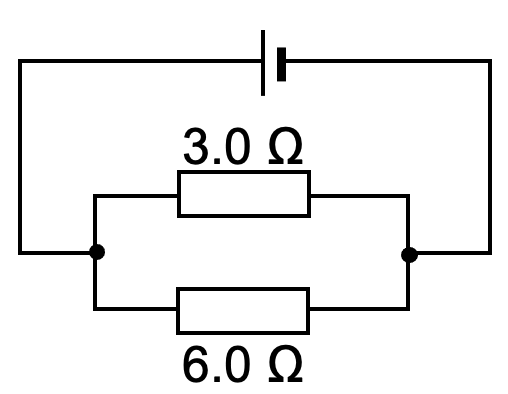
Determine the effective resistance Re in the following circuit. Show all necessary working.

\frac{\text{1}}{\text{R}_e}\text{ = }\frac{\text{1}}{\text{R}_1}\text{ + }\frac{\text{1}}{\text{R}_2}

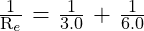
\frac{\text{1}}{\text{R}_e}\text{ = }\frac{\text{1}}{\text{3.0}}\text{ + }\frac{\text{1}}{\text{6.0}}

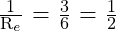
\frac{\text{1}}{\text{R}_e}\text{ = }\frac{\text{3}}{\text{6}}\text{ = }\frac{\text{1}}{\text{2}}

{\text{R}_e}\text{ = }\text{2.0 ohms}

Example 2B
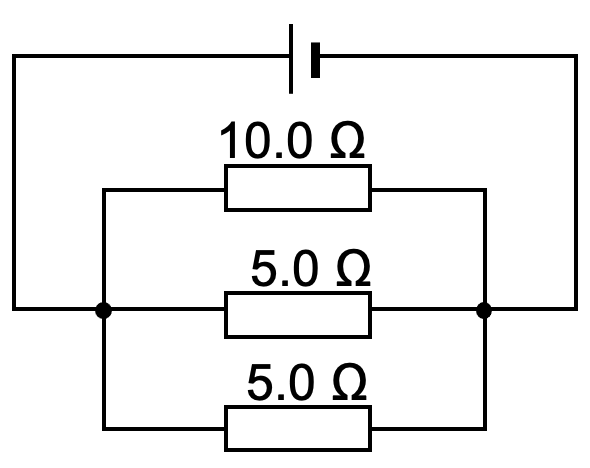
Determine the effective resistance Re in the following circuit. Show all necessary working.

\frac{\text{1}}{\text{R}_e}\text{ = }\frac{\text{1}}{\text{R}_1}\text{ + }\frac{\text{1}}{\text{R}_2}\text{ + }\frac{\text{1}}{\text{R}_3}

\frac{\text{1}}{\text{R}_e}\text{ = }\frac{\text{1}}{\text{10.0}}\text{ + }\frac{\text{1}}{\text{5.0}}\text{ + }\frac{\text{1}}{\text{5.0}}

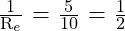
\frac{\text{1}}{\text{R}_e}\text{ = }\frac{\text{5}}{\text{10}}\text{ = }\frac{\text{1}}{\text{2}}

{\text{R}_e}\text{ = }\text{2.0 ohms}

Example 3
What happens to the brightness of the bulb as the resistance of the rheostat is slowly increased?
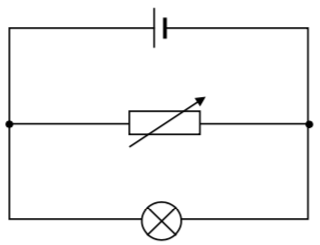
As the two branches are parallel, they will share a p.d. across them.

As the two branches are parallel with the battery they will share the p.d. across the whole circuit (the e.m.f. of the battery).

Thus, as the resistance of the rheostat is increased, the p.d. across the bulb will remain the same and thus will have the same brightness.

Example 4
What happens to the ammeter and voltmeter readings when switch S is closed?
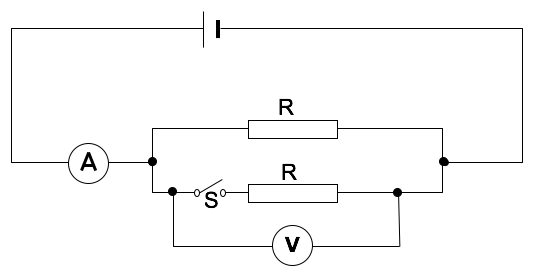
With the switch S open, current will only be flowing though the top branch. When the switch is closed current is able to flow across the bottom branch as well as the top branch. As both resistors are equal there will be an equal current flowing in each branch, thus the ammeter reading will double.

The voltmeter can be considered to be connected across the battery as there are no circuit components between its wires and the two terminals of the battery. (The ammeter doesn’t count!) Thus it is reading the voltage acrosss the whole circuit (the e.m.f. of the battery) and will not change whether the switch is open or closed.

Example 5
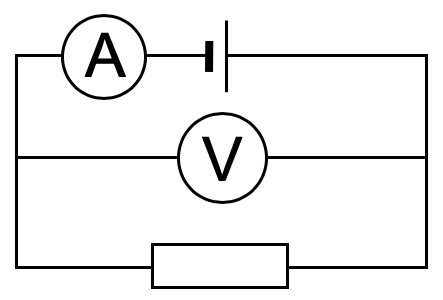
A cell, an ammeter, a voltmeter and a resistor are connected as shown below.

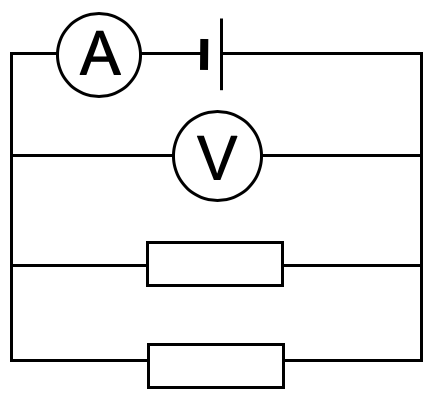
Given that the ammeter and voltmeter readings are 1.0 A and 2.0 V respectively, what are the new readings when an identical resistor is attached in parallel as shown below?

The effective resistance of the circuit is now halved, so the current flowing from the battery will be double of the original value. i.e. 2.0 A

The voltmeter is connected across the whole circuit and so is reading the e.m.f. of the battery it will continue to read 2.0 V.

Example 6
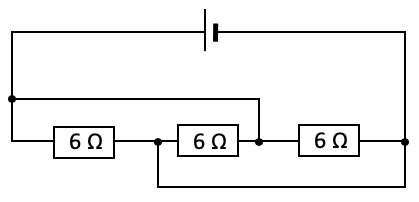
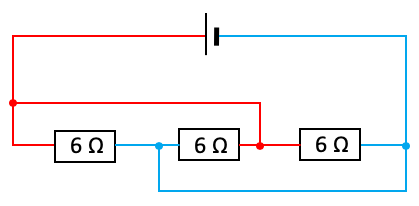
What is the effective resistance of the following circuit?

This is a particularly difficult circuit to figure out. In fact the three resistors are in parallel with each other. It might be easier to visualise if we use the concept of electrical potential and think of the potentials of the wires connected to the battery.

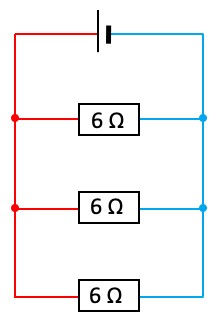
We can see that each resistor actually is connected to one red wire (ie directly to the +ve of the battery) and one blue wire (ie directly to the -ve of the battery). So each resistor has the same p.d. across it.

This circuit can be drawn like this:

\frac{\text{1}}{\text{R}_e}\text{ = }\frac{\text{1}}{\text{R}_1}\text{ + }\frac{\text{1}}{\text{R}_2}\text{ + }\frac{\text{1}}{\text{R}_3}

\frac{\text{1}}{\text{R}_e}\text{ = }\frac{\text{1}}{\text{6}}\text{ + }\frac{\text{1}}{\text{6}}\text{ + }\frac{\text{1}}{\text{6}}

\frac{\text{1}}{\text{R}_e}\text{ = }\frac{\text{3}}{\text{6}}

{\text{R}_e}\text{ = }\text{2.0 ohm}


2025 Physics Lessons