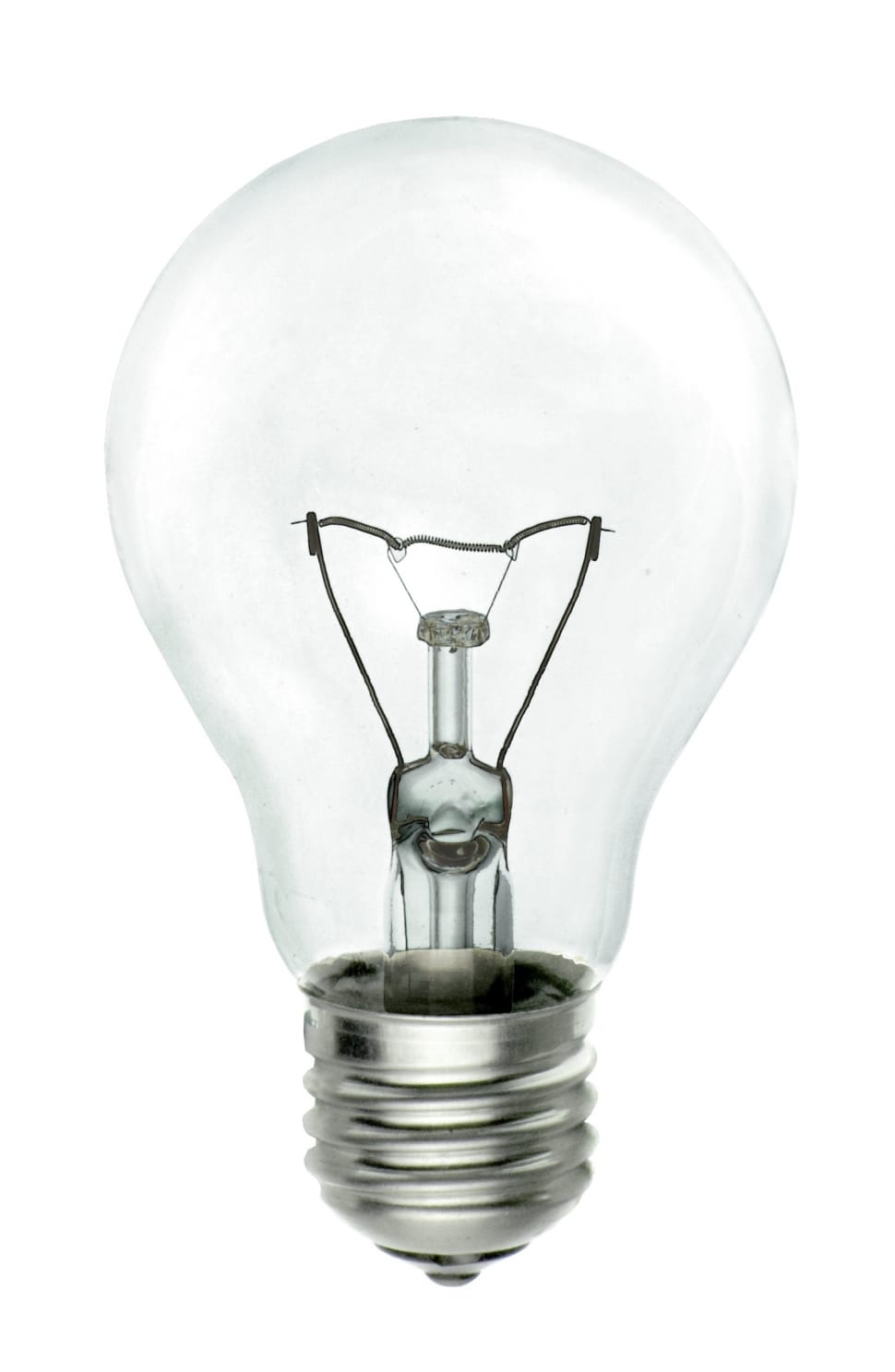
A filament lamp (also known as an incandescent lamp or bulb) is a light source that generates light via the heating of a thin metal wire known as the filament.
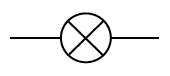
Represented in a circuit diagram with the following symbol:
Becoming less common now due to their poor efficiency – frequently less than 5% of the energy supplied to them would be emitted as visible light – the rest being given out as heat. They were the only type of bulb readily available for more than 100 years.
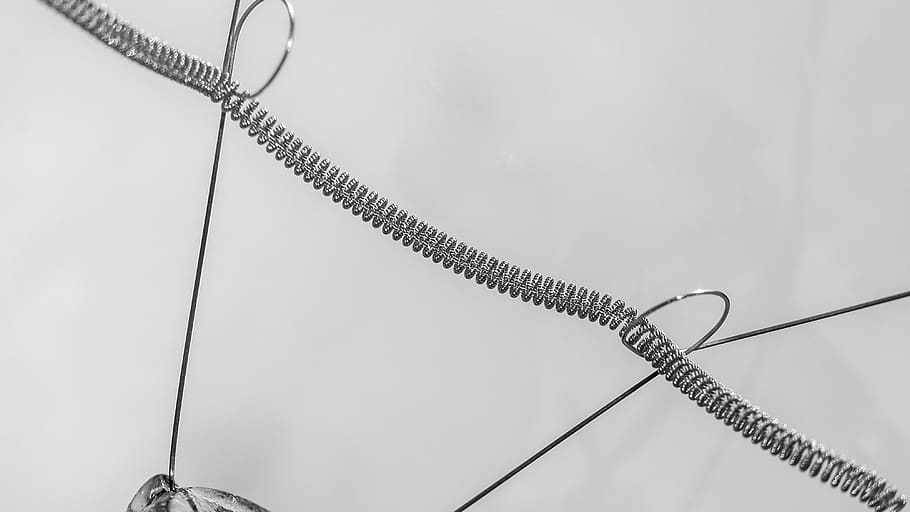
The filament is actually a coiled coil. The metal is usually tungsten – due to its high melting point of 3695 K (3422 °C).
The thickness of the wire is typically only 0.05 mm (thinner than a human hair) and about 0.5 m long if fully stretched out.
A filament lamp is a non-ohmic component, hence it does not obey Ohm’s law. As the current increases, causing its temperature to rise, its resistance increases.
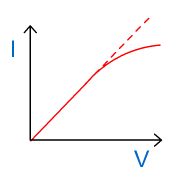
a filament lamp
A filament bulb will heat from room temperature (~300 K) to maybe ~3000 K at normal brightness. This massive change in temperature cannot be ignored.
The resistance of the bulb has increased as it gets brighter. We can attribute this to atoms vibrating more as it gets hotter, making the path of an electron passing through the conductor much more likely to collide with atoms along the way.
| Note |
|---|
| In circuit calculations, resistance of a lamp is usually assumed to remain constant.
However, the resistance of a lamp may change in certain contexts when its temperature changes. |
| Example |
|---|
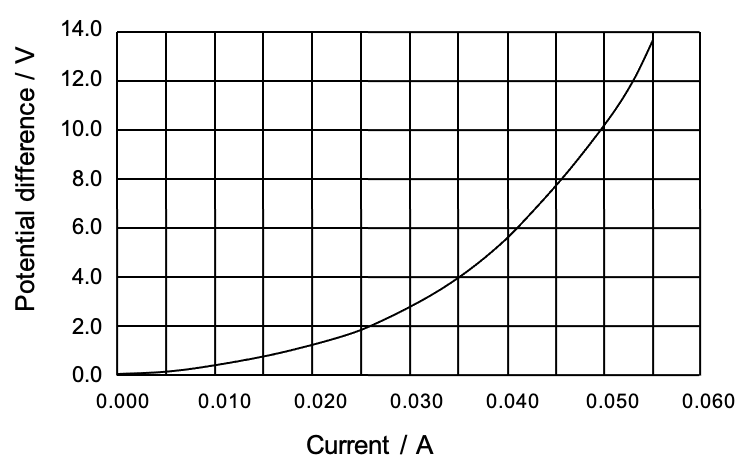
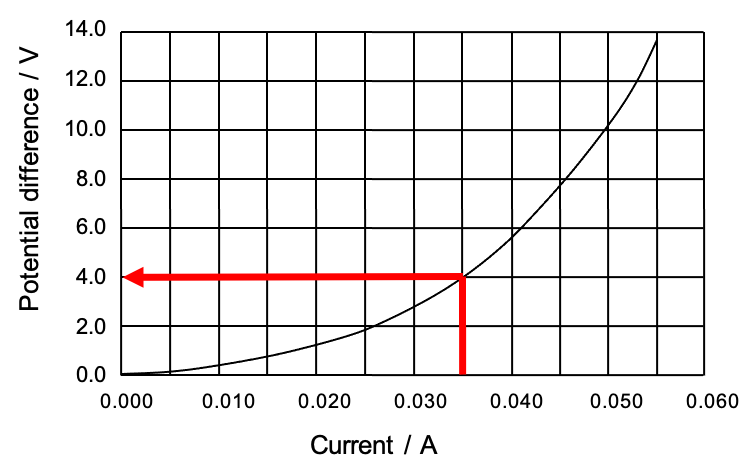
| The graph of potential difference against current for a lamp is shown below.
(a) When the current in the lamp is 0.035 A, determine the potential difference across the lamp. (b) When the current in the lamp is 0.035 A, determine the resistance of the lamp. |
Brightness of a Filament Bulb
Electrical energy is converted to heat and light in a lamp.
The power of the lamp determines the brightness of a lamp. A larger p.d. V across the lamp or a larger current I through lamp will increase its power and hence its brightness.
Note that if V or I is doubled, brightness is not doubled.
Rating of a lamp
Given a particular lamp has a 3.0 V rating:
- If 3.0 V is applied across it, we say the lamp has normal brightness
- If applied voltage is > 3.0 V, the lamp is brighter than normal.
- If applied voltage is < 3.0 V, the lamp is dimmer than normal.
If there is no voltage applied across a lamp we would describe it as not lit.
When a voltage larger than the bulb rating is applied it is likely that the bulb will “blow” – meaning that the filament has melted. Once this happens the bulb will need to be replaced.
Thus for any experiments done using bulbs we will start with the lowest current and increase it to take readings. This way it is unlikely that the bulb will blow at the start of an experiment.
When small voltages are applied across a bulb it may not heat up enough to glow and give out light.
| Note |
|---|
| In professional and industrial applications, brightness or light intensity may be measured in units such as candela, lumens and lux.
You are not expected to be familiar with these units. |
| Question – Bulb Rating |
|---|
| What is meant by a bulb rating of 6.0 V, 0.90 W? |
| << Back | D.C. Circuits | Next >> |