Potential Difference
| Definition: Potential Difference (p.d.) |
|---|
| The potential difference (p.d.) across a circuit component is the work done to drive a unit charge through the component. |
This can be expressed in an equation as:
| V = W/Q |
Where:
V – potential difference across the component (V)
W – energy converted from electrical energy into non electrical energy in the component (J)
Q – charges moved through the component (C)
Both e.m.f and p.d. are measured in volts (V).
| Caution |
|---|
| In everyday talk we often refer to p.d. and e.m.f. simply as “voltage”.
Try to avoid doing this in Physics lessons. |
| Example 4 |
|---|
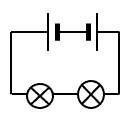
| The cells and the lamps in the following diagrams are identical.
If lamp X is at normal brightness, compare the brightness of each lamp in the following circuit with that of lamp X. (a)
(b)
(c)
(d)
|
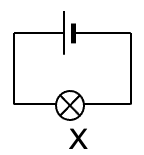
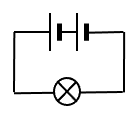
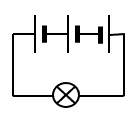
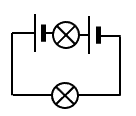
| Example 5A |
|---|
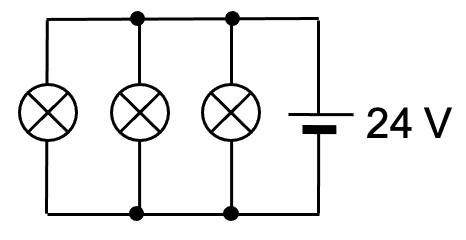
| In the diagram shown, the three identical bulbs connected to a 24 V supply are working at normal brightness.
What is the voltage rating of each bulb? |
| Example 5B |
|---|
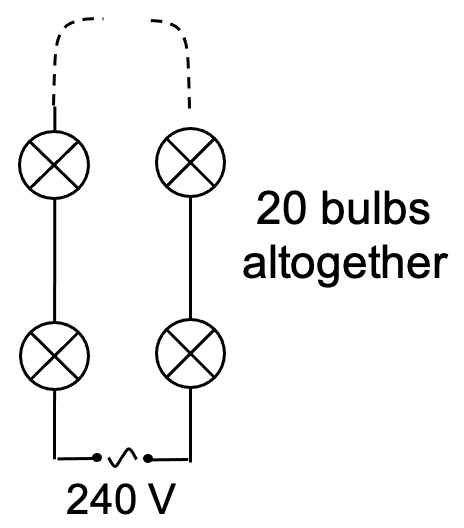
| Twenty identical Christmas tree light bulbs work normally from a 240 V mains when they are connected as shown in the diagram.
What is the voltage rating of each bulb? |
Measuring Potential Difference
Potential difference (p.d.) is measured by a voltmeter connected in parallel to the component being measured.
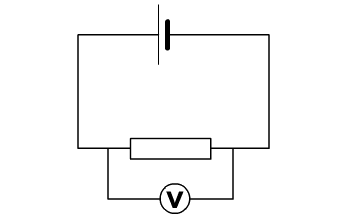
Voltmeter is measuring the p.d. across the resistor
Electromotive Force vs Potential Difference
| Electromotive Force | Potential Difference |
| Associated with an electrical energy source (e.g. a dry cell) | Associated with two points in an electric circuit |
| It is work done to move each unit charge through the complete circuit | It is the work done by each unit charge passing through the components between two points |
| Non-electrical energy is converted to electrical energy | Electrical energy is converted to other forms of energy |
| E.m.f. is present even when no current is drawn from the source | P.d. across any electrical component is zero in absence of current |
| << Back | Current of Electricity | Next >> |