| Definition: Ohm’s Law |
|---|
| Ohm’s Law states that the potential difference across the ends of a conductor is directly proportional to the current flowing through it, provided that the temperature and other physical conditions are unchanged. |
- Conductors that obey Ohm’s Law are called ohmic. For ohmic conductors, R is a constant.
- Conductors that do not obey Ohm’s law are non-ohmic. i.e. although R is still given by V/I , it is not a constant.
| Physical Conditions |
|---|
| Physical conditions here really refers to the temperature. If the temperature changes significantly then we cannot say all of the physical conditions are the same. e.g. A light bulb switched off will have a filament at room temperature, in operation the temperature may reach 2000 °C or more. |
Current-Voltage Characteristic Graphs
| Example 2 |
|---|
Draw the  against against  graph and against graph for an ohmic conductor that has a 100 Ω resistance. graph and against graph for an ohmic conductor that has a 100 Ω resistance.
In this case the gradient is equal to the reciprocal of the resistance of the component. |
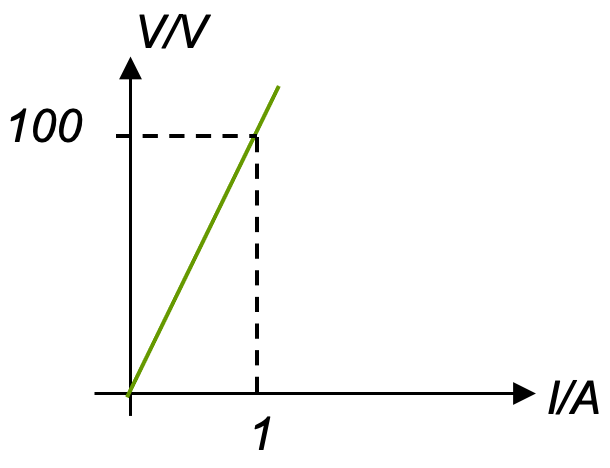
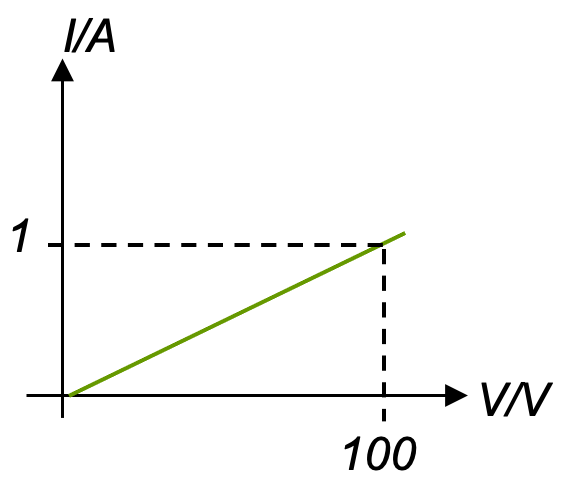
The following shows the typical Current-Voltage (I/V) Characteristic Graphs for some common materials.
Pure Metal at Constant Temperature
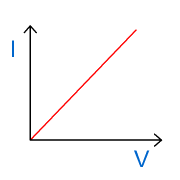
a pure metal at constant temperature
The metal behaves ohmically for all currents. Resistance is constant for all temperatures.
| I-V graph is not a V-I graph |
|---|
| The axes are I (y-axis) and V (x-axis).
The gradient is NOT equal to the resistance in this case. The resistance is of course the reciprocal of the gradient. |
Later we will be coming across components that are non-ohmic such as the filament bulb, thermistor, light-dependent resistor, and diode.
Thermistor
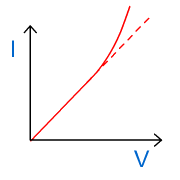
a thermistor
Larger currents produce a heating effect which again causes the resistance to change and the component to show non-ohmic characteristics.
What happens to the resistance at higher voltages?
| << Back | Current of Electricity |
| Links |
|---|
| https://en.wikipedia.org/wiki/Incandescent_light_bulb |