Measuring Resistance
- Resistance R is defined as the ratio of the potential difference across a component to the current flowing through the component.
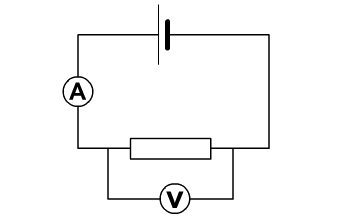
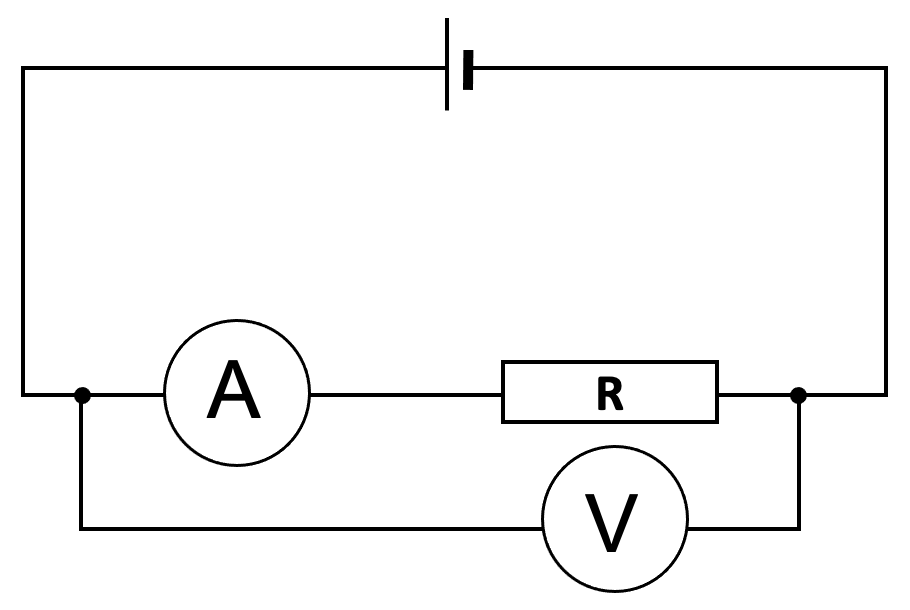
The above circuit is measuring the current through the resistor and the potential difference across it. substituting these values into R = V/I will give the value if the resistance of the resistor in ohms.
- The internal resistance of an ideal ammeter is zero Ω.
- The internal resistance of an ideal voltmeter is infinitely high.
- The internal resistance of a cell or battery is assumed to be negligible.
Alternative Method of Determining Resistance
To obtain a more accurate value for the resistance of a material a graphical method can be adopted.
Use a variable resistor (rheostat) to give a series of readings of current and voltage.
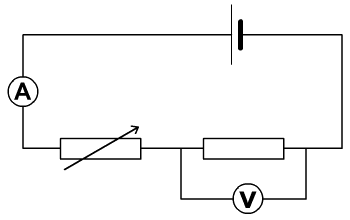
Plot these on a graph as shown below.
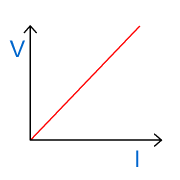
The gradient can then be determined.
Since R=V/I this is the value of the resistance of the resistor.
Positioning of Ammeter and Voltmeter
The ammeter and voltmeter can be positioned in one of two ways as shown below:
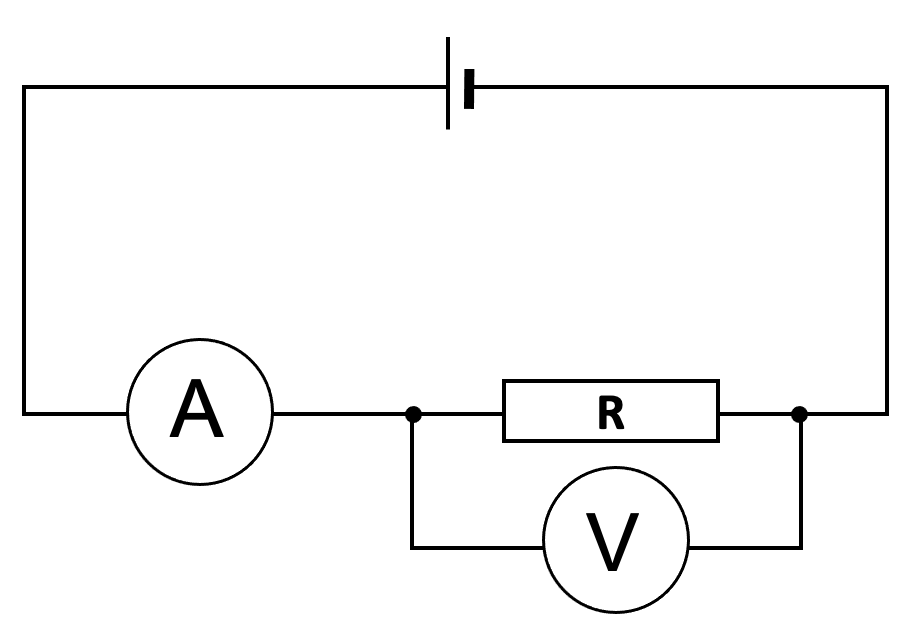
Setup A
Setup B
If the ammeter and voltmeter are both considered to be ideal then there will be no difference in these two layouts and both will give identical readings, which, when substituted back into V=IR, will give an exact value for the resistance of R.
| Case 1: Ideal Meters, Small R, Setup A |
|---|
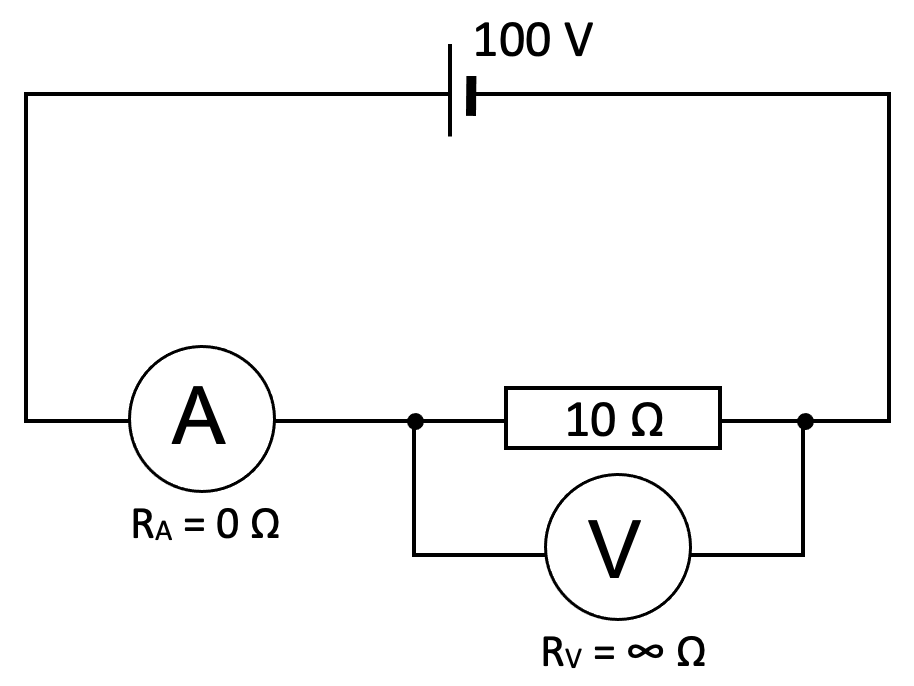
Reading on Voltmeter, V = 100 V Reading on Ammeter, I = 10 A Calculated Resistance = V/I = 100/10 = 10 Ω Agrees perfectly with true value. |
| Case 2: Ideal Meters, Large R, Setup A |
|---|
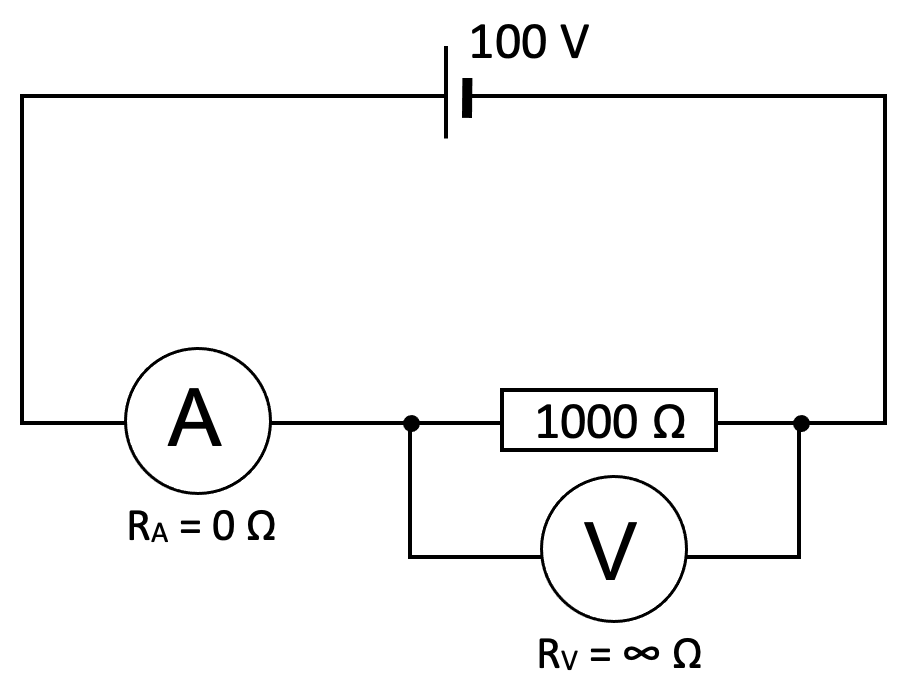
Reading on Voltmeter, V = 100 V Reading on Ammeter, I = 0.10 A Calculated Resistance = V/I = 100/0.10 = 1000 Ω Agrees perfectly with true value. |
| Case 3: Ideal Meters, Small R, Setup B |
|---|
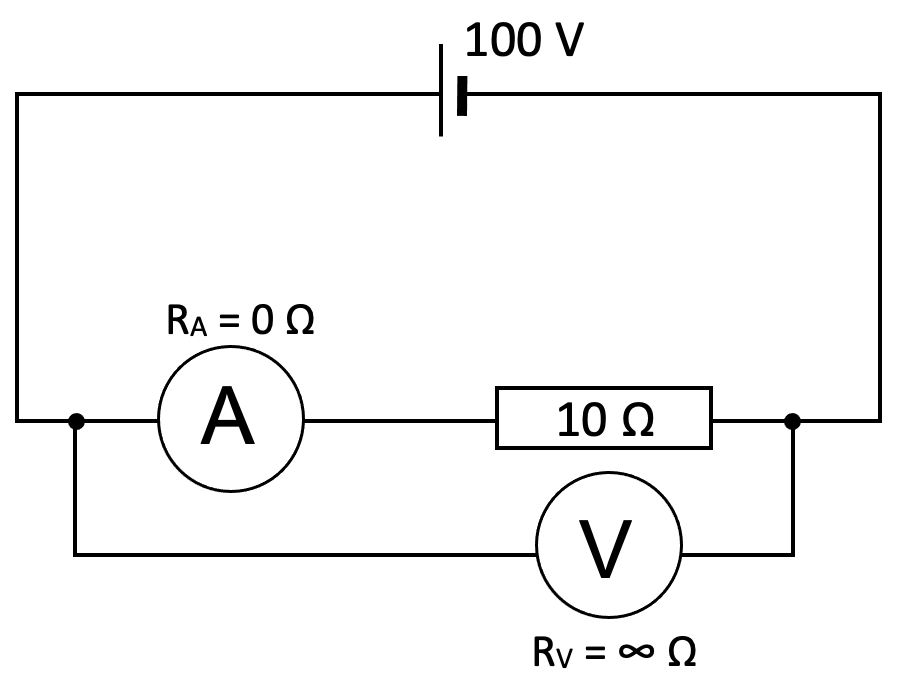
Reading on Voltmeter, V = 100 V Reading on Ammeter, I = 10 A Calculated Resistance = V/I = 100/10 = 10 Ω Agrees perfectly with true value. |
| Case 4: Ideal Meters, Large R, Setup B |
|---|
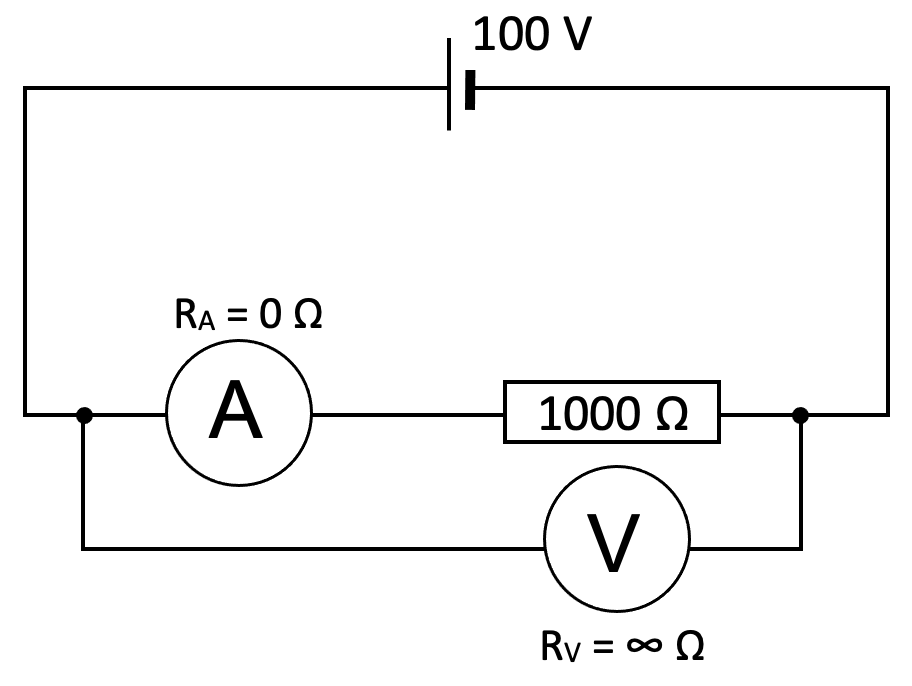
Reading on Voltmeter, V = 100 V Reading on Ammeter, I = 0.10 A Calculated Resistance = V/I = 100/0.10 = 1000 Ω Agrees perfectly with true value. |
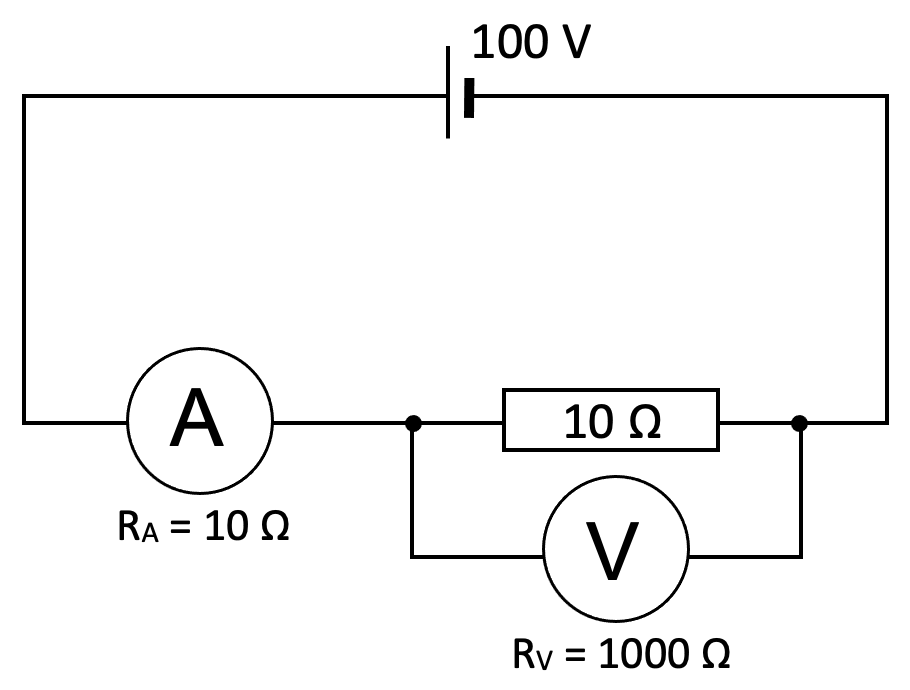
If the two meters are not ideal then there will some discrepancies. Consider the case of an ammeter with RA = 10 Ω and a voltmeter with resistance RV = 1000 Ω:
| Case 5: Non-Ideal Meters, Small R, Setup A |
|---|
|
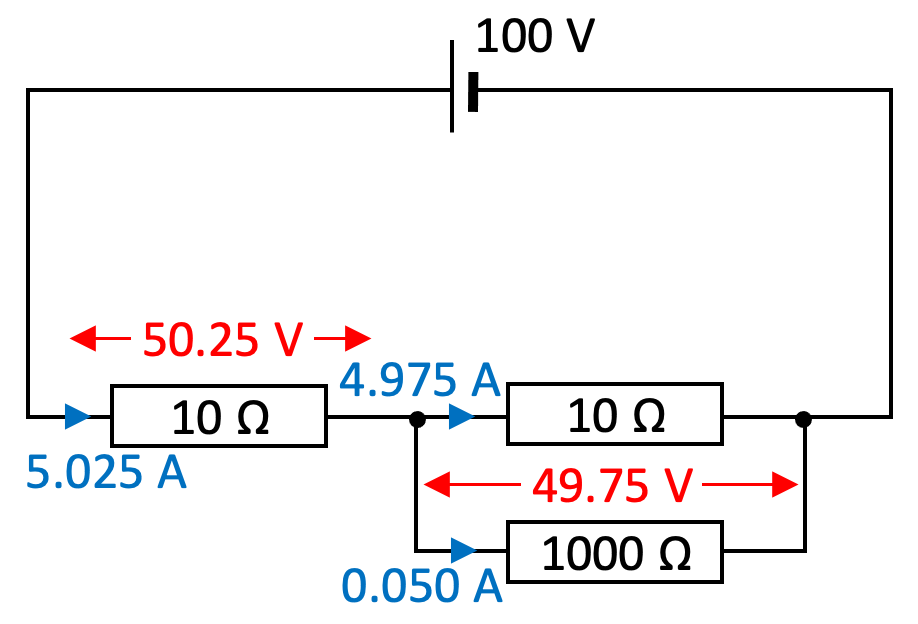
Reading on Voltmeter, V = 49.75 V Reading on Ammeter, I = 5.025 A Calculated Resistance = V/I =49.75/5.025 = 9.90 Ω The calculated value is very close to the true value. |
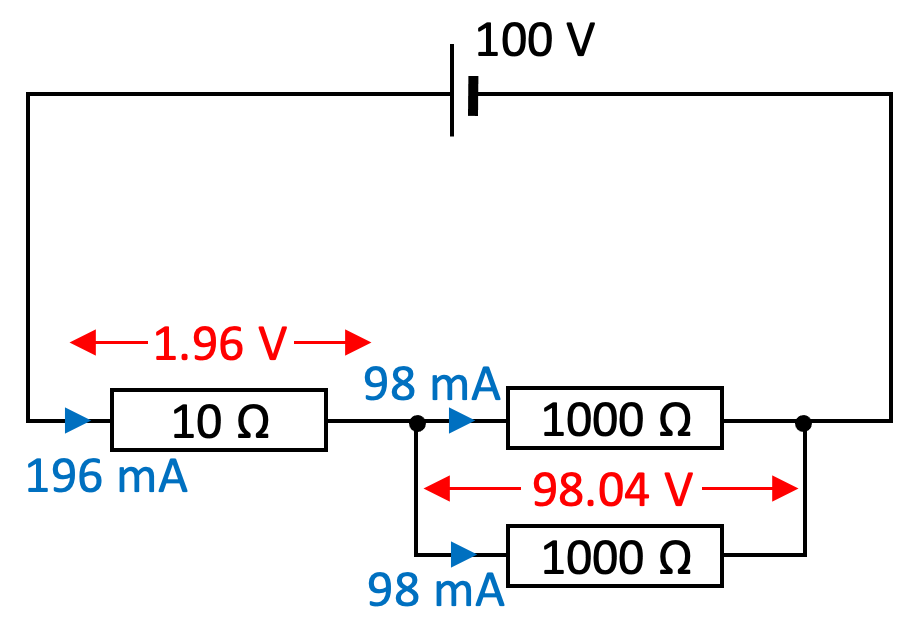
| Case 6: Non-Ideal Meters, Large R, Setup A |
|---|
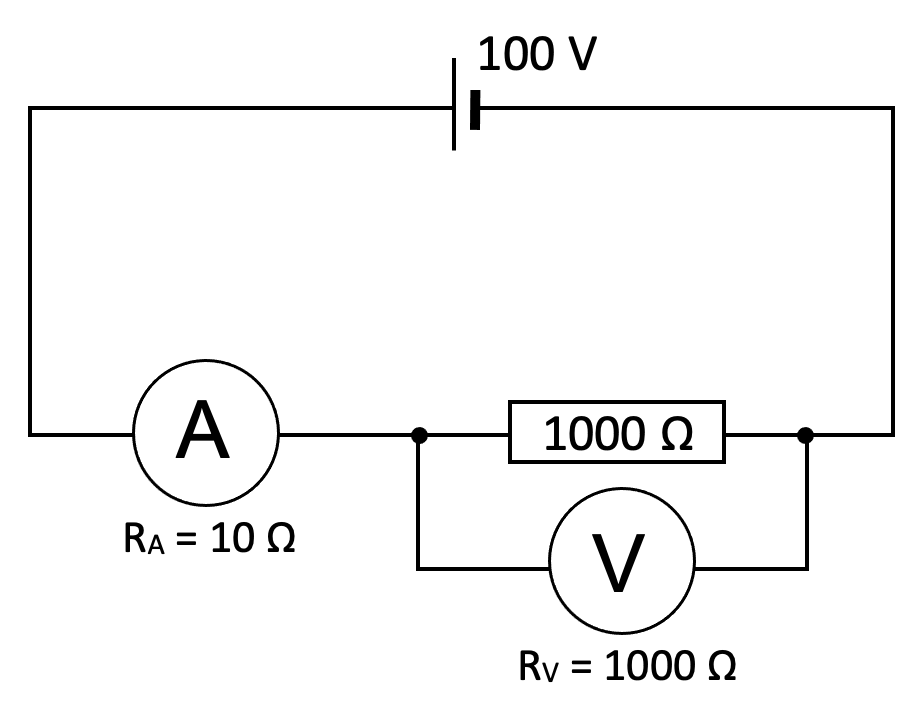
Reading on Voltmeter, V = 98.04 V Reading on Ammeter, I = 196 mA = 0.196 A Calculated Resistance = V/I = 98.04/0.196 = 500 Ω The calculated value is not close to the true value. |
| Case 7: Non-Ideal Meters, Small R, Setup B |
|---|
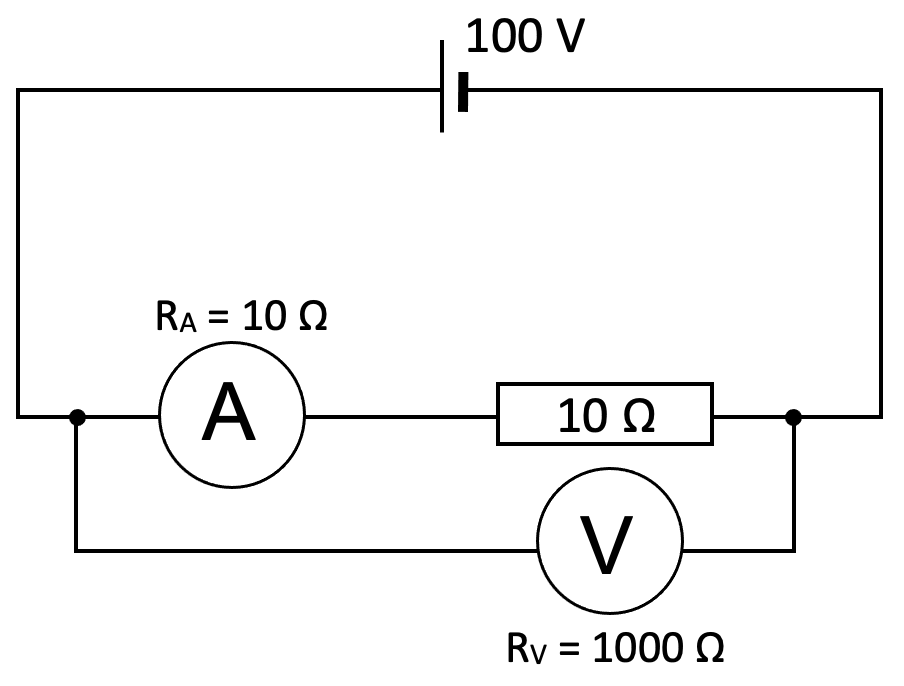
Reading on Voltmeter = 100.0 V Reading on Ammeter, V = 5.00 A Calculated Resistance, I = V/I =100.0/5.00 = 20.0 Ω The calculated value is not close to the true value. |
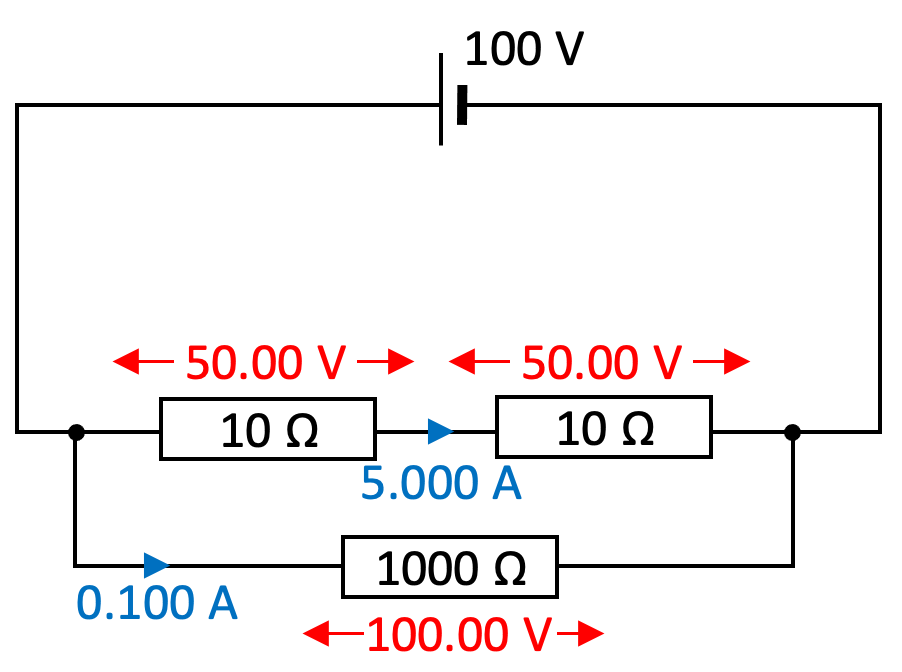
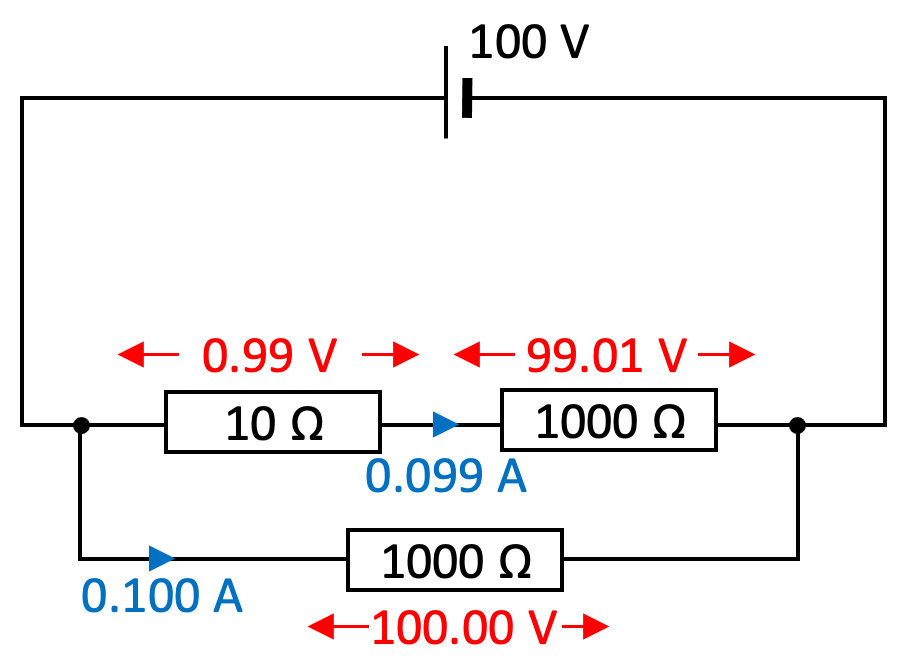
| Case 8: Non-Ideal Meters, Large R, Setup B |
|---|
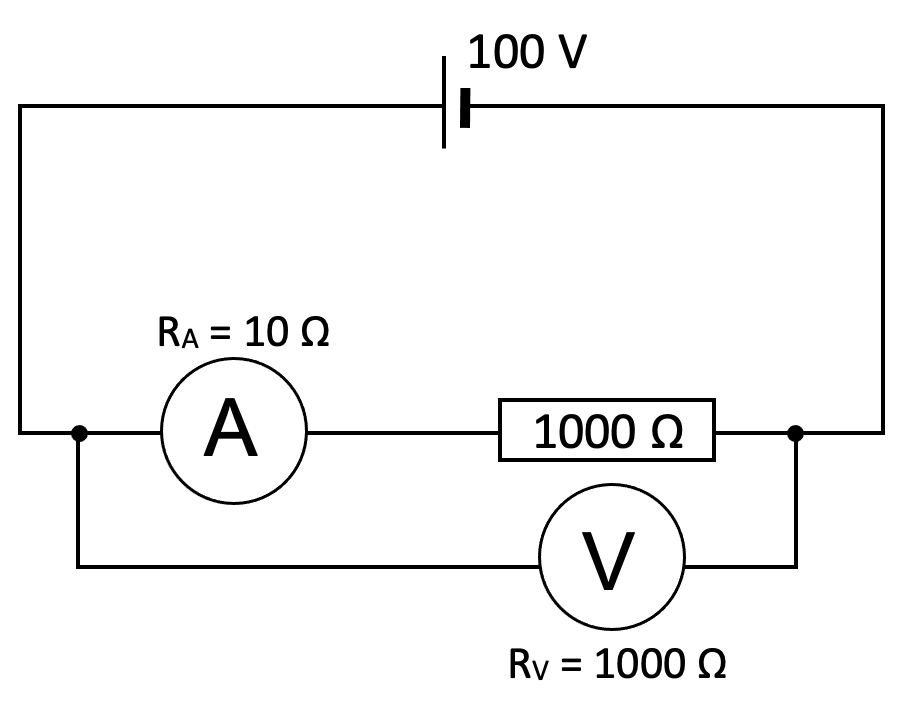
Reading on Voltmeter, V = 100.0 V Reading on Ammeter, I = 0.099 A Calculated Resistance = V/I = 100.0/0.099 = 1010 Ω The calculated value is very close to the true value. |
In summary:
Circuit to be used if R is small
Circuit to be used if R is large
| << Back | Current of Electricity | Next >> |