Electric Charge
Electric charge (Q) is a physical property of a material that causes it to experience a force when placed near another matter with charge.
- There are 2 types of charge, positive and negative.
- The charge on an electron is negative while the charge on a proton is positive. Neutrons have no charge and are therefore neutral.
- The charge on an electron is –1.6×10⁻¹⁹ C and that on a proton is +1.6×10⁻¹⁹.
- An amount of matter has a net negative charge if there are more electrons than protons in the matter.
- An amount of matter has a net positive charge if there are less electrons than protons in the matter.
- The matter is neutral if the number of electrons and protons are equal.
- Like charges (negative & negative or positive & positive) repel; unlike charges (negative & positive) attract.
- The quantity of charge is represented by Q and it is measured in the SI unit coulomb represented by C.
| Example 1 |
|---|
| Calculate the number of electrons in 1.0 C of charge. |
Electric Current
| Definition: Electric Current |
|---|
| Electric current is the rate of flow of electric charge through a given cross-section of a conductor. |
In equation form:
 |
However, this is often presented as:
 |
where:
 – charge (C)
 – Electric Current (A)
 – time taken (s)
Current is measured in amperes (A). The symbol I is usually used to represent electric current.
One ampere is equivalent to one coulomb per second (C s⁻¹)
| Example 2 |
|---|
| The current in a small torch bulb is 0.40 A. What is the total electric charge which passes a point in the circuit in 10 minutes? |

 0.40 x (10 x 60)
 240 C
240 C
| Example 3 |
|---|
| In a camera flash lamp, a charge of 6.3 C passes through the lamp in 15 ms. What is the average current involved? |


 420 A
420 AWhen charge flows, as charge can be either positive or negative, it can be flowing both ways at the same time.
However, in most cases we will be looking at current in metallic conductors (eg. wires), in which case the moving charges are only electrons (i.e only negative charges are moving).
By definition current is defined as the direction in which a positive charge would flow.
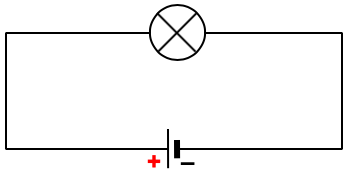
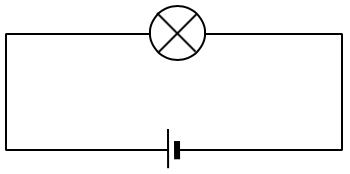
Consider the above diagram of a bulb connected to a battery:
Electron Current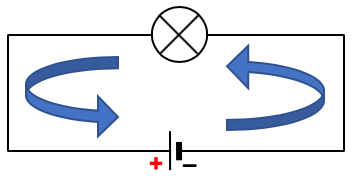 The electrons are travelling in this anticlockwise direction around the circuit (from the negative terminal of the battery towards the positive terminal of the battery).
Conventional Current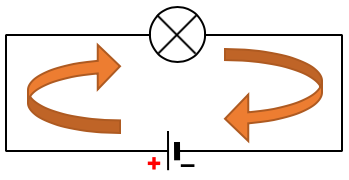 However, as current is defined as the direction in which positive charge would flow, we actually say that the current is flowing from the positive terminal of the battery and around the circuit in this clockwise direction.
For historical reasons, the direction of conventional current is taken to be the direction a positive charge would move in. We still always use this direction when stating the direction of a current.
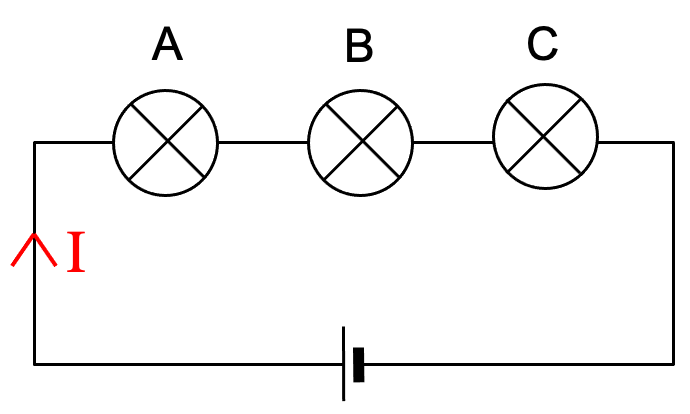
Normally we will indicate electric current like this:
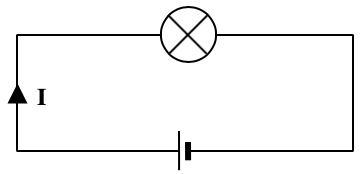
“Current” here will be referring to conventional current.
Thus the current direction is from the positive terminal to the negative terminal.
We always use the letter to represent current.
| Example 5 |
|---|
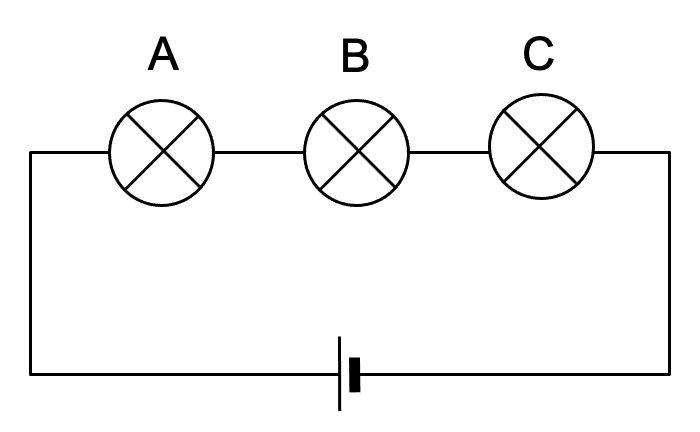
| Identical light bulbs A, B and C are connected in series to a battery.
(a) Indicate, on the diagram, the direction of the flow of current in the circuit.
(b) Which light bulb will light up first? Explain your answer.
(c) Which light bulb will be the brightest? Explain your answer in terms of current flow. |
| Visualising Electric Currents |
|---|
| Links of a Chain:
Think of the flow of current like a metal chain. When you pull at one end of the chain the entire chain moves. The electrons are linked in a similar way, if one begins to move through the circuit, it will push the electron in front of it and pull the electron behind it. Since all the electrons around the circuit move instantaneously at the same time by the “chain” principle, all the lights should light up at the same moment. Water in a Pipe: Another analogy would be the water that comes out of a tap. When you turn on the tap, the water in all parts of the pipe starts flowing simultaneously. You do not have to wait for the water to be pumped from the reservoir, then along the pipe and finally ending up at the tap. |
Measuring Electric Current
Current is measured with an ammeter.
An ammeter is connected in series in a circuit. It is a measure of the rate that charges (electrons) are moving through it (past that point in the circuit).
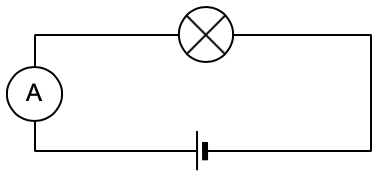 An ammeter is placed like this in series with the other components. It measures the current flowing through it.
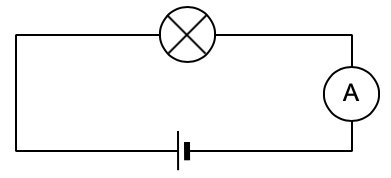
The ammeter could have been put in this position and it would still state the same value. This is because current (electrons moving through the circuit) does not change as it passes through the bulb. Energy is transferred to the bulb but electrons are not ‘lost’.
| Ammeters are not really circuit components |
|---|
The ammeter does not change the circuit in any way. The ammeter is only there to measure the current. This diagram (and the current flowing in the wires) is identical to the two above circuits. Often redrawing circuits without ammeters (and voltmeters) can make the question easier to understand. |
| Example 6 |
|---|
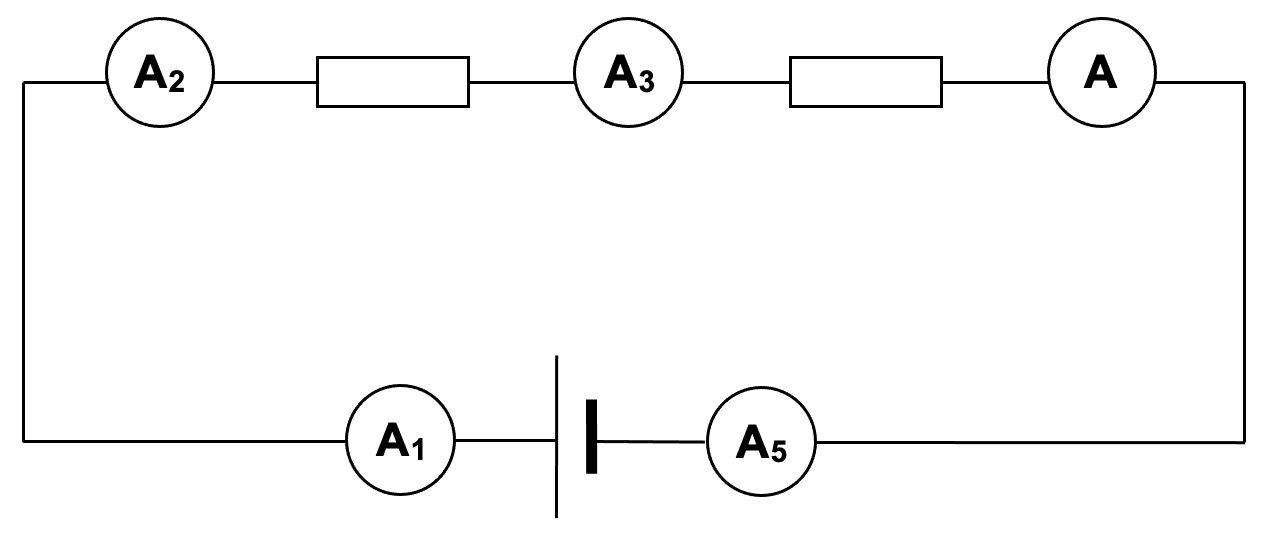
| The following diagram shows 5 ammeters and 2 resistors, each of 5.0 Ω connected in series to a 6.0 V battery.
Which ammeter shows the highest reading and which ammeter shows the lowest reading? |
| Example 7 |
|---|
|
The following diagram shows 5 ammeters and 4 resistors, each of 1.0 Ω connected in series to a 6.0 V battery.
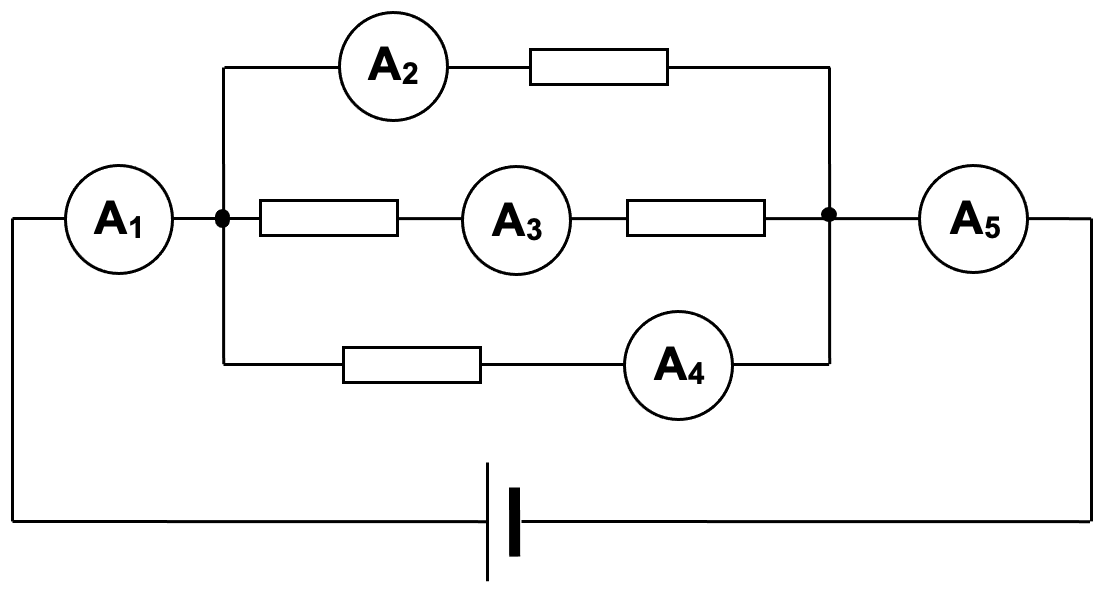 Which ammeter(s) shows the highest reading and which ammeter(s) shows the lowest reading? |
Short Circuits
If a wire connects from one side of a component to the other, then current will only flow through the wire (zero resistance) and none will flow through the component. We say that the component “has been short-circuited”.
| Example 8 |
|---|
| Two resistors are connected to a 2.0 V cell as shown in circuit 1. In circuit 2, a short circuit is created across the 4.0 Ω resistor by connecting a wire across the 4.0 Ω resistor. 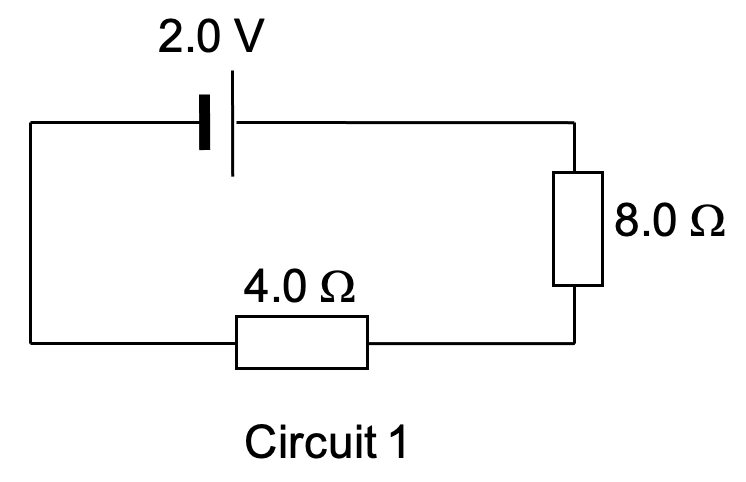 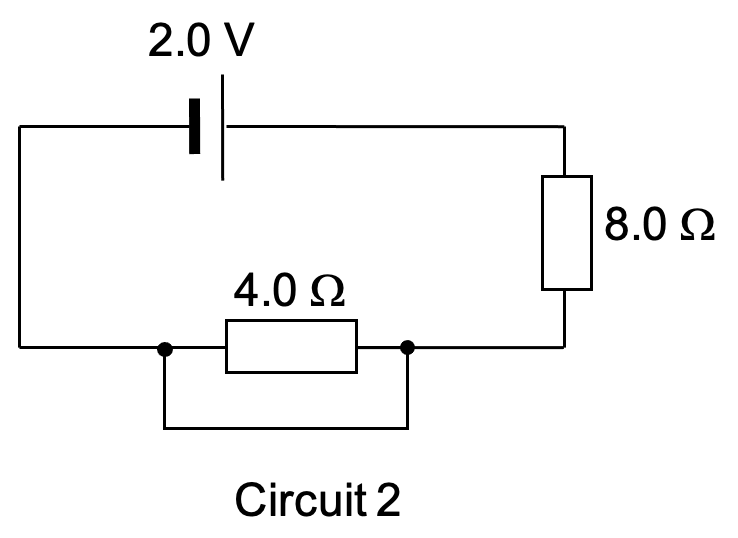 Neglecting the resistance of the connecting wires, the ammeter and the cell, calculate the current flowing through the 4.0 Ω resistor in: Neglecting the resistance of the connecting wires, the ammeter and the cell, calculate the current flowing through the 4.0 Ω resistor in:
(a) Circuit 1.
(b) Circuit 2. |
| Current of Electricity | Next >> |