When making measurements the accuracy of the measurement should be indicated with the appropriate number of decimal places being used for any particular measuring instrument and unit.
Example
A given rule can measure to the nearest 1 mm.
Some examples of the ruler being used to measure correctly are:
12 mm
30 mm
23.4 cm
10.0 cm
Some examples of the ruler being used incorrectly are:
67.5 mm
34.0 mm
– rule cannot be used to measure smaller than 1 mm
13 cm
20 cm
– rule can measure more accurately than the nearest 1 cm
| Example |
|---|
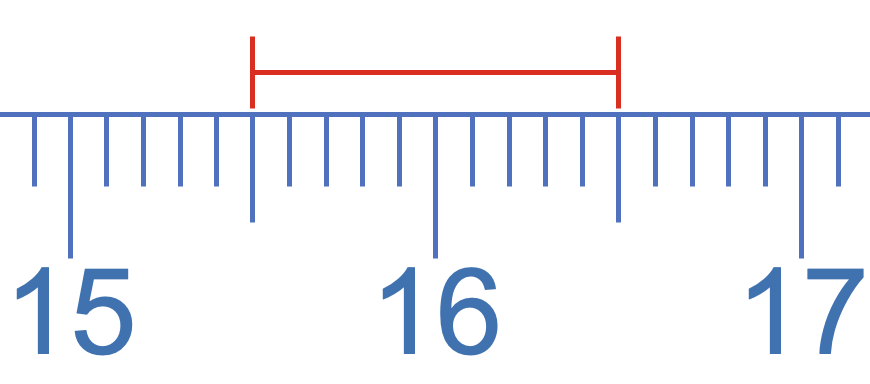
| A statement says ‘height = 1.6 m’. What does it mean?
A stated value of 1.6 m tells us that the value is between 1.5 m and 1.7 m. However it should also tell us that the value is closer to 1.6 than either 1.5 or 1.7 is. Hence the exact height must be between 1.55 m and 1.65 m. |
| Example |
|---|
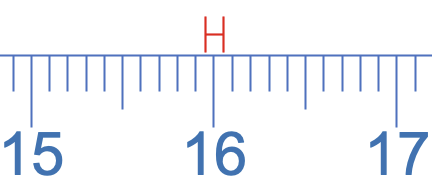
| Does ‘length =16 cm’ mean the same as ‘length = 16.0 cm’?
No. 16 cm implies the object is measured to the nearest 1 cm which means that the exact height must lie between 15.5 cm and 16.5 cm. (15.5 ≤ x < 16.5)
16.0 cm implies the object is measured to the nearest 0.1 cm which means the exact height must lie between 15.95 cm and 16.05 cm. Hence we know the height to a much greater precision than in the first example. (15.95 ≤ x < 16.05)
|
| Basics |