Processed data are readings obtained from adding, subtracting, multiplying or dividing two or more raw data, or other mathematical operations e.g. squaring, trigonometry ratios.
1 For Addition and Subtraction of Data:
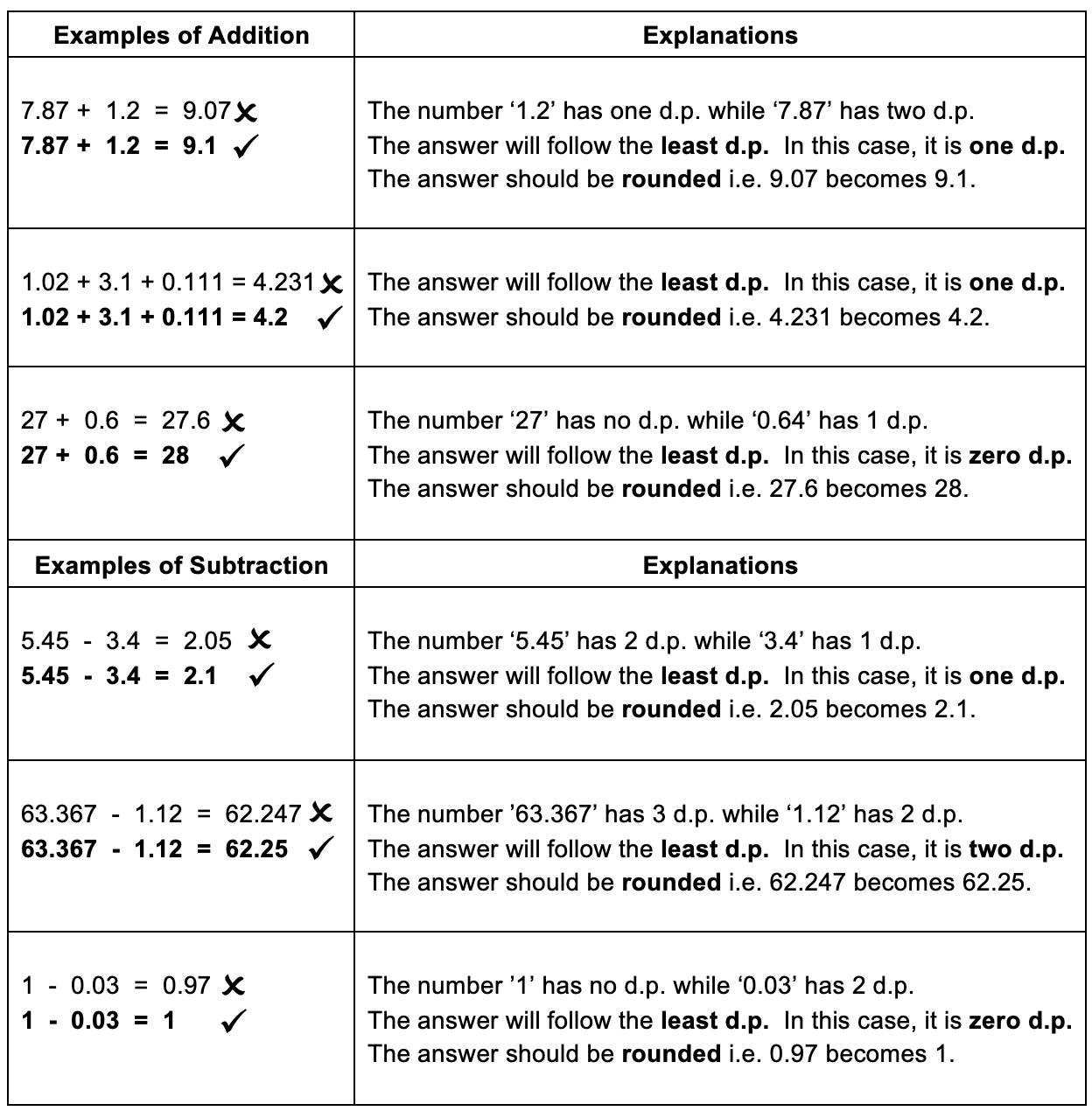
The calculated answer will always follow the raw data with the least number of decimal places (d.p.).
| Analogy |
|---|
| Imagine I have “2 dollars and 15 cents” in my left pocket and “about 4 dollars” in my right other pocket.
How much money do I have?
You cannot state that I have $6.15 as the exact amount in my right pocket is unclear and could likely be anything from $3.50 to $4.50. Thus we can only know the answer to the nearest $1 You could only state that I have “about 6 dollars”. |
2 For Multiplication and Division of Data:
The calculated answer will always follow the raw data with the least number of significant figures (s.f.).
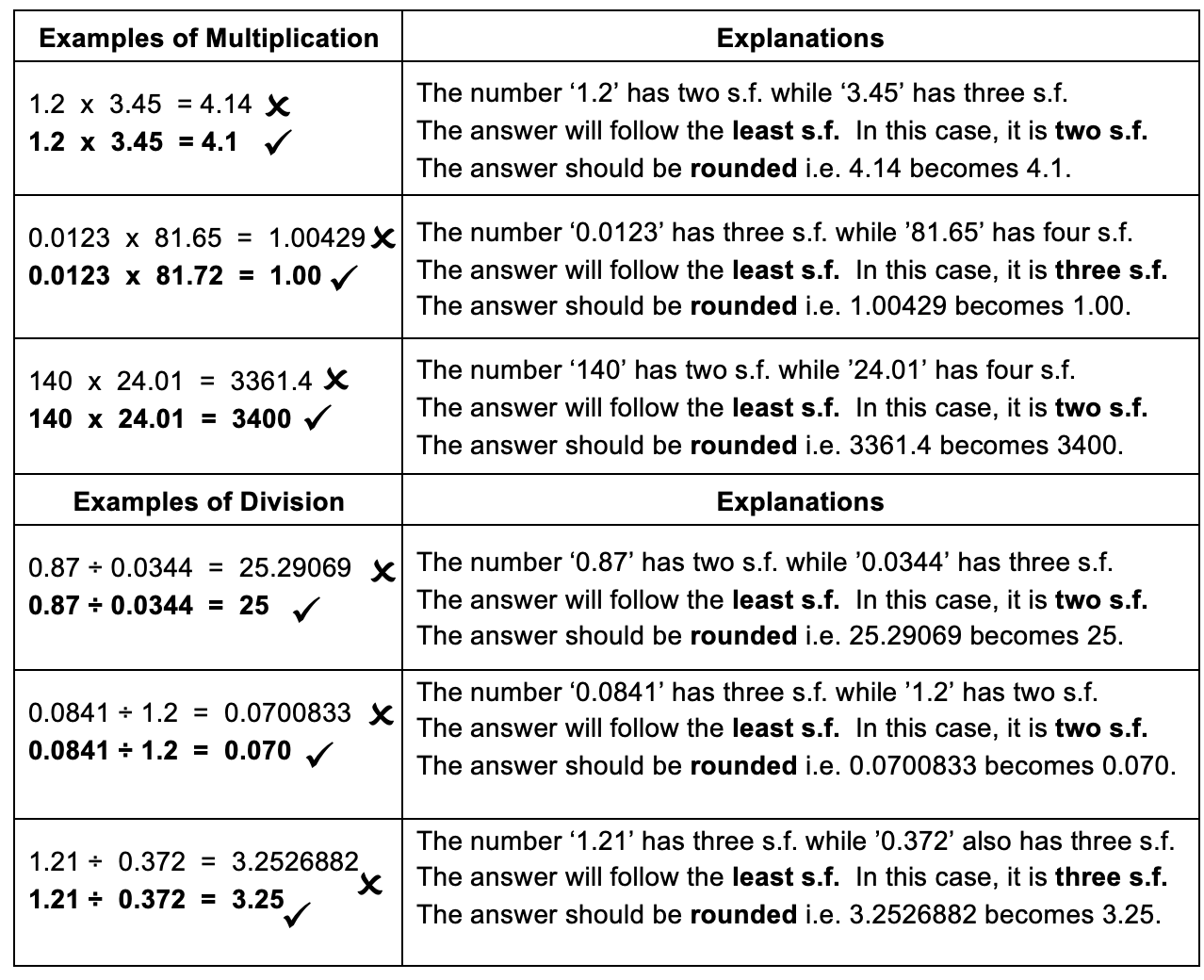
Note: We will never leave an answer as 1 s.f.; take 2 s.f. as the smallest.
3 For other Mathematical Functions:
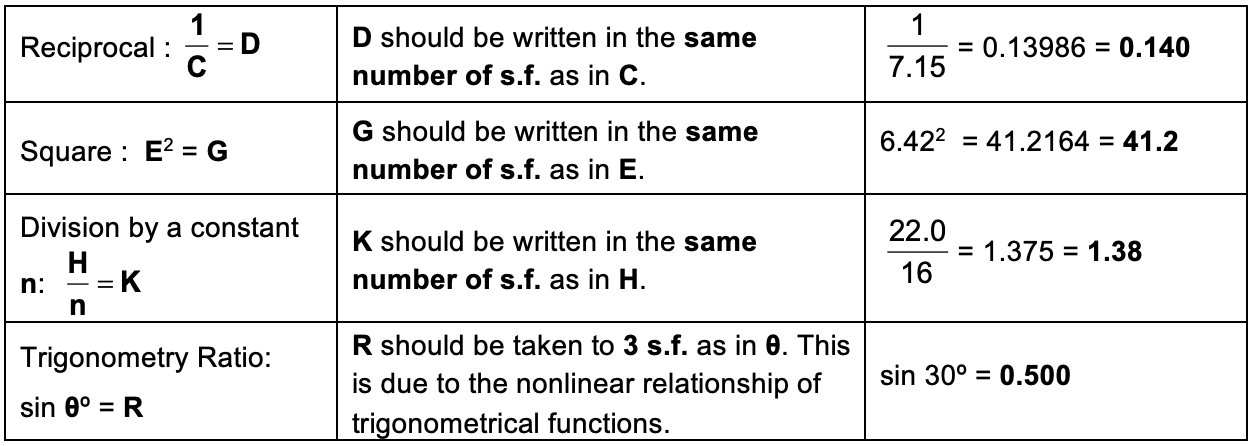
Ignore the significant figures of any provided values including constants e.g. 10 ms-2. The calculated value should be to the number of significant figures of the raw data measured.
1 Addition and Subtraction
For Addition and Subtraction of Raw Data the calculated answer will always follow the raw data with the least number of decimal places (d.p.).
2 Multiplication and Division
For Multiplication and Division of Raw Data the calculated answer will always follow the raw data with the least number of significant figures (s.f.).
3 Constants
These are not used in determining the number of significant figures in the processed data values. (eg acceleration of free-fall given as 10 ms-2 or calculating a pendulum period from 20 oscillations (T=20.45 s /20) would not limit the processed data to 2 significant figures.)
4 Other Mathematical Functions
In general the calculated value should be to the same number of significant figures as the given raw data.
Trigonometric functions (sin, cos, etc.) are non-linear and so we will simply take the values to 3 significant figures when calculating these.
| Basics |