Accuracy: correctness. A measurement is accurate if it is close to the true value. Since the true value of a quantity can never be exactly known, an accepted value is commonly used as the test of accuracy.
| Example: difference between precision and accuracy |
|---|
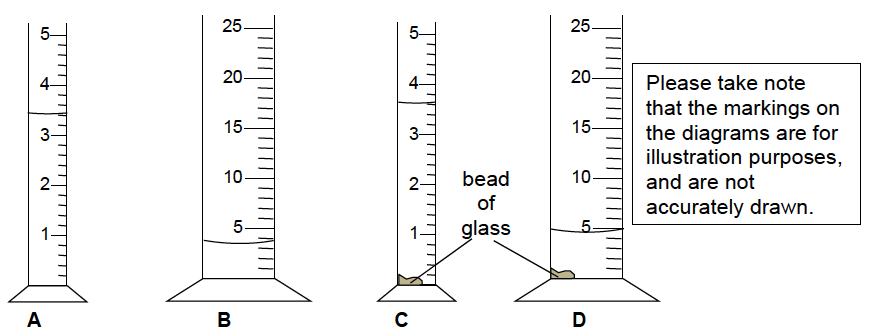
| Four graduated cylinders are used to measure the volume of a known quantity of water.
Due to the manufacturing flaw, both cylinders C and D have an extraneous bead of glass fused at their bottom. This results in their inaccuracy.
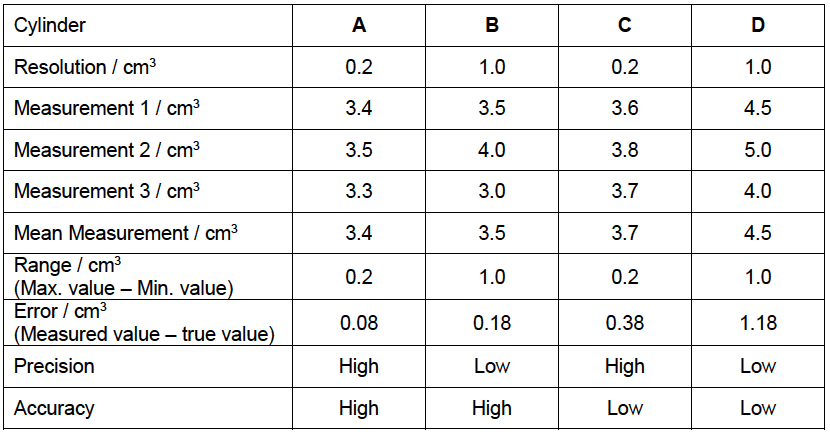
Each of the above cylinders has been filled with exactly 3.32 cm³ of water. The table below shows the data obtained by a student from the graduated cylinders:
(a) Which cylinder(s) are more precise? Cylinders A and C can be read to 0.1 cm³, but cylinders B and D can only be read up to 0.5 cm³. Hence, cylinders A and C are more precise. (b) Which cylinder(s) are more accurate? Cylinders A and B are the most accurate. The mean values are closest to the true value (3.32 cm³ of water). |
| Basics |