Measurement is the act or process of measuring. Even the best scientific measurements involve some experimental error.
An experimental error (or experimental uncertainty) is anything that causes a measurement to differ from the true value. The amount by which the measured value differs from the true value is also called the error.
An experimental error should not be confused with a mistake made by the experimenter. Experimental errors are to be found in all experiments and no result should be considered to be “perfect”.
Random and Systematic Errors (or Uncertainties)
In making measurements, there are two types of error (or uncertainty) that you have to be aware of:
Random Error
- A random error is one that occurs inconsistently each time a measurement is repeated. Such errors have an equal chance of being positive or negative. Random error can be caused by the inaccurate reading of the observer from a scale (e.g. human judgement error in determining the position on the scale) or due to the background disturbance (e.g. wind, background noise, vibration in the environment).
- Random errors cause poor precision and can be reduced by averaging the results of repeated measurements.
- Examples: reading a scale, timing oscillations, measuring out a volume of liquid.
Systematic Error
- A systematic error is one that occurs consistently each time the measurement is repeated. Such errors can be detected by comparing with a calibration standard. Systematic error can also associated with poor experimental technique.
- Systematic errors cause poor accuracy in measurement and can be adjusted applying a correction factor.
- Examples: reading a meter with a zero error, instrument with incorrectly calibrated scale, lag time of experimenter starting a stopwatch.
Precision & Random errors
- Precision indicates the size of random errors in a set of measurements or how close the readings are to the average
- If an experiment has small random errors, it is said to have high precision – the readings are close to the average value.
- The number of significant figures quoted for a measurement gives an indication of its precision. The greater number of s.f.s implies greater precision.
Accuracy & Systematic errors
- Accuracy indicates the size of systematic errors in a set of measurements or how close the readings are to the true
- If an experiment has small systematic errors, it is said to have high accuracy – the readings are close to the true value.
- No measurement can be made with absolute accuracy; all measurements have an uncertainty.
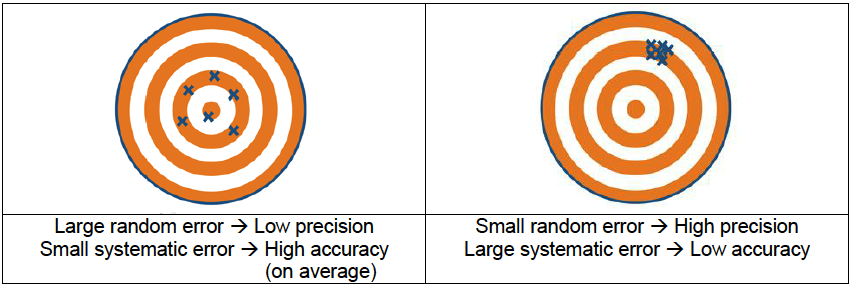
Identifying Experimental Errors
If you are asked to identify any errors, you are being asked for things that are beyond your control.
Examples
- Reaction time in starting/stopping the stopwatch
- Human judgement in determining the exact position for the sharpest focus of the image on the screen
- Human judgement in reading to the smallest division on the scale
Non-Examples
The following would NEVER be considered as errors (Mr Shone has seen all of these as answers!).
- I read the instrument wrongly
- I recorded the values wrongly
- Parallax error (correct reading would avoid this)
- The instrument was broken (you should have fixed/replaced it)
- There was zero error – you can check for (and correct for) this
- Human error