To record data correctly, one needs to understand the correct way of reading instruments, consider the uncertainty involved and record the data to reflect the uncertainty.
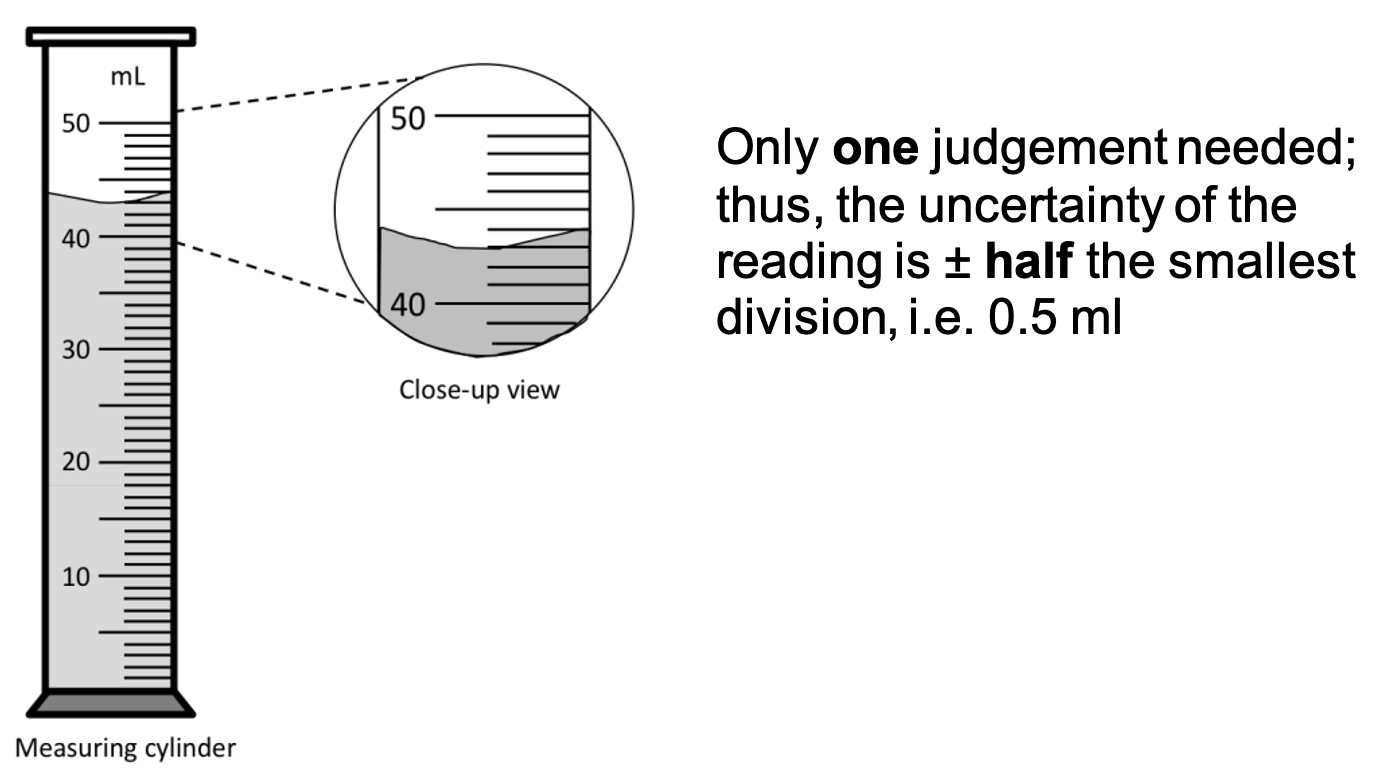
Values obtained using a single judgement is called a ‘reading’. For example, when determining the volume of liquid in a measuring cylinder, the student only needs to judge the value indicated by the position of the meniscus. Hence, the uncertainty of the reading is ± half of the smallest division of the scale. In this case, the volume should be recorded as 43.0 ml and not 43 ml.
Values obtained using the difference between the judgement of two values is called a ‘measurement’. For example, when determining the length of a crayon using a ruler, as shown below, one needs to align the crayon to the start of the ruler and also judge which part of the ruler the crayon ends.
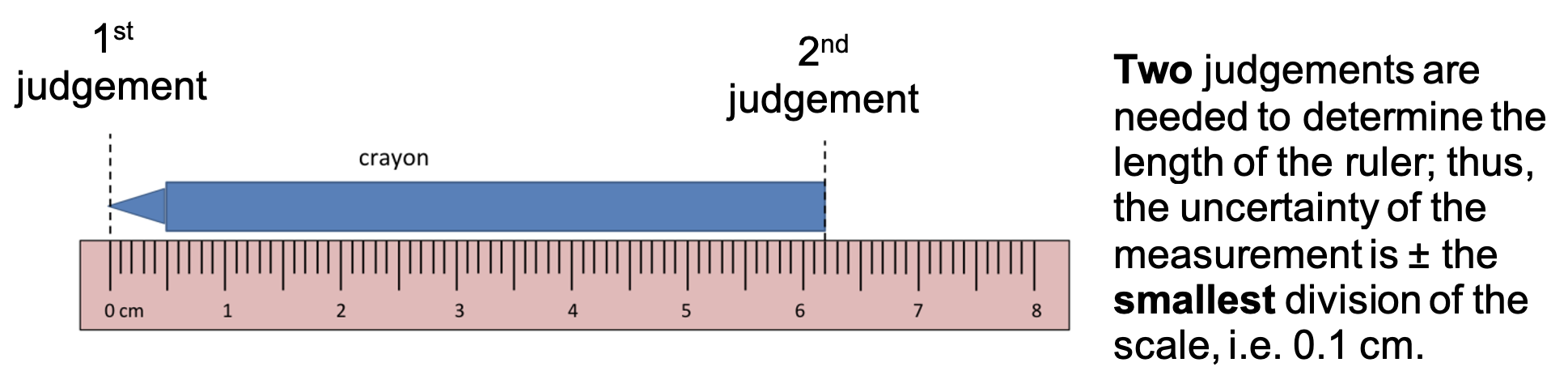
The length of the crayon should be recorded as 6.2 cm and not 6.20 cm.
Measurement is the act or process of measuring. Even the best scientific measurements involve some error. Awareness of the concepts of precision and accuracy is important.
Other Common Terms Used in Measurements
- Resolution: the smallest division of that can be read off the scale of an instrument. Typically, instruments can be read to half of the smallest division. An instrument with a better resolution can measure smaller intervals and is likely to give values that are closer together. Hence, an instrument with a better resolution is also a more precise instrument.
- Precision refers to the smallest measurement possible using an instrument. e.g. precision of a metre rule is 0.1 cm. An instrument with a better resolution can measure smaller intervals and is likely to give values that are closer together. Hence, an instrument with a better resolution is also a more precise instrument.
- Precision also refers to the reproducibility. A set of measurements is precise if they are close to other values obtained by repeating the measurement using the same procedure.
- Accuracy: correctness. A measurement is accurate if it is close to the true value. Since the true value of a quantity can never be exactly known, an accepted value is commonly used as the test of accuracy.
- Experimental Error: anything that causes a measurement to differ from the true value. The amount by which the measured value differs from the true value is also called the error.
| Examples |
|---|
|
| Basics |