Category Archives: sec-4-2026

Physics WA: Physics Performance Task: The “Physics Explained” Challenge

1. Task Overview

Total Marks: 30
Target Audience: Lower Secondary Students (Sec 1 & 2)
Group Size: 3 pax
Format: 90-second video

The Challenge
Your team must create an educational demonstration video to illustrate a Physics concept from a topic in the Sec 3 or Sec 4 syllabus. You must make the concept easy to understand, engaging,
and visually clear for a lower secondary student.

Submission Requirements

  • Each group must submit a 90 s video.
  • Originality: The video must be entirely your own work. Do not reuse videos from the internet or experiments already shown by your teacher in class.
  • Group introduction: At the start of the video, all members must appear on screen to introduce themselves.
  • Demonstration: You must use a real-life apparatus and setup.
    • Note: Animations/drawings are allowed for explanation only, not for the primary
      demonstration.
  • Captions: All speech must be captioned in the video.
  • Balanced participation: Every member must speak in the video, and speaking time should be roughly equal, no single member should dominate the presentation.
  • At the end of video, references and sources should be acknowledged.
  • Project brief to be submitted by the group leader by 9 Mar 2026 (Term 1 Week 10, Monday) for teachers’ approval.

401 Group / Topic Selection Form

409 Group / Topic Selection Form

  • The video should be submitted by the group leader via Google classroom to your Physics teacher by 13 April 2026 (Term 2 Week 4, Monday)

Links to be updated here nearer to submission due date

  • Peer assessment form must also be completed and submitted by each member by 13 April 2026. Link to the form will be provided by your subject teacher in due course.
    • Individual scores are subject to moderation based on peer assessment of contribution.


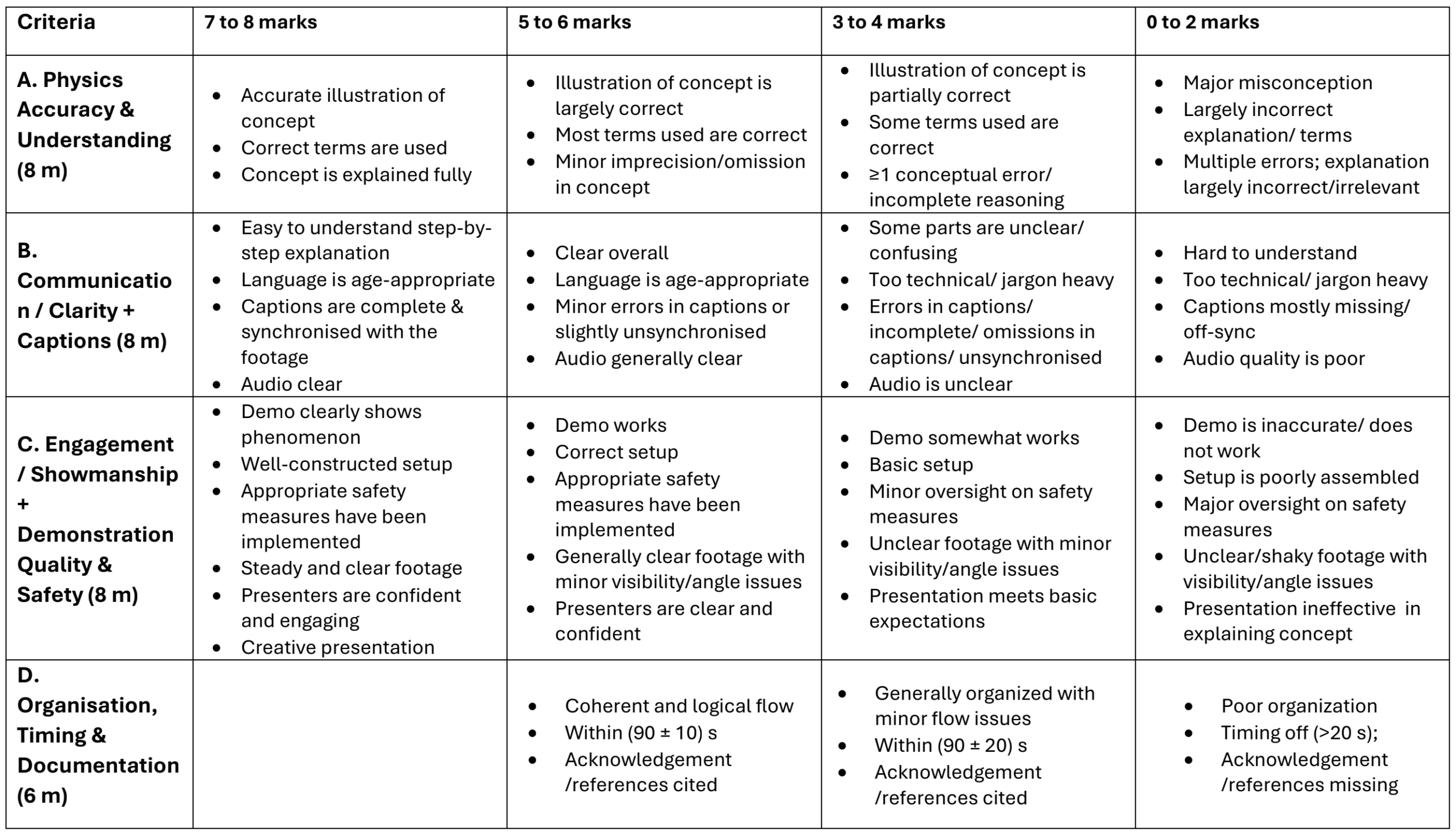
2. Assessment Rubrics (30 Marks)
 

3. Student FAQ

  • Can I use AI to help me?
    You may use AI to brainstorm ideas or simplify your script. However, the final script must be your own work, and you cannot use AI-generated voiceovers.
  • Do we all need to be on camera?
    Only for the introduction at the start. After that, you may choose who demonstrates and who narrates.
  • Can I use a drawing for the experiment?
    No. The demonstration must be a real, physical setup. You can use drawings only to help explain the “non-visible” physics concepts (like force arrows or light rays).
  • What is the time limit?
    90 seconds. You have a 10 second buffer. Going significantly over or under will result in mark deductions.
  • Can we borrow equipment from the lab?
    No. Please source for your own equipment.


4. Checklist

  • All members introduced themselves on camera at the start.
  • The video is approximately 90 seconds long.
  • Every word spoken has a clear caption on screen.
  • The physics phenomenon is demonstrated with real objects.
  • The language is simple enough for a lower secondary student.
  • We have all submitted the peer review form.

PDF Version of this information

409 TASK: Electromagnetic Waves

In your assigned groups create a mini presentation on your assigned em wave to share during tomorrow’s lesson.

Group 1: Radio Waves & Microwaves

Group 2: Infrared (IR)

Group 3: Visible light

Group 4: Ultra-violet (UV)

Group 5: X-rays & Gamma Rays


Some questions to consider:

  1. How are the waves made/ created? (in nature and man-made)
  2. How are they detected?
  3. What are the typical wavelength and frequency of these waves.
  4. What are some typical uses /applications of these waves?
  5. Are there any dangers from exposure to these waves? How can risk be reduced?

Each group should create a presentation to share during tomorrow’s lesson:

    • Use diagrams/ photos/ images

    • Include real-life examples

    • Explain dangers clearly

    • Keep slides clear (not too wordy)

    • Speak clearly for 2–3 minutes


Application for DSO National Laboratories Research@YDSP Projects

Dear Sec 4 students

If you are a Singaporean and interested in undertaking a research project related to defence science, you are invited to apply for a research opportunity at DSO National Laboratories.

Research@YDSP (DSO) projects are nine-month project attachments which offer hands-on opportunities to work on defence-related projects, under the mentorship of top defence engineers, software developers, cybersecurity experts and research scientists from DSO.

The project details are listed in the microsite and as summarised below. The prerequisites for the projects are stated in the individual posting.

Project Title Project Details
Improving LIDAR using Quantum Illumination Link
Length-Preserving Encryption and its Applications to Full-Disk Encryption Link
Modernized Analysis of Attacks Against Triple-Encryption Link
Naval Platform Protection with the NEAT Algorithm Link
Passive Magnetic Measurements, Signal Processing And Motion Compensation Link
Wideband Monopole Antenna and Methods to Enhance its Performance Link

Read the following carefully:

  1. Applications must be Singapore Citizens & Sec 4 students.
  2. All applicants are to directly apply for the project(s) that they are interested in via the posting(s) at the microsite.
  3. If you wish to form your own teams, you may include your team members’ names in the application form. However, each student should submit their individual application. They will be assessed individually.
  4. Each student can apply for no more than 2 projects.

You may visit this link to have a glimpse of what a day in the life of a DSO student researcher is like.

Deadline for application is 20 February 2026.

The Science Department would like to support you in your application by providing advice on your write-up before you submit. Please reply to me by 6 February 2026, Friday to indicate your interest to apply. I will then share with you a google doc link to draft your application.

Regards

Mr Shone

(***Copy of email sent out to all Sec 4 students on 18 January***)

Young Defence Scientists Programme (YDSP) World of Science (WOS) Modules

Dear Sec 4 students,

Our school is invited to nominate Singaporean students for the Young Defence Scientists Programme (YDSP) World of Science (WOS) modules.

WOS is a series of hands-on STEM-related enrichment modules that allow students to discover advanced topics in Physical Sciences to Information Technologies critical to Singapore’s defence. There are a total of 8 exciting WOS enrichment modules this year:

  • Remote Sensing Technologies
  • Robotics
  • Quantum Technologies
  • EM Waves Unleashed: Electromagnetics and the Science Behind Wireless Communications
  • Cryptography
  • Computer Security
  • Artificial Intelligence
  • Aerodynamics

To help you better understand the modules, please refer to the microsite for more details. You may also refer to the LinkedIn video link here for the key highlights of past runs of WOS.

A Certificate of Participation will be given to students who achieve 100% attendance for the modules. You may select up to three modules according to your preference. If selected, you will only attend ONE module. Successful allocation is subject to the enrolment demand of each module as well as the suitability of students based on the quiz attempted (for selected modules).

Kindly indicate your interest for nomination by completing this form no later than Tuesday, 3 February 2026. Please ensure that you select only modules you can commit to attending for their entire duration (check your parents do not intend to take you on holiday during the dates of the module). Note that once enrolled, withdrawals from modules will not be allowed. I encourage you to carefully consider your availability before submitting your interest.

Regards,

Mr Shone

(***Copy of email I sent out on 15 January***)

Welcome to Sec4 2026 Physics

Mr Shone uses this website as a central point for accessing course information, notes and links. Please make sure you bookmark the site.

Soft-copies of course materials can be found in the Google Classroom for the cohort. The Google Classroom is the same as the one used in 2025, thus you should be already enrolled.

Google Classroom: 5vir2hj