Category Archives: Sec 4 (2022)
Answer Schemes to Practicals
Sec 4 Practicals
PR1 Convex Lenses – Answer Scheme
PR2 Measuring Current & PD – Answer Scheme
PR3 Resistors In Parallel – Answer Scheme
PR4 Current In Filament Lamp – Answer Scheme
PR5 Resistance Wire –Answer Scheme
Sec 3 Practicals
PR 1 Measurement of Length – Answer Scheme
PR 2 Pendulum – Answer Scheme
PR 3 Rolling Marble – Answer Scheme
PR 4 Forces in Equilibrium – Answer Scheme
PR 5 Balances of Masses – Answer Scheme
PR 6 Centre of Gravity – Answer Scheme
PR 7 Reflection of Light – Answer Scheme
PR 8 Refraction of Light – Answer Scheme
SOLUTIONS TO PLANNING EXERCISE 4
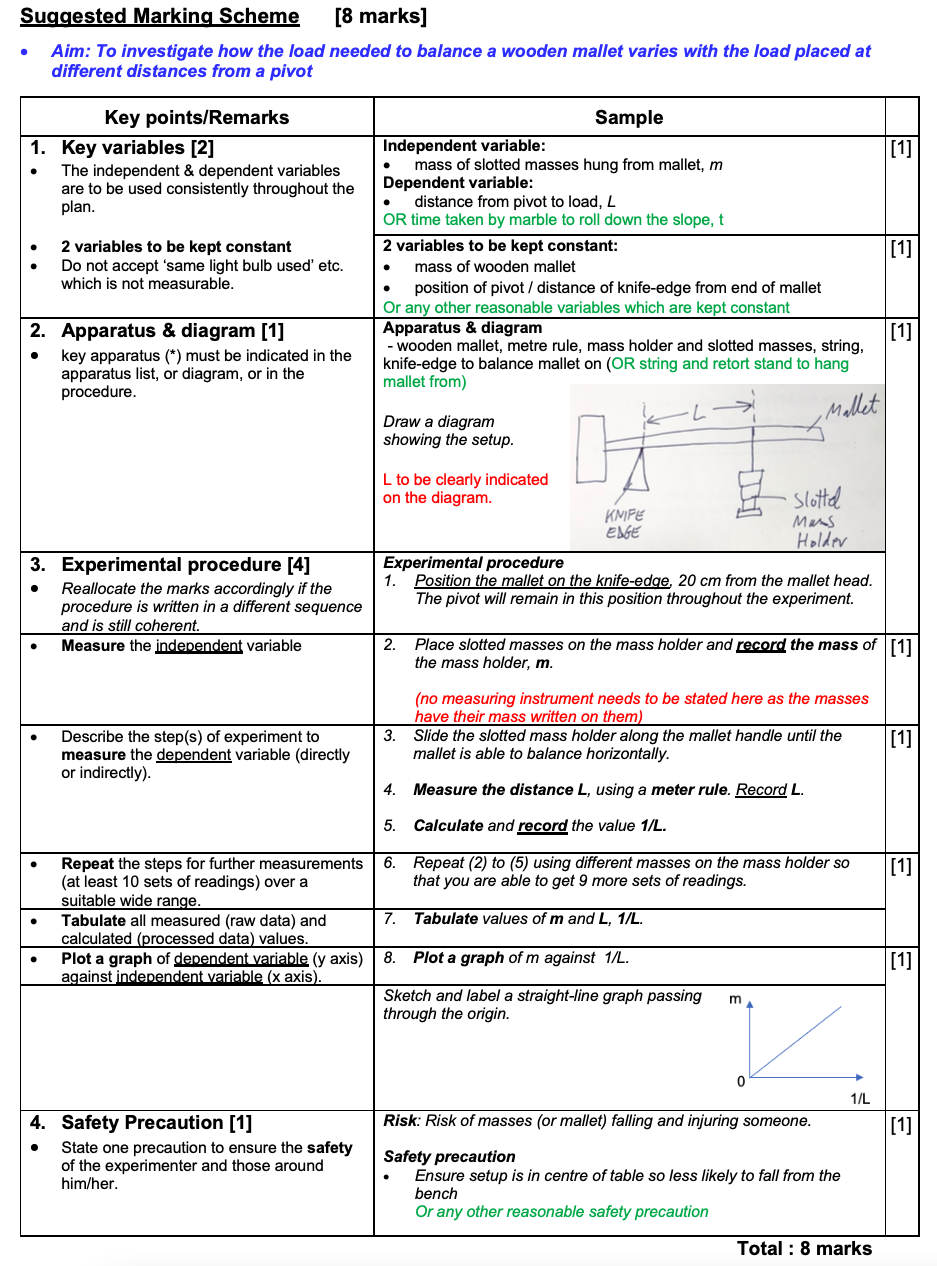
Sec 4 EOY Information
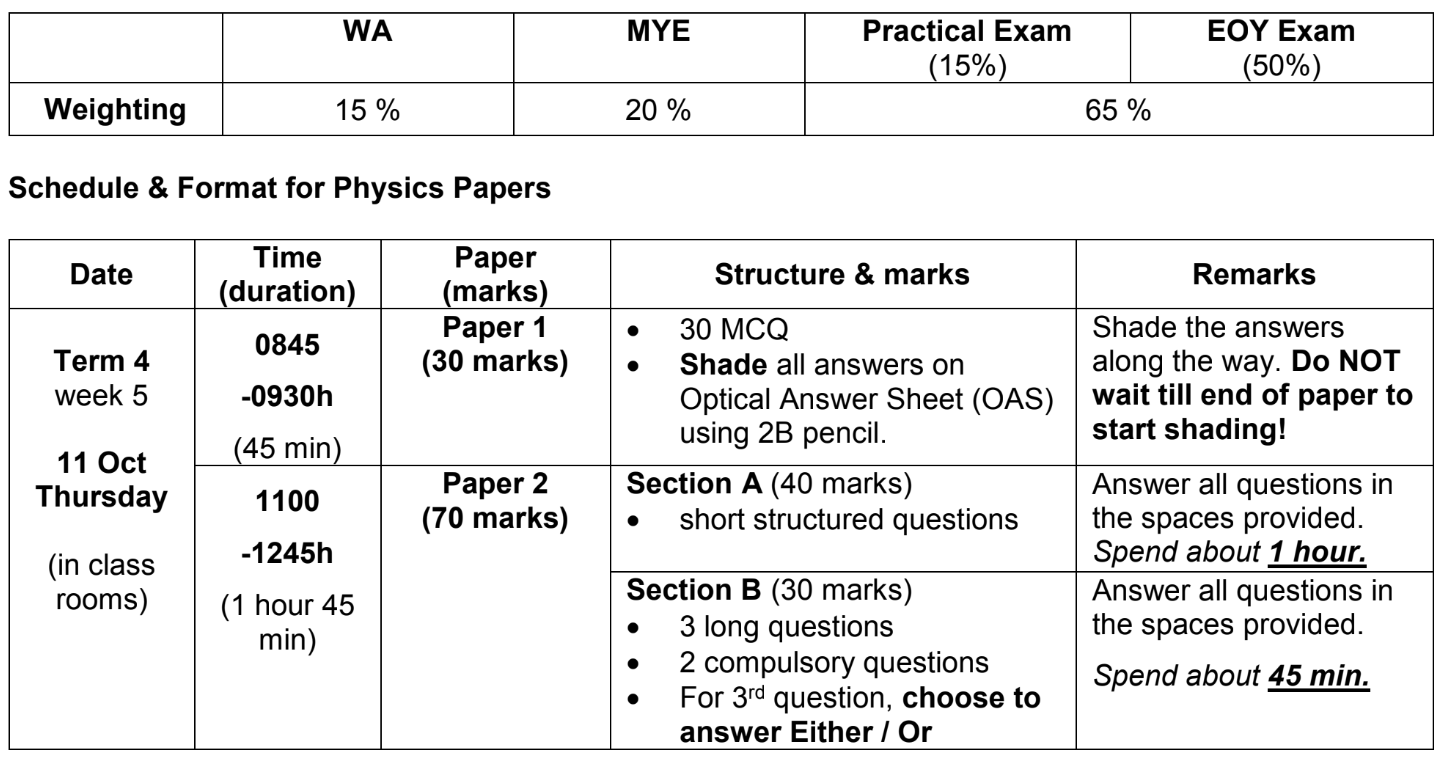
Sec 4 Practical Exam
Dear Sec 4s,
The Physics Practical paper will take place on Monday, Term 4 Week 1 (12 September 2022).
You will be informed of the allocated shifts and reporting times in due course.
The format of the paper is as follows:
- 1 long question (20 marks)
- 1 to 3 short questions (12 marks) and
- 1 planning question (8 marks)
Total of 40 marks for the paper.
The scope: All Sec 4 and Sec 3 topics
Please remember to bring along your own
- scientific calculator (with NYGH approved sticker)
- 30 cm ruler
- flexible curve rule
- mathematical set
Borrowing will not be allowed.
You should also have your student pass for the invigilator to verify your attendance.
The entire paper is 1 h 50 min and there is a changeover after 55 minutes. This means you will only have 55 minutes with each set of apparatus. You will not be allowed to revisit the apparatus.
All the best and jiayou!
Your Physics teachers
Practical Revison (with solutions)
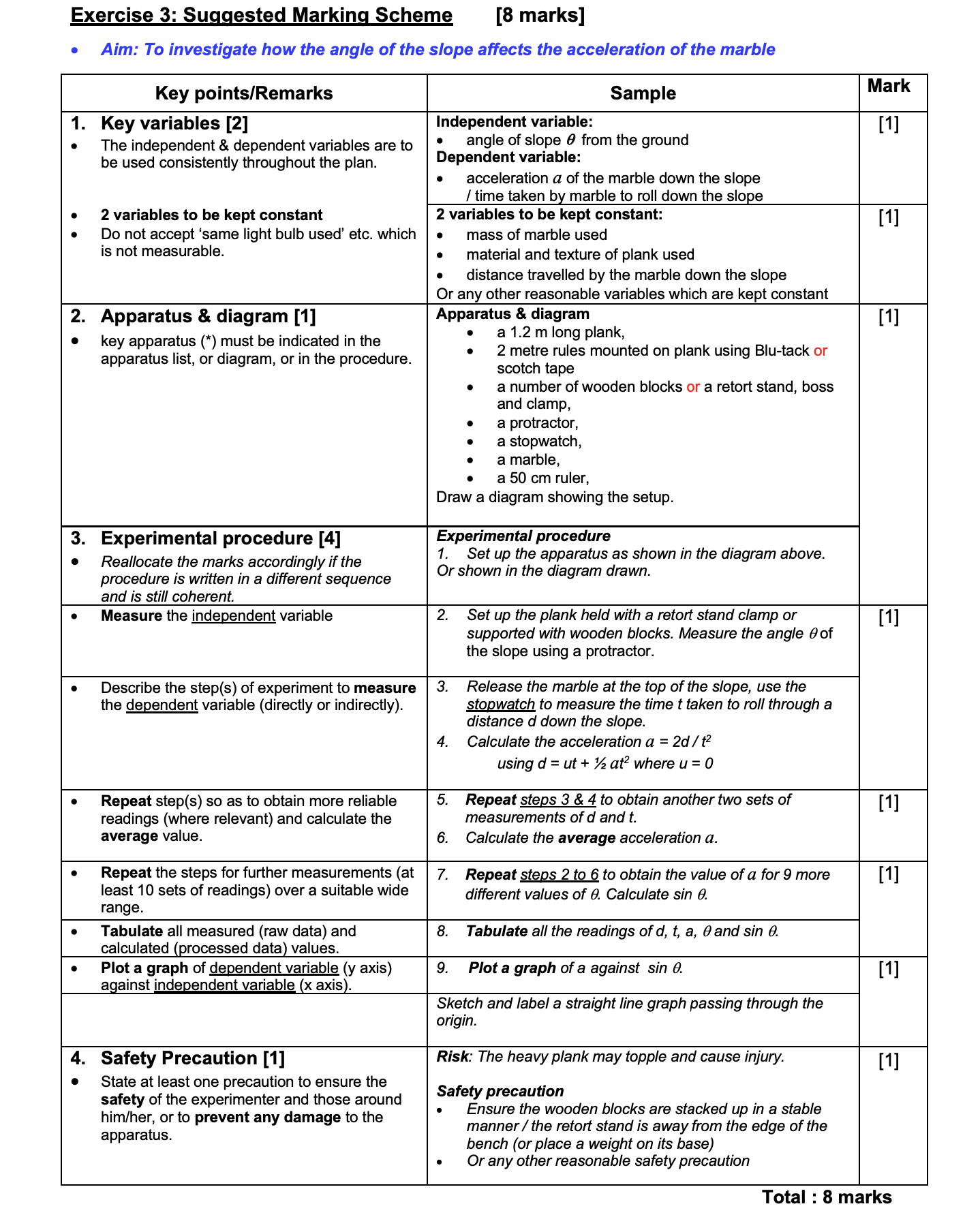
SOLUTIONS TO PLANNING EXERCISE 3
ANSWERS TO CHAPTER 20: THERMAL PHYSICS
Answers to Chapter 19: Electromagnetic Induction (EMI)
Answers to Chapter 18: Electromagnetism
Answers to Chapter 17: Magnetism
Answers to 2021 S4 Mid-Year Paper
Answers to 2019 S4 Mid-Year Paper
Ask A Physics Question
Worked Examples By Topic
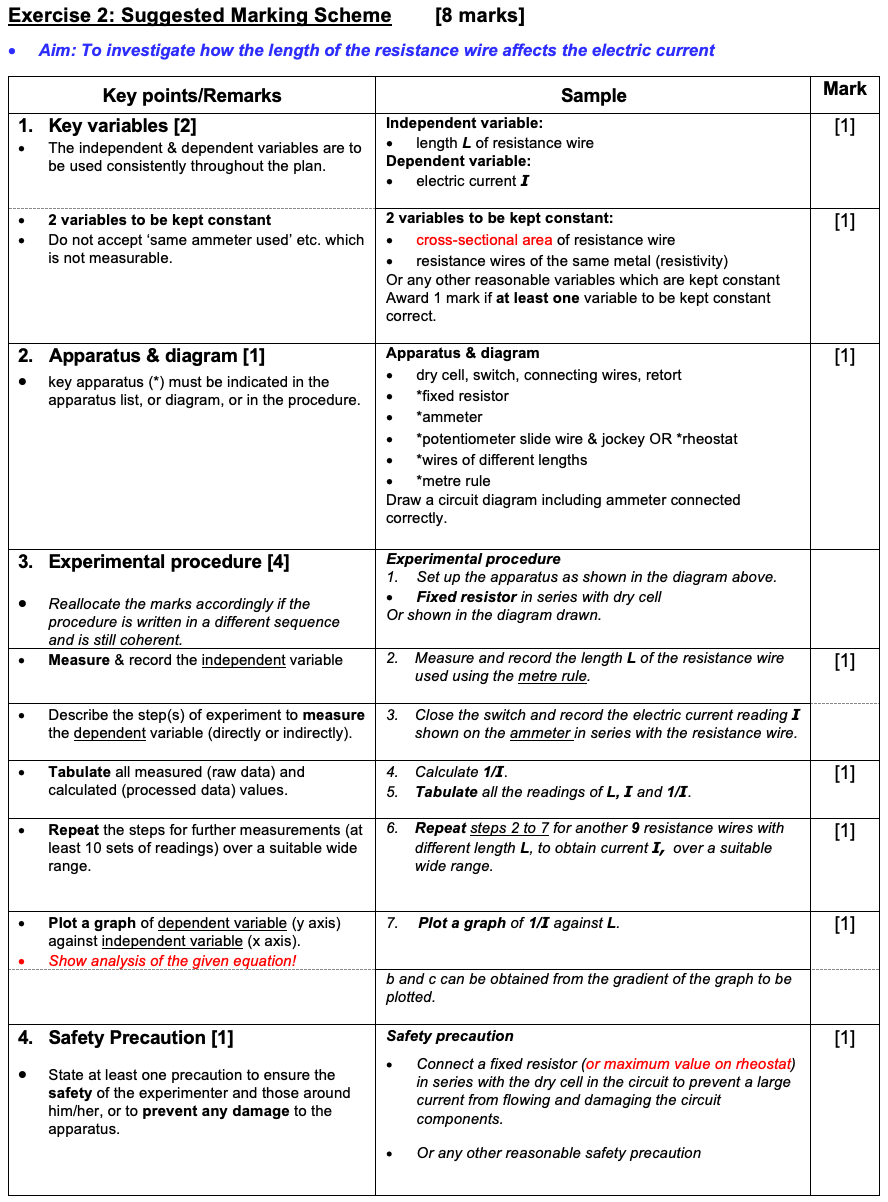
Solutions to Planning Exercise 2
Solutions to Planning Exercise 1A
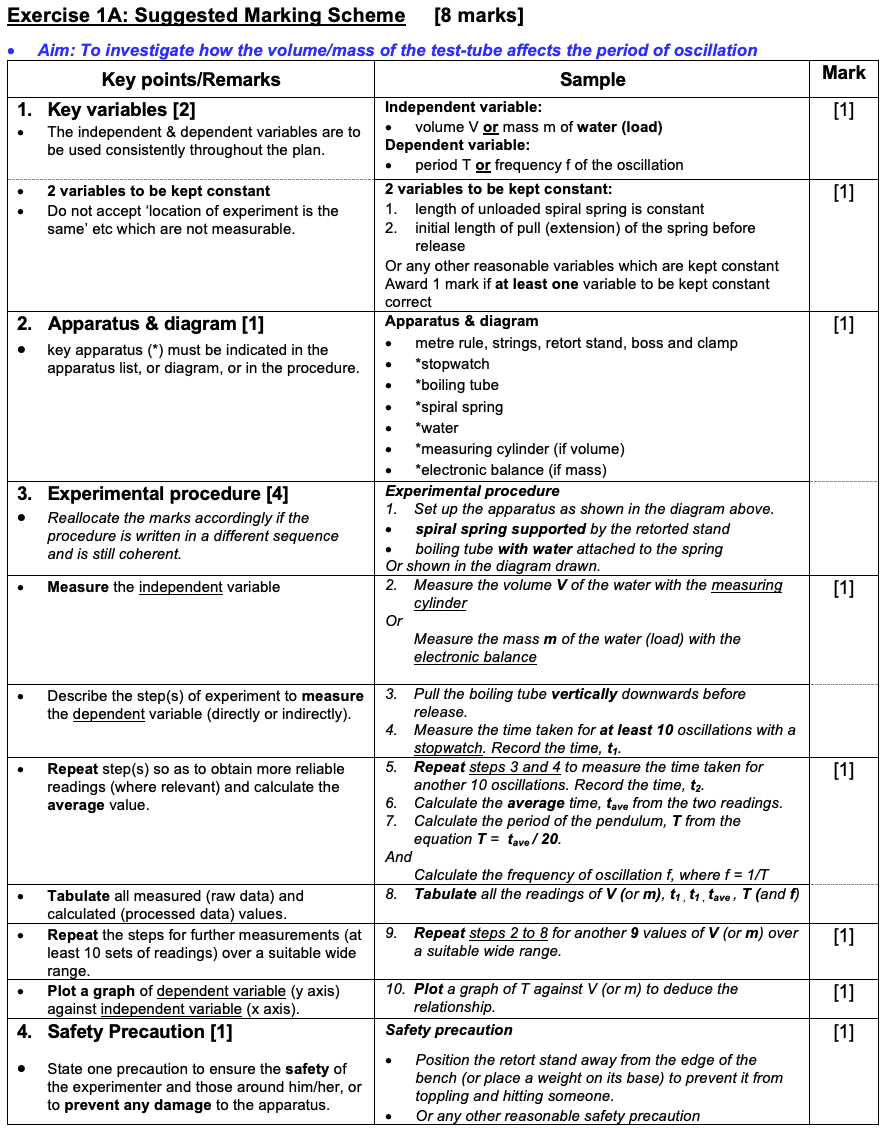
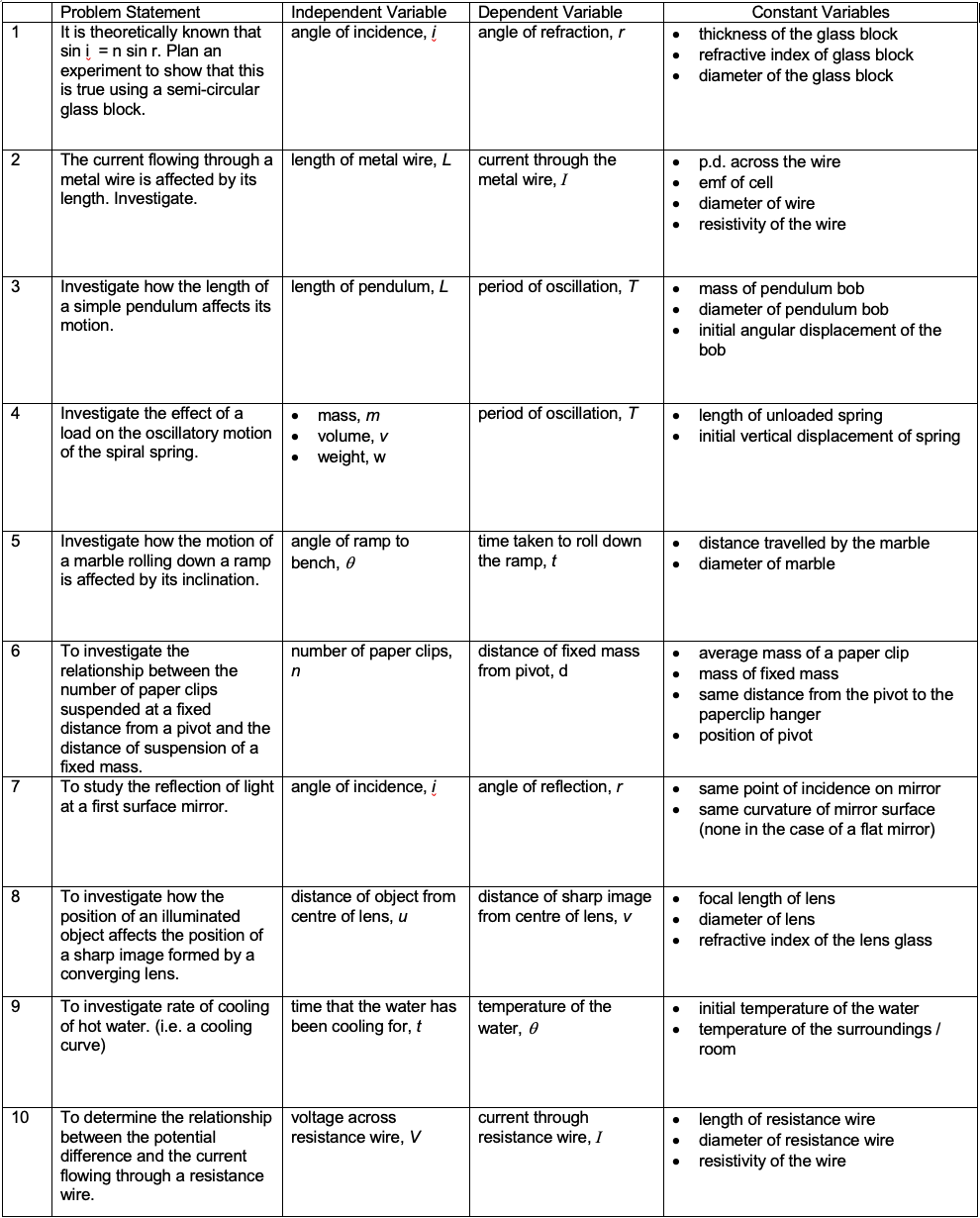
Suggested Solutions to Planning Variables Exercise
Extra Questions on Linearisation
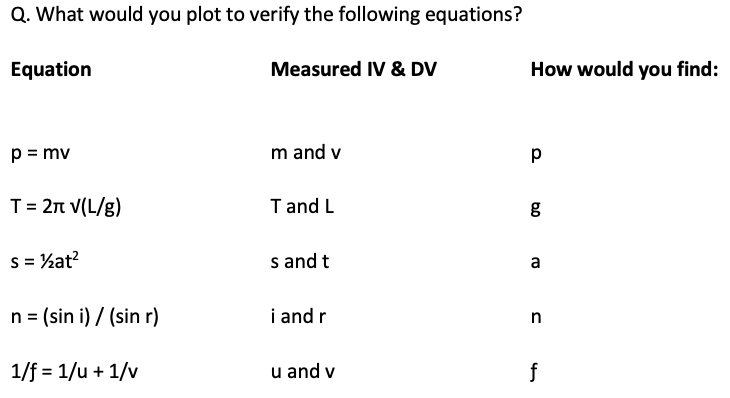
We are always trying to put the equation in to the form:
y = mx + c
a) p = mv
p/v = m
p(1/v) = m
m = p(1/v)
So to get a straight line graph we will plot m against 1/v
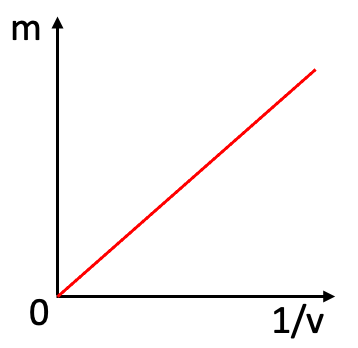
Gradient will be p.
c = 0
Therefore intercept will be (0,0)
b) T = 2π √(L/g)
T² = 4π² (L/g)
T² = (4π²/g)L
So to get a straight line graph we will plot T² against L
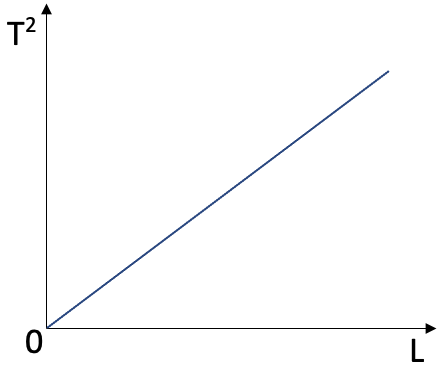
Gradient will be 4π²/g.
Thus g can be found from g = 4π²/(gradient)
c = 0
Therefore intercept will be (0,0)
c) s = ½at²
s = ½at²
So to get a straight line graph we will plot s against t²
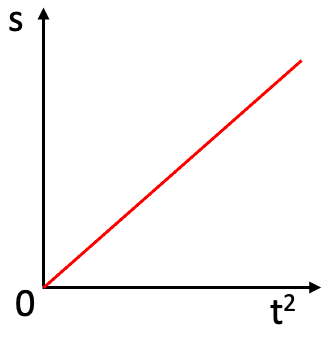
Gradient will be ½a
Thus a can be found from a = 2 × (gradient)
c = 0
d) n = (sin i) / (sin r)
(sin r)n = (sin i)
(sin i) = n(sin r)
So to get a straight line graph we will plot (sin i) against (sin r).
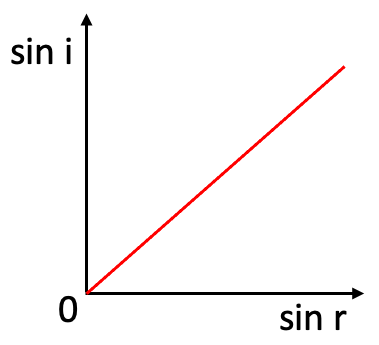
Gradient will be n.
c = 0
Therefore intercept will be (0,0).
e) 1/ƒ = 1/u + 1/v
(1/u) = (–1)(1/v) + (1/ƒ)
(1/u) = (–1)(1/v) + (1/ƒ)
So to get a straight line graph we will plot 1/u against 1/v
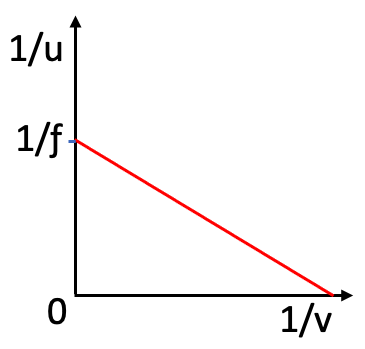
Gradient will be -1.
c = (1/ƒ)
Thus intercept will be (0,(1/ƒ))
ƒ can be found from ƒ = 1/(gradient)
Sec 4 Mid-Year Physics Exam
Dear students,
Please note that the Sec 4 Mid-Year Examination for Physics will take place on 1 July 2022, Friday.
The following topics will be tested:
1) Kinematics (Sec 3 topic)
2) Dynamics (Sec 3 topic)
3) Pressure
4) Electromagnetic Spectrum
5) General Wave Properties
6) Sound
7) Static Electricity
8) Current of Electricity
9) D.C Circuits
The format of the paper will be:
Paper 1 – Multiple Choice Questions
(45 minutes; 30 marks)
Paper 2 – Structured Questions
(1 hour 15 minutes; 50 marks)
· Section A (40 marks) – Short structured questions
· Section B (10 marks) – Long structured question
Total marks for Paper 1 and Paper 2 is 80 marks.
The use of calculator and mathematical set during the exam is allowed.
All the best for the MYE preparation.
Answers to Chapter 15: D.C. Circuits
Answers to Chapter 14: Current Electricity
Answers to Practical PR3
Common Mistakes made were:
- forgetting units in table headings
Graph
- not labelling axes correctly (with units)
- poor scales
- not differentiating the two types of points
- poor best fit curve
- working for gradient not shown on the graph (large triangle and coordinates of end-points stated)
Three common shapes of graph are:
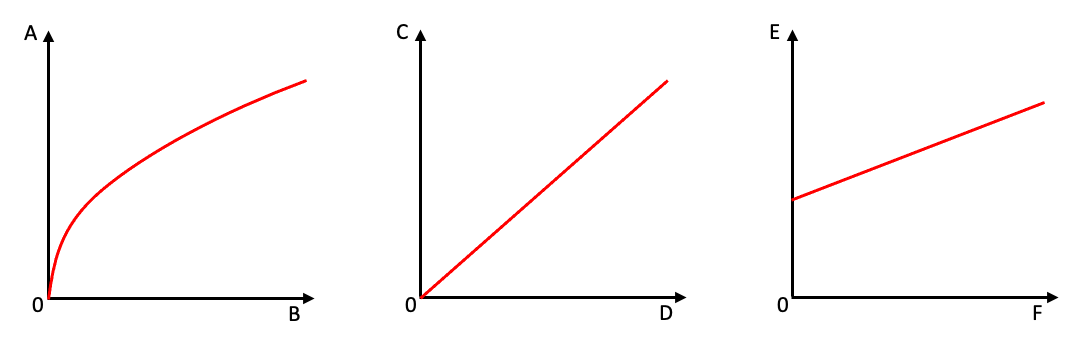
Your description of the graph m
ust allow the reader to differentiate which one you are referring to.
A increases as B increases.
C is directly proportional to D
E is linearly related to F.
Reminder:
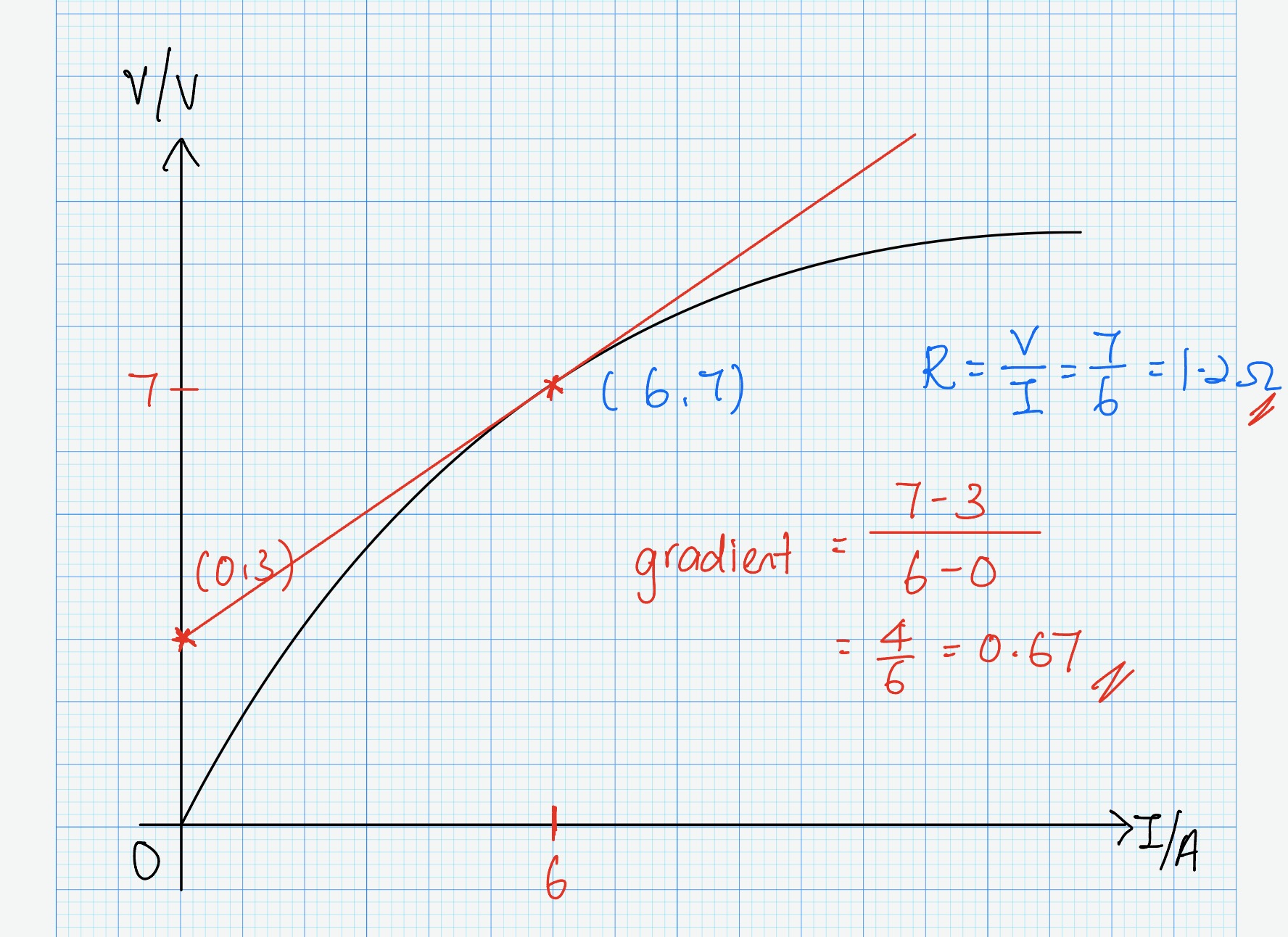 Gradient = Δy/Δx
Resistance = y/x i.e R=V/I
y/x ≠ Δy/Δx (except for a straight line passing through (0,0).)
Answers to “Further Questions on General Wave Properties and Sound”
ANSWERS TO CHAPTER 13: ELECTROSTATICS
Answers to Chapter 12: Sound
Answers to Chapter 11: General Wave Properties
Answers to Chapter 10: EM Spectrum
Ask a question…
Use the following link to ask any physics questions you may have:
https://docs.google.com/presentation/d/179SNzkp5kqUsVaiyyul4g4tudzpwd-Gc87EFcCy_cFU/edit?usp=sharing
PHYSICS WA1 – Tuesday, 15 February
Some details for your Physics WA 1:
Date: 15 Feb (Tuesday)
Format: Written Test (10 MCQ, 20 Mark Structured; Total = 30 marks)
Duration: 45 minutes
Topics:
- Dynamics
- Work, Energy and Power
- Pressure
Do note that you will be allowed to bring a calculator and a handwritten summary (optional).
Specifications for the summary:
- A4 size (only write on 1 side)
- Handwritten (not printed)
- Must be stapled to the test paper and submitted with the test
Revision questions for Work, Energy & Power and Pressure will be uploaded on Google Classroom for your practice, do keep a look out for them.
Answers to Additional Pressure Questions
Updated WA Schedule for 2022
The revised WA percentages (Physics & Advanced Physics) are as follows:
WA1 – 15%
WA2 – 20%
WA3 – 15% (Practical Exam)
EOY – 50%
Answers to Chapter 9: Pressure
YDSP 2022
Dear Sec 4 students,
Invitation to Participate in the Young Defence Scientists Programme (YDSP) World of Science (WOS) Modules 2022
The YDSP WOS 2022 is now open for student applications.
There are 7 exciting WOS enrichment modules this year! The modules are specially designed for IP4 to IP5/JC1 students. To help you and your students better understand the modules, please refer to the attached file ‘YDSP WOS 2022 Module Synopsis’ for more details.
In view of the current COVID-19 situation and the safe management measures in place, the modules will be conducted via physical and/or virtual sessions. DSTA will continue to monitor the COVID-19 situation. If necessary, all modules will be conducted via virtual platforms. The final arrangement will be confirmed with the shortlisted students nearer the date.
A Certificate of Participation will be given to students who achieve 100% attendance for the modules. Please note that students may select up to three modules according to their preference. If selected, they will only attend ONE module.
Please take note of the dates of each module and ONLY apply if you are able to fully commit to the stated dates. In the event that you are selected for the module but decide to withdraw from the module due to any reason or fail to attend all the sessions, it may adversely affect future scholarship or programme application with DSTA.
Please also note that WOS 2022 is only open to Singaporeans.
Please click on this link to submit your application by 21 Jan 2022.
(Original post is from ang_wee_ling@nygh.edu.sg 13:22 on 10 January)
More info can be found here: YDSP WOS 2022 Module Synopsis
Welcome to Sec 4!
A few reminders:
Google Classroom is the same as that used last year (code:ggzzicg). It will have updated soft-copy notes, level-wide announcements, etc.
My website is at physics.shone.sg (bookmark it!)