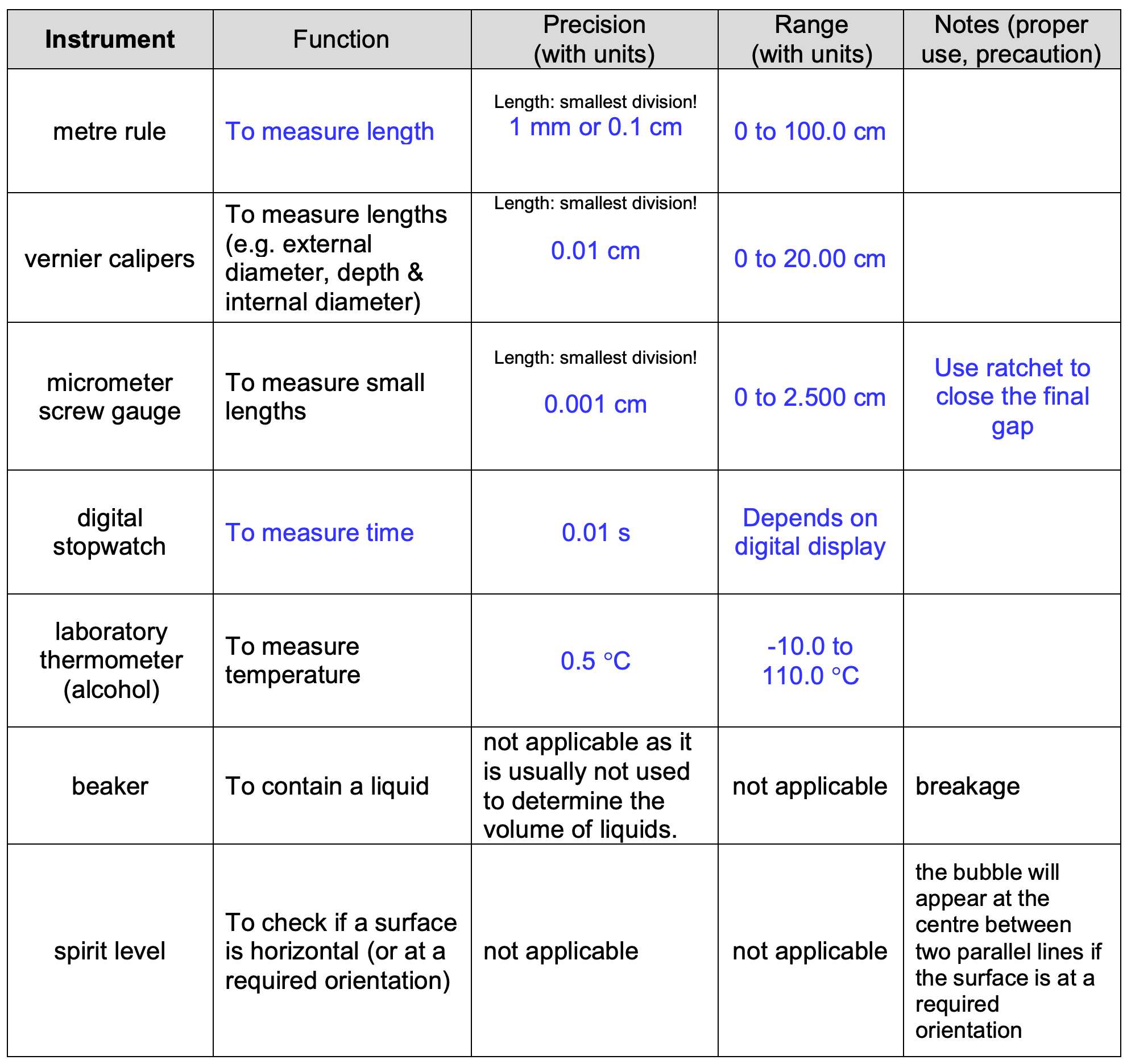
For a more complete list see:
physics.shone.sg/notes/basics/reading-raw-data/
Activity 1: Setting up the retort stand and simple pendulum
1.
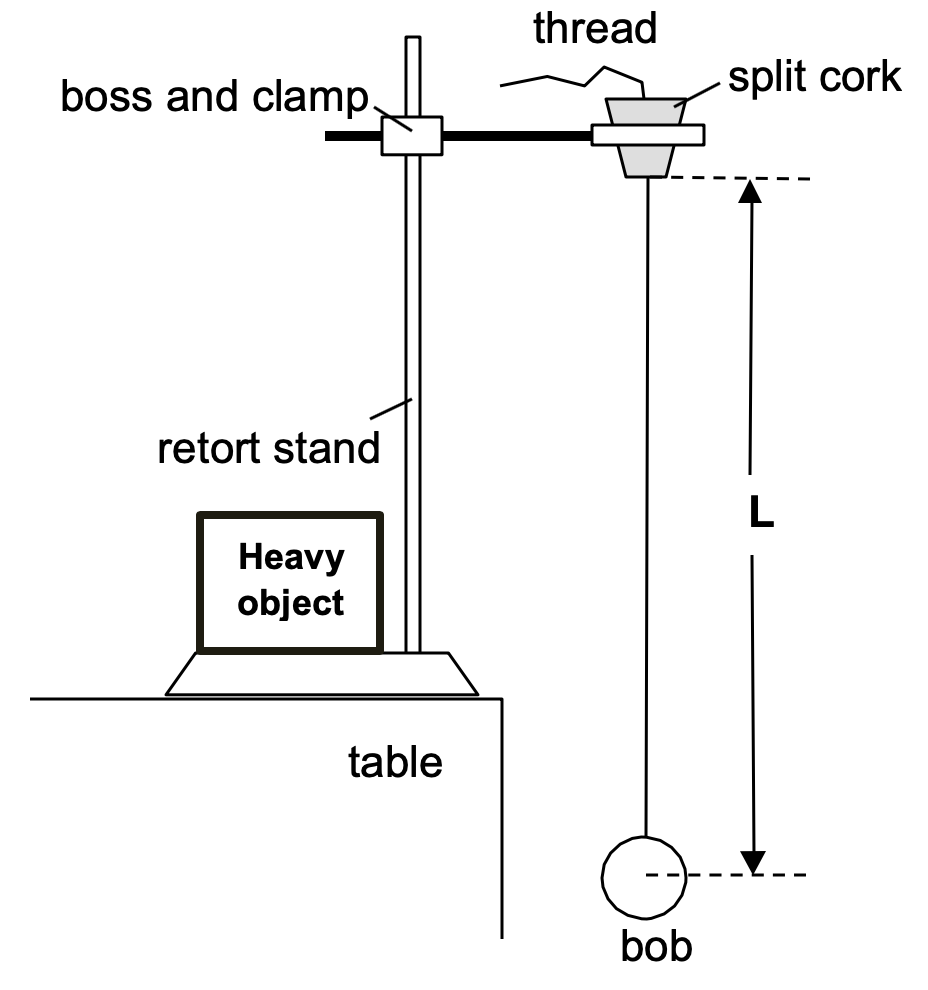 The length of a pendulum is to the centre of the bob – the CoG of the bob.
3. Place a heavy object at the base of the retort stand to ensure it will not topple. (see diagram above)
4. Any complete cycle: eg A→B→C→B→A
or
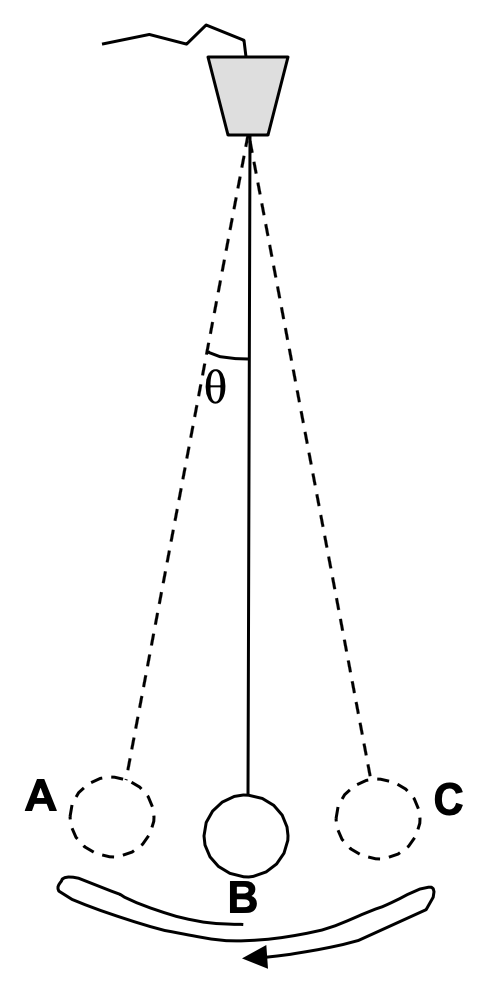
Reminder θ should be very small. Pull the bob just a few centimetres. Smaller angles actually give (slightly) better results. Max angle should be 10°. (Aim for 5° – estimate don’t need to use a protractor).
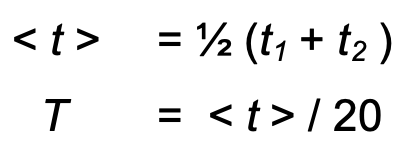
5. n =20
6. Use a reference vertical line (e.g. retort stand) at the centre of the oscillation when counting the oscillations.
7. Honestly in this experiment a single reading will suffice!
Reason: We are averaging any human reaction time over 20 oscillations. This already will likely give only a tiny error in an individual period.
8.

9. Ensure that the angular displacement θ (shown in Fig. 1.2) is smaller than 5° to reduce the effects of air resistanceon the oscillation.
- Temperature of the water = (record to 0.5 °C)
- Use a retort stand, boss-head and clamp to hold the thermometer in a fixed vertical position. The bulb of the thermometer should be fully submerged in water and not in contact with the wall or the bottom of the beaker. Also ensure that the scale of the thermometer is not blocked from your view.
Activity 2: Measuring lengths

2.

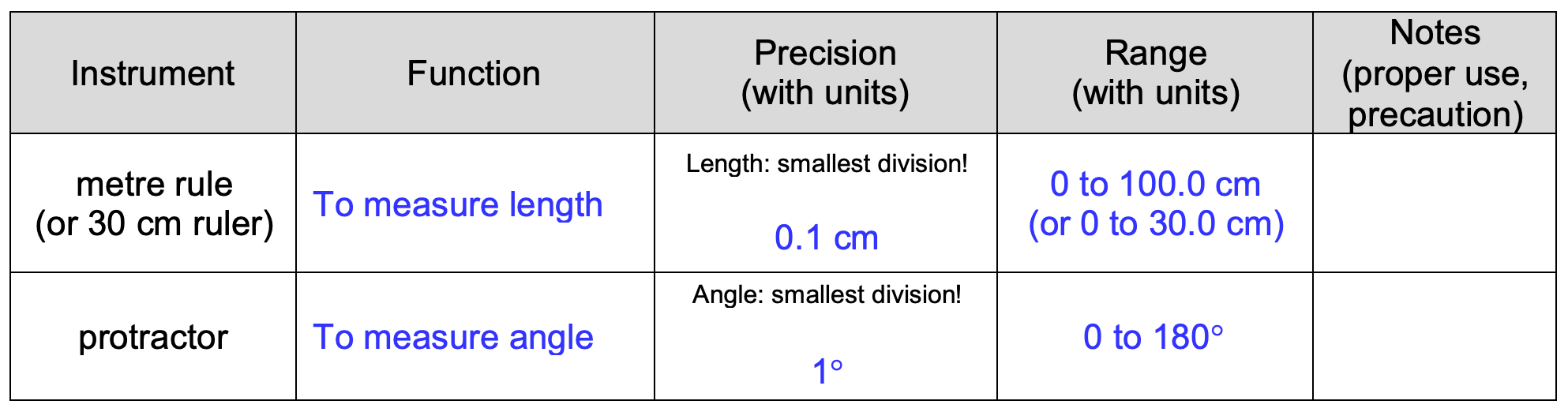
3. To account for non-uniformity in the lengths due to imprecise manufacturing.
Activity 3: Measurements with mass, weight & volume
1.
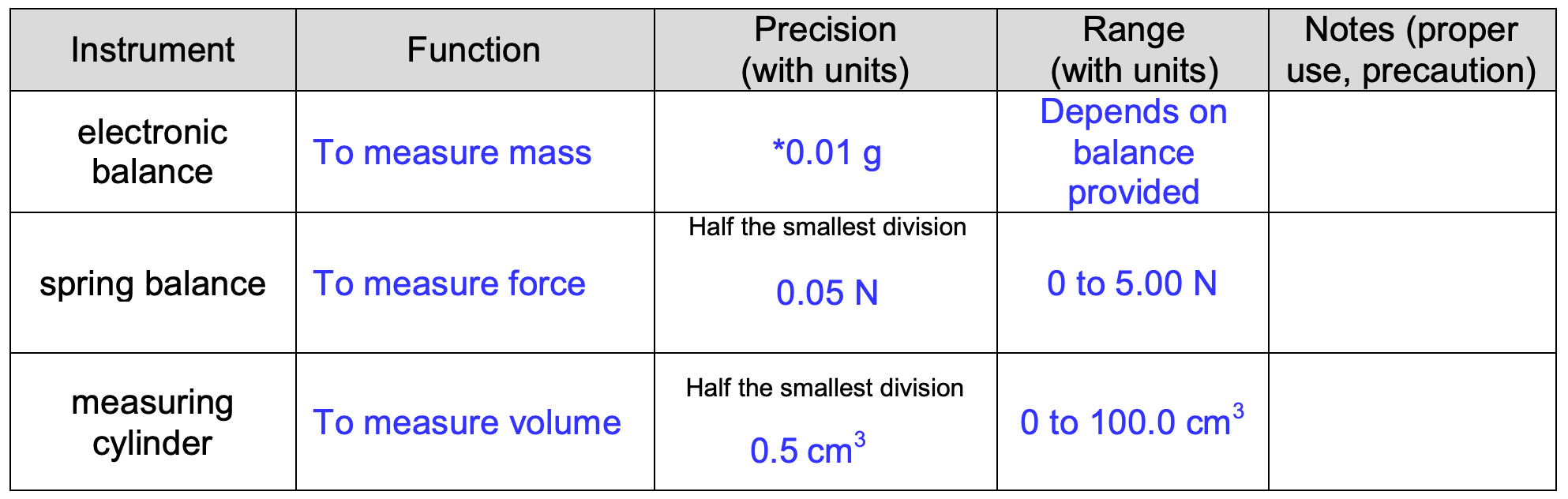
Ensure there is no zero error in the electronic balance before any measurement (press “tare”).
Ensure there is no zero error in the spring balance before any measurement. Ensure that the measuring cylinder is completely dry before any measurement.
Ensure that the 20 g mass is placed gently into the measuring cylinder with water without splashing.
2. Measure the total volume of all the 20 g mass available before taking the average.
Activity 4.1: Use of lens system
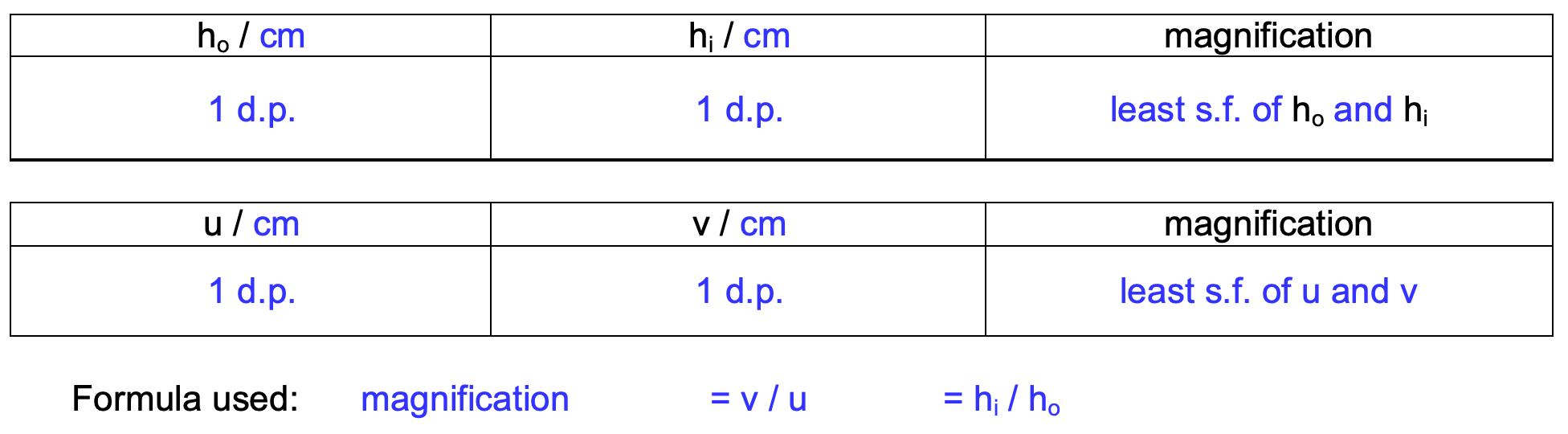
- The method using u and v should be used. The lengths u and v are much larger (than ho and hi) so their measurements would have smaller percentage errors, and the magnification calculated would have higherprecision.
- The set square was used to accurately align the position of the illuminated object with the metre rule.
- There was human judgement error in determining the position of the sharpest image of the object observed when measuring the image distance.
Activity 4.2: Use of glass block and optical pins

1.
The optical pins were ensured to be vertical during the measurements.
Each pair of optical pins on each side of the glass block were ensured to be at least 5.0 cm apart.
- There may be human judgement error in determining the alignment of the optical pins and their imagesthrough the glass block.
The size of the holes made by the optical pins may be large and affect the accuracy of the lines drawn torepresent the refracted rays.